Job 14
Bible in Basic English · Toca un versículo para ver sus referencias cruzadas.
Job Laments the Finality of Death
1As for man, the son of woman, his days are short and full of trouble. 2He comes out like a flower, and is cut down: he goes in flight like a shade, and is never seen again. 3Is it on such a one as this that your eyes are fixed, with the purpose of judging him? 4If only a clean thing might come out of an unclean! But it is not possible. 5If his days are ordered, and you have knowledge of the number of his months, having given him a fixed limit past which he may not go; 6Let your eyes be turned away from him, and take your hand from him, so that he may have pleasure at the end of his day, like a servant working for payment. 7For there is hope of a tree; if it is cut down, it will come to life again, and its branches will not come to an end. 8Though its root may be old in the earth, and its cut-off end may be dead in the dust; 9Still, at the smell of water, it will make buds, and put out branches like a young plant. 10But man comes to his death and is gone: he gives up his spirit, and where is he? 11The waters go from a pool, and a river becomes waste and dry; 12So man goes down to his last resting-place and comes not again: till the heavens come to an end, they will not be awake or come out of their sleep. 13If only you would keep me safe in the underworld, putting me in a secret place till your wrath is past, giving me a fixed time when I might come to your memory again! 14If death takes a man, will he come to life again? All the days of my trouble I would be waiting, till the time came for me to be free. 15At the sound of your voice I would give an answer, and you would have a desire for the work of your hands. 16For now my steps are numbered by you, and my sin is not overlooked. 17My wrongdoing is corded up in a bag, and my sin is shut up safe. 18But truly a mountain falling comes to dust, and a rock is moved from its place; 19The stones are crushed small by the force of the waters; the dust of the earth is washed away by their overflowing: and so you put an end to the hope of man. 20You overcome him for ever, and he is gone; his face is changed in death, and you send him away. 21His sons come to honour, and he has no knowledge of it; they are made low, but he is not conscious of it. 22Only his flesh still has pain, and his soul is sad.
¿Sabías que…?
La Fragilidad de la Vida y la Esperanza de Renovación
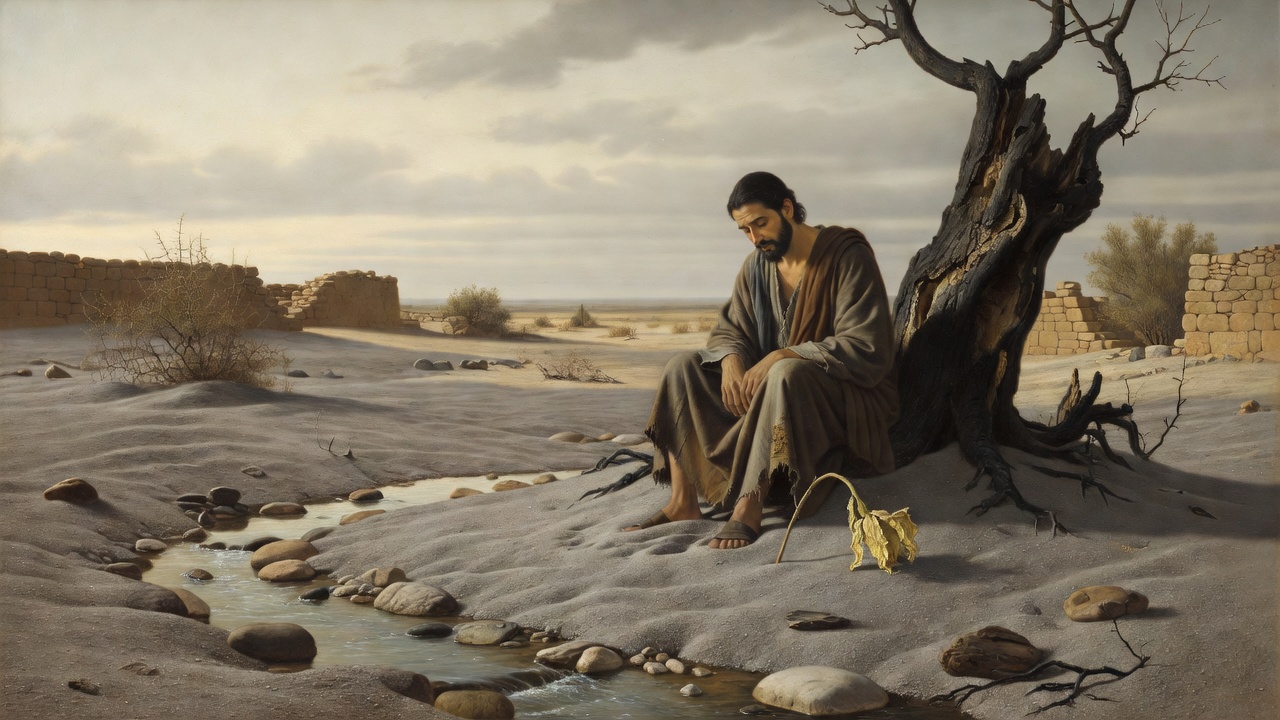
- En este discurso, Job contrasta el destino de los mortales con el de un árbol. Mientras que un árbol cortado puede volver a brotar ante el olor del agua aun cuando su tronco parezca muerto, el ser humano muere, yace y no vuelve a levantarse en esta tierra.Fuentes: el propio texto bíblico
- Job contempla el Seol como un posible refugio donde podría esconderse hasta que pase la ira divina, imaginando un anhelo en el que Dios sellaría sus transgresiones en una bolsa y llamaría a la obra de Sus manos.Fuentes: el propio texto bíblico
- Para ilustrar la brevedad y el desgaste de la existencia humana, el capítulo recurre a metáforas naturales de erosión y fugacidad, comparando la vida con una sombra pasajera, una flor marchita y rocas desgastadas por el agua.Fuentes: el propio texto bíblico
Notas escritas con ayuda de IA a partir de fuentes abiertas (Theographic Bible Metadata, CC BY-SA 4.0; Easton’s Bible Dictionary, dominio público) y revisadas antes de publicarse.
Créditos y licencia de esta traducción
Bible in Basic English
The Bible in Basic English
Public Domain
Language: English
Dialect: simple British
Translation by: Samuel Henry Hooke
The Bible In Basic English was printed in 1965 by Cambridge Press in England. Published without any copyright notice and distributed in America, this work fell immediately and irretrievably into the Public Domain in the United States according to the UCC convention of that time. A call to Cambridge prior to placing this work in etext resulted in an admission of this fact.
2020-04-17
Títulos de sección adaptados de la Berean Standard Bible (dominio público); no forman parte del texto bíblico de esta traducción.
Fuente: http://ebible.org/engBBE/ · eBible.org