Isaías 11
Bible in Basic English · Toca un versículo para ver sus referencias cruzadas.
The Root of Jesse
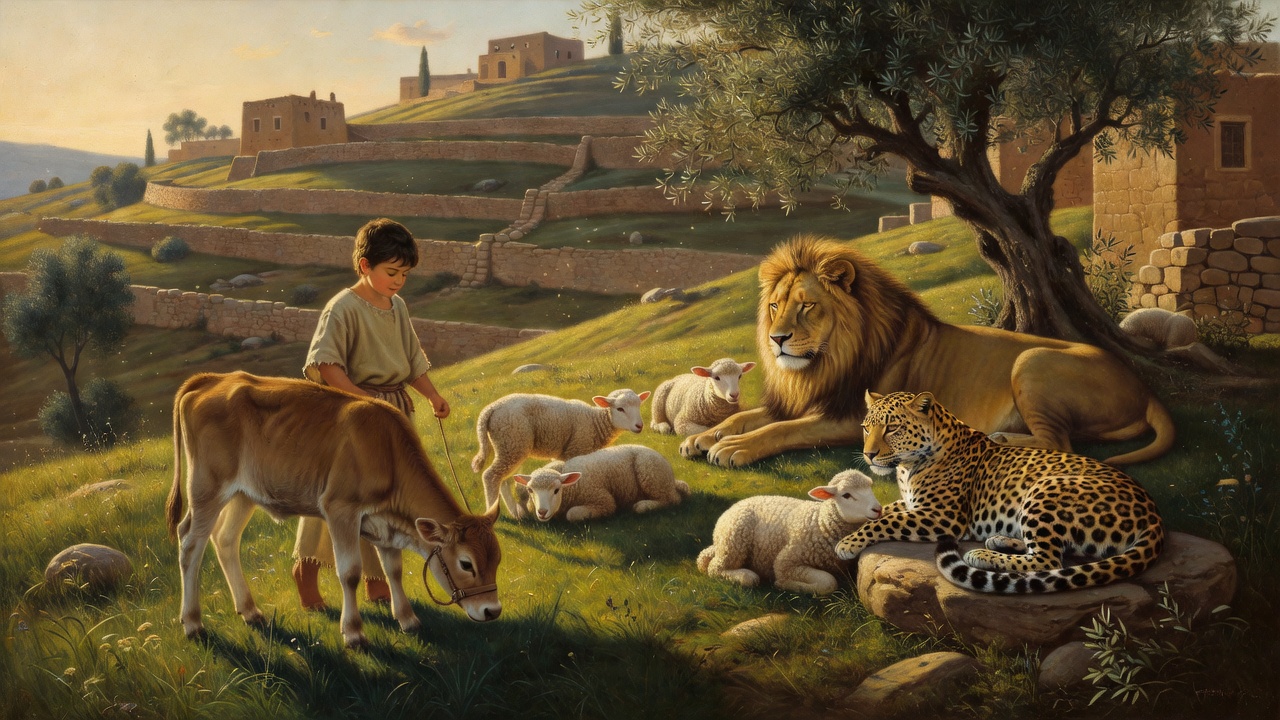
1And there will come a rod out of the broken tree of Jesse, and a branch out of his roots will give fruit. 2And the spirit of the Lord will be resting on him, the spirit of wisdom and good sense, the spirit of wise guiding and strength, the spirit of knowledge and of the fear of the Lord; 3And he will not be guided in his judging by what he sees, or give decisions by the hearing of his ears: 4But he will do right in the cause of the poor, and give wise decisions for those in the land who are in need; and the rod of his mouth will come down on the cruel, and with the breath of his lips he will put an end to the evil-doer. 5And righteousness will be the cord of his robe, and good faith the band round his breast. 6And the wolf will be living with the lamb, and the leopard will take his rest with the young goat; and the lion will take grass for food like the ox; and the young lion will go with the young ones of the herd; and a little child will be their guide. 7And the cow and the bear will be friends while their young ones are sleeping together. 8And the child at the breast will be playing by the hole of the snake, and the older child will put his hand on the bright eye of the poison-snake. 9There will be no cause of pain or destruction in all my holy mountain: for the earth will be full of the knowledge of the Lord as the sea is covered by the waters. 10And in that day, the eyes of the nations will be turned to the root of Jesse which will be lifted up as the flag of the peoples; and his resting-place will be glory. 11And in that day the hand of the Lord will be stretched out the second time to get back the rest of his people, from Assyria, and from Egypt, and from Pathros, and from Cush, and from Elam, and from Shinar, and from Hamath, and from the sea-lands. 12And he will put up a flag as a sign to the nations, and he will get together those of Israel who had been sent away, and the wandering ones of Judah, from the four ends of the earth. 13And the envy of Ephraim will be gone, and those who make trouble for Judah will come to an end: Ephraim will have no more envy of Judah, and there will be an end of Judah's hate for Ephraim. 14And they will be united in attacking the Philistines on the west, and together they will take the goods of the children of the east: their hand will be on Edom and Moab; and the children of Ammon will be under their rule. 15And the Lord will make the tongue of the Egyptian sea completely dry; and with his burning wind his hand will be stretched out over the River, and it will be parted into seven streams, so that men may go over it with dry feet. 16And there will be a highway for the rest of his people from Assyria; as there was for Israel in the day when he came up out of the land of Egypt.
¿Sabías que…?
El Reino de Paz y el Remanente Restaurado
- Isaí de Belén fue el padre del rey David. Al describir al gobernante venidero como un retoño del tronco de Isaí y como la raíz de Isaí, la profecía señala la renovación de la dinastía davídica, aun después de que la casa real pareciera talada.Fuentes: Jesse · el propio texto bíblico
- Los lugares enumerados para la reunión del remanente reflejan la geografía del antiguo Oriente Próximo: Patros designa el Alto Egipto, Sinar es un nombre antiguo para Babilonia en el sur de Mesopotamia, y Elam era un territorio montañoso situado al este de Babilonia.Fuentes: Pathros · Shinar · Elam · el propio texto bíblico
- Efraín, llamado así por el segundo hijo de José, solía representar en los textos proféticos al reino del norte de Israel. Isaías prevé un tiempo de reconciliación duradera que pondría fin a la antigua rivalidad y discordia entre las tribus del norte y Judá.Fuentes: Ephraim · el propio texto bíblico
Notas escritas con ayuda de IA a partir de fuentes abiertas (Theographic Bible Metadata, CC BY-SA 4.0; Easton’s Bible Dictionary, dominio público) y revisadas antes de publicarse.
Lugares de este capítulo
- Assyria · 36.359, 43.153 · versículos 11, 16
- Cush · Hoy: Cush 1 · 16.935, 33.751 · versículo 11
- Egypt · 30.129, 31.308 · versículos 11, 16
- Elam · 32.189, 48.258 · versículo 11
- Great Sea · Hoy: Mediterranean Sea · 31.805, 34.170 · versículo 11
- Hamath · Hoy: Hama · 35.136, 36.750 · versículo 11
- Pathros · Hoy: Upper Egypt · 24.100, 32.700 · versículo 11
- Shinar · Hoy: Babylonia · 32.543, 44.422 · versículo 11
- Ammon · 31.955, 35.934 · versículo 14
- East · Hoy: region around Amman · 31.955, 35.934 · versículo 14
- Edom · 30.746, 35.604 · versículo 14
- Moab · Hoy: Moab 1 · 31.181, 35.701 · versículo 14
- Philistia · 31.664, 34.546 · versículo 14
- Euphrates · Hoy: Euphrates River · 31.004, 47.442 · versículo 15
Solo aparecen lugares identificados con alta confianza (90 % o más según las fuentes académicas reunidas por OpenBible). Mapa de la época: DARE (Digital Atlas of the Roman Empire), CC BY 4.0; mapa actual: © colaboradores de OpenStreetMap; lugares: OpenBible.info (CC BY 4.0).
Créditos y licencia de esta traducción
Bible in Basic English
The Bible in Basic English
Public Domain
Language: English
Dialect: simple British
Translation by: Samuel Henry Hooke
The Bible In Basic English was printed in 1965 by Cambridge Press in England. Published without any copyright notice and distributed in America, this work fell immediately and irretrievably into the Public Domain in the United States according to the UCC convention of that time. A call to Cambridge prior to placing this work in etext resulted in an admission of this fact.
2020-04-17
Títulos de sección adaptados de la Berean Standard Bible (dominio público); no forman parte del texto bíblico de esta traducción.
Fuente: http://ebible.org/engBBE/ · eBible.org