1 Crónicas 8
World English Bible British Edition with Deuterocanon · Toca un versículo para ver sus referencias cruzadas.
Genealogy from Benjamin to Saul
1Benjamin became the father of Bela his firstborn, Ashbel the second, Aharah the third, 2Nohah the fourth, and Rapha the fifth. 3Bela had sons: Addar, Gera, Abihud, 4Abishua, Naaman, Ahoah, 5Gera, Shephuphan, and Huram. 6These are the sons of Ehud. These are the heads of fathers’ households of the inhabitants of Geba, who were carried captive to Manahath: 7Naaman, Ahijah, and Gera, who carried them captive; and he became the father of Uzza and Ahihud.
8Shaharaim became the father of children in the field of Moab, after he had sent them away. Hushim and Baara were his wives. 9By Hodesh his wife, he became the father of Jobab, Zibia, Mesha, Malcam, 10Jeuz, Shachia, and Mirmah. These were his sons, heads of fathers’ households. 11By Hushim, he became the father of Abitub and Elpaal. 12The sons of Elpaal: Eber, Misham, and Shemed, who built Ono and Lod, with its towns; 13and Beriah and Shema, who were heads of fathers’ households of the inhabitants of Aijalon, who put to flight the inhabitants of Gath; 14and Ahio, Shashak, Jeremoth, 15Zebadiah, Arad, Eder, 16Michael, Ishpah, Joha, the sons of Beriah, 17Zebadiah, Meshullam, Hizki, Heber, 18Ishmerai, Izliah, Jobab, the sons of Elpaal, 19Jakim, Zichri, Zabdi, 20Elienai, Zillethai, Eliel, 21Adaiah, Beraiah, Shimrath, the sons of Shimei, 22Ishpan, Eber, Eliel, 23Abdon, Zichri, Hanan, 24Hananiah, Elam, Anthothijah, 25Iphdeiah, Penuel, the sons of Shashak, 26Shamsherai, Shehariah, Athaliah, 27Jaareshiah, Elijah, Zichri, and the sons of Jeroham. 28These were heads of fathers’ households throughout their generations, chief men. These lived in Jerusalem.
29The father of Gibeon, whose wife’s name was Maacah, lived in Gibeon 30with his firstborn son Abdon, Zur, Kish, Baal, Nadab, 31Gedor, Ahio, Zecher, 32and Mikloth, who became the father of Shimeah. They also lived with their families in Jerusalem, near their relatives.
The Family of Saul
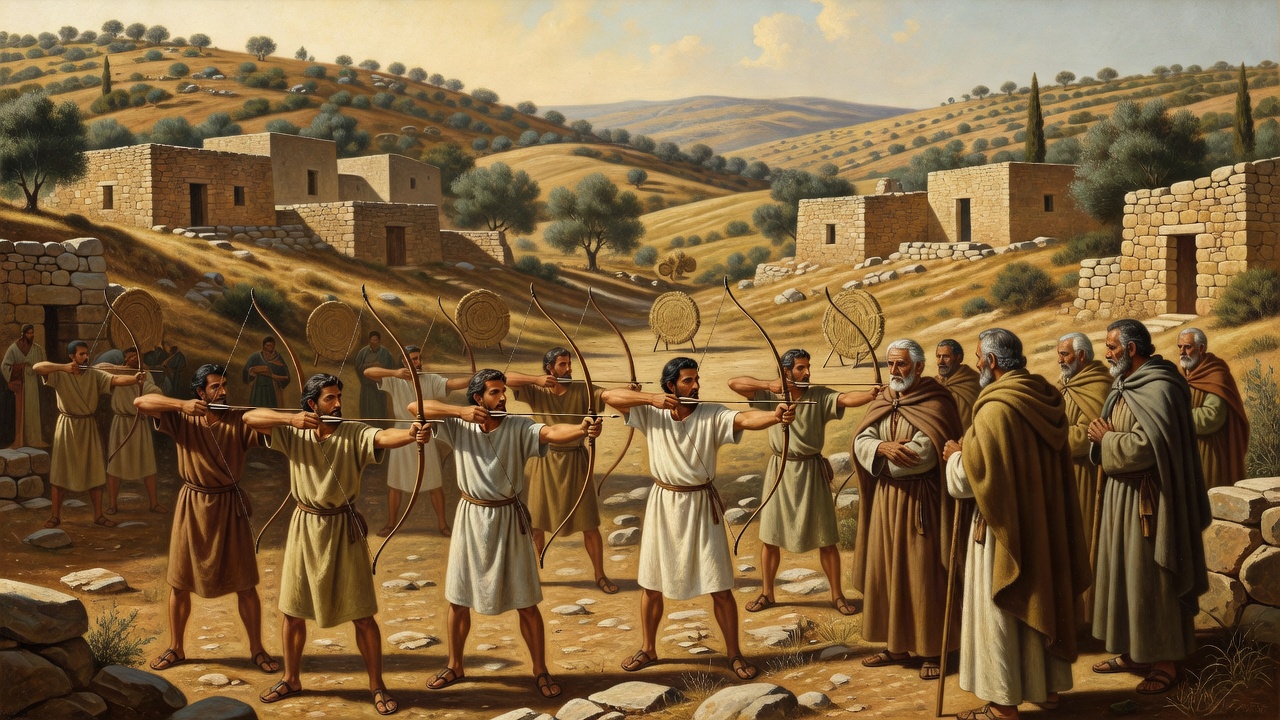
33Ner became the father of Kish. Kish became the father of Saul. Saul became the father of Jonathan, Malchishua, Abinadab, and Eshbaal. 34The son of Jonathan was Merib-baal. Merib-baal became the father of Micah. 35The sons of Micah: Pithon, Melech, Tarea, and Ahaz. 36Ahaz became the father of Jehoaddah. Jehoaddah became the father of Alemeth, Azmaveth, and Zimri. Zimri became the father of Moza. 37Moza became the father of Binea. Raphah was his son, Eleasah his son, and Azel his son. 38Azel had six sons, whose names are these: Azrikam, Bocheru, Ishmael, Sheariah, Obadiah, and Hanan. All these were the sons of Azel. 39The sons of Eshek his brother: Ulam his firstborn, Jeush the second, and Eliphelet the third. 40The sons of Ulam were mighty men of valour, archers, and had many sons, and grandsons, one hundred and fifty. All these were of the sons of Benjamin.
¿Sabías que…?
Genealogía de Benjamín y el linaje de Saúl
- 1 Crónicas 8 presenta una extensa genealogía de la tribu de Benjamín, que culmina en la línea familiar del rey Saúl y de su hijo Jonatán. El registro traza los descendientes de Jonatán a lo largo de varias generaciones, entre ellos Merib-baal, Micaía y una estirpe de valientes arqueros descendientes de Ulam.Fuentes: el propio texto bíblico · Jonathan · Micah
- El capítulo destaca asentamientos y acciones de los clanes benjamitas, como Semed, quien fundó Ono y Lod, y los jefes Bería y Sema, que expulsaron a los habitantes de Gat desde Ajalón. Además de estas ciudades, muchos cabezas de familia benjamitas están registrados como residentes de Jerusalén.Fuentes: el propio texto bíblico · Beriah · Ono · Jerusalem
Notas escritas con ayuda de IA a partir de fuentes abiertas (Theographic Bible Metadata, CC BY-SA 4.0; Easton’s Bible Dictionary, dominio público) y revisadas antes de publicarse.
Lugares de este capítulo
- Moab · Hoy: Moab 1 · 31.181, 35.701 · versículo 8
- Lod · 31.950, 34.900 · versículo 12
- Jerusalem · 31.777, 35.234 · versículos 28, 32
- Gibeon · Hoy: El Jib · 31.847, 35.183 · versículo 29
Solo aparecen lugares identificados con alta confianza (90 % o más según las fuentes académicas reunidas por OpenBible). Mapa de la época: DARE (Digital Atlas of the Roman Empire), CC BY 4.0; mapa actual: © colaboradores de OpenStreetMap; lugares: OpenBible.info (CC BY 4.0).
Créditos y licencia de esta traducción
The World English Bible British Edition with Deuterocanon
The World English Bible British Edition is not copyrighted. It is in the Public Domain. However "World English Bible" is a Trademark.
You may copy, publish, proclaim, distribute, redistribute, sell, give away, quote, memorize, read publicly, broadcast, transmit, share, back up, post on the Internet, print, reproduce, preach, teach from, and use the World English Bible as much as you want, and others may also do so. All we ask is that if you CHANGE the actual text of the World English Bible in any way, you not call the result the World English Bible any more. This is to avoid confusion, not to limit your freedom. The Holy Bible is God's Word. It belongs to God. He gave it to us freely, and we who have worked on this translation freely give it to you by dedicating it to the Public Domain.
Donations to help with the expenses of this project and thus help others have free access to the Word of God may be made to us, but are not required. Please see https://MLJohnson.org/partner/ for more about that.
For a list of what is different between the World English Bible and the World English Bible British Edition, besides the handling of God's Proper Name, see phrasetranslog.txt and phrasetranslist.txt .
2020 stable text edition
Títulos de sección adaptados de la Berean Standard Bible (dominio público); no forman parte del texto bíblico de esta traducción.
Fuente: http://ebible.org/eng-webbe/ · eBible.org