Juan 6
World English Bible Classic · Toca un versículo para ver sus referencias cruzadas.
The Feeding of the Five Thousand
1After these things, Jesus went away to the other side of the sea of Galilee, which is also called the Sea of Tiberias. 2A great multitude followed him, because they saw his signs which he did on those who were sick. 3Jesus went up into the mountain, and he sat there with his disciples. 4Now the Passover, the feast of the Jews, was at hand. 5Jesus therefore, lifting up his eyes and seeing that a great multitude was coming to him, said to Philip, “Where are we to buy bread, that these may eat?” 6He said this to test him, for he himself knew what he would do.
7Philip answered him, “Two hundred denarii worth of bread is not sufficient for them, that every one of them may receive a little.”
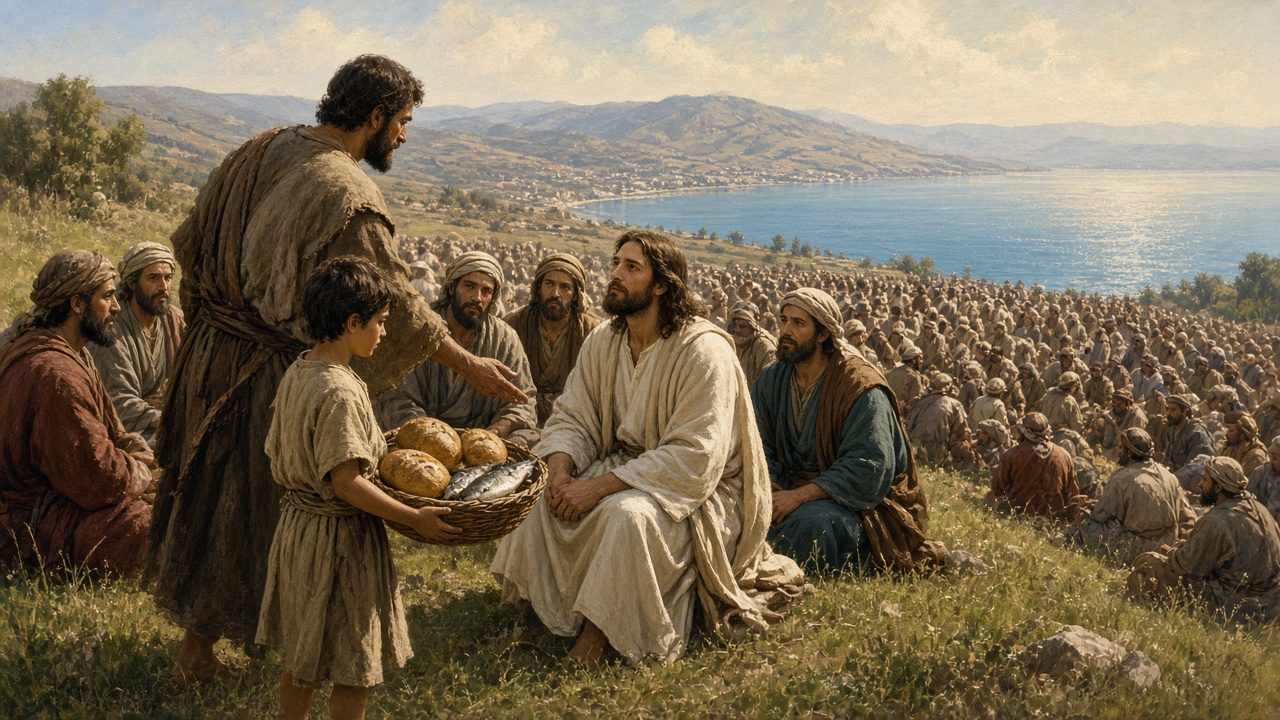
8One of his disciples, Andrew, Simon Peter’s brother, said to him, 9“There is a boy here who has five barley loaves and two fish, but what are these among so many?”
10Jesus said, “Have the people sit down.” Now there was much grass in that place. So the men sat down, in number about five thousand. 11Jesus took the loaves, and having given thanks, he distributed to the disciples, and the disciples to those who were sitting down, likewise also of the fish as much as they desired. 12When they were filled, he said to his disciples, “Gather up the broken pieces which are left over, that nothing be lost.” 13So they gathered them up, and filled twelve baskets with broken pieces from the five barley loaves, which were left over by those who had eaten. 14When therefore the people saw the sign which Jesus did, they said, “This is truly the prophet who comes into the world.” 15Jesus therefore, perceiving that they were about to come and take him by force to make him king, withdrew again to the mountain by himself.
Jesus Walks on Water
16When evening came, his disciples went down to the sea. 17They entered into the boat, and were going over the sea to Capernaum. It was now dark, and Jesus had not come to them. 18The sea was tossed by a great wind blowing. 19When therefore they had rowed about twenty-five or thirty stadia, they saw Jesus walking on the sea and drawing near to the boat; and they were afraid. 20But he said to them, “It is I. Don’t be afraid.” 21They were willing therefore to receive him into the boat. Immediately the boat was at the land where they were going.
Jesus the Bread of Life
22On the next day, the multitude that stood on the other side of the sea saw that there was no other boat there, except the one in which his disciples had embarked, and that Jesus hadn’t entered with his disciples into the boat, but his disciples had gone away alone. 23However, boats from Tiberias came near to the place where they ate the bread after the Lord had given thanks. 24When the multitude therefore saw that Jesus wasn’t there, nor his disciples, they themselves got into the boats and came to Capernaum, seeking Jesus. 25When they found him on the other side of the sea, they asked him, “Rabbi, when did you come here?”
26Jesus answered them, “Most certainly I tell you, you seek me, not because you saw signs, but because you ate of the loaves and were filled. 27Don’t work for the food which perishes, but for the food which remains to eternal life, which the Son of Man will give to you. For God the Father has sealed him.”
28They said therefore to him, “What must we do, that we may work the works of God?”
29Jesus answered them, “This is the work of God, that you believe in him whom he has sent.”
30They said therefore to him, “What then do you do for a sign, that we may see and believe you? What work do you do? 31Our fathers ate the manna in the wilderness. As it is written, ‘He gave them bread out of heaven to eat.’”
32Jesus therefore said to them, “Most certainly, I tell you, it wasn’t Moses who gave you the bread out of heaven, but my Father gives you the true bread out of heaven. 33For the bread of God is that which comes down out of heaven and gives life to the world.”
34They said therefore to him, “Lord, always give us this bread.”
35Jesus said to them, “I am the bread of life. Whoever comes to me will not be hungry, and whoever believes in me will never be thirsty. 36But I told you that you have seen me, and yet you don’t believe. 37All those whom the Father gives me will come to me. He who comes to me I will in no way throw out. 38For I have come down from heaven, not to do my own will, but the will of him who sent me. 39This is the will of my Father who sent me, that of all he has given to me I should lose nothing, but should raise him up at the last day. 40This is the will of the one who sent me, that everyone who sees the Son and believes in him should have eternal life; and I will raise him up at the last day.”
41The Jews therefore murmured concerning him, because he said, “I am the bread which came down out of heaven.” 42They said, “Isn’t this Jesus, the son of Joseph, whose father and mother we know? How then does he say, ‘I have come down out of heaven’?”
43Therefore Jesus answered them, “Don’t murmur among yourselves. 44No one can come to me unless the Father who sent me draws him; and I will raise him up in the last day. 45It is written in the prophets, ‘They will all be taught by God.’ Therefore everyone who hears from the Father and has learned, comes to me. 46Not that anyone has seen the Father, except he who is from God. He has seen the Father. 47Most certainly, I tell you, he who believes in me has eternal life. 48I am the bread of life. 49Your fathers ate the manna in the wilderness and they died. 50This is the bread which comes down out of heaven, that anyone may eat of it and not die. 51I am the living bread which came down out of heaven. If anyone eats of this bread, he will live forever. Yes, the bread which I will give for the life of the world is my flesh.”
52The Jews therefore contended with one another, saying, “How can this man give us his flesh to eat?”
53Jesus therefore said to them, “Most certainly I tell you, unless you eat the flesh of the Son of Man and drink his blood, you don’t have life in yourselves. 54He who eats my flesh and drinks my blood has eternal life, and I will raise him up at the last day. 55For my flesh is food indeed, and my blood is drink indeed. 56He who eats my flesh and drinks my blood lives in me, and I in him. 57As the living Father sent me, and I live because of the Father, so he who feeds on me will also live because of me. 58This is the bread which came down out of heaven—not as our fathers ate the manna and died. He who eats this bread will live forever.”
Many Disciples Turn Back
59He said these things in the synagogue, as he taught in Capernaum.
60Therefore many of his disciples, when they heard this, said, “This is a hard saying! Who can listen to it?”
61But Jesus knowing in himself that his disciples murmured at this, said to them, “Does this cause you to stumble? 62Then what if you would see the Son of Man ascending to where he was before? 63It is the spirit who gives life. The flesh profits nothing. The words that I speak to you are spirit, and are life. 64But there are some of you who don’t believe.” For Jesus knew from the beginning who they were who didn’t believe, and who it was who would betray him. 65He said, “For this cause I have said to you that no one can come to me, unless it is given to him by my Father.”
66At this, many of his disciples went back and walked no more with him.
Peter’s Confession of Faith
67Jesus said therefore to the twelve, “You don’t also want to go away, do you?”
68Simon Peter answered him, “Lord, to whom would we go? You have the words of eternal life. 69We have come to believe and know that you are the Christ, the Son of the living God.”
70Jesus answered them, “Didn’t I choose you, the twelve, and one of you is a devil?” 71Now he spoke of Judas, the son of Simon Iscariot, for it was he who would betray him, being one of the twelve.
¿Sabías que…?
El pan de vida
- En este capítulo, Juan llama al lago Mar de Galilea y también Mar de Tiberíades. El Diccionario Bíblico de Easton lo describe con doce millas y media de largo y de cuatro a siete millas y media de ancho, con la superficie a 682 pies bajo el Mediterráneo. De Tiberíades, en la orilla occidental, se dice que fue fundada por Herodes Antipas en el año 16 d.C. y que recibió su nombre en honor del emperador Tiberio; algunas barcas de esa ciudad llegaron cerca del lugar donde la gente había comido el pan.Fuentes: el propio texto bíblico · Sea of Galilee · Tiberias
- Esa noche los discípulos salieron en barca rumbo a Capernaúm, y al día siguiente la multitud cruzó y encontró allí a Jesús. Él pronunció la enseñanza sobre el pan de vida en la sinagoga de Capernaúm. El Diccionario Bíblico de Easton señala que la ciudad, no mencionada en el Antiguo Testamento, llegó a ser la propia ciudad de Jesús después de su expulsión de Nazaret y fue escenario de muchos episodios de su ministerio.Fuentes: el propio texto bíblico · Capernaum
- Cuando la multitud se acercaba, Jesús preguntó a Felipe dónde podían comprar pan, una pregunta que el relato dice que era para ponerlo a prueba, pues Jesús ya sabía lo que iba a hacer. Felipe, como Andrés y Pedro, era de Betsaida; respondió que doscientos denarios no alcanzarían para que cada persona recibiera un pedazo pequeño. Andrés, hermano de Pedro, señaló entonces a un muchacho con cinco panes de cebada y dos pescados pequeños, y el Diccionario Bíblico de Easton, al citar ese diálogo entre otros pasajes, dice que Felipe parece haber ocupado un lugar destacado entre los apóstoles.Fuentes: el propio texto bíblico · Phillip the Apostle · Andrew · Simon Peter
Notas escritas con ayuda de IA a partir de fuentes abiertas (Theographic Bible Metadata, CC BY-SA 4.0; Easton’s Bible Dictionary, dominio público) y revisadas antes de publicarse.
Lugares de este capítulo
Solo aparecen lugares identificados con alta confianza (90 % o más según las fuentes académicas reunidas por OpenBible). Mapa de la época: DARE (Digital Atlas of the Roman Empire), CC BY 4.0; mapa actual: © colaboradores de OpenStreetMap; lugares: OpenBible.info (CC BY 4.0).
Créditos y licencia de esta traducción
The World English Bible
The World English Bible is in the Public Domain. That means that it is not copyrighted. However, "World English Bible" is a Trademark of eBible.org.
You may copy, publish, proclaim, distribute, redistribute, sell, give away, quote, memorize, read publicly, broadcast, transmit, share, back up, post on the Internet, print, reproduce, preach, teach from, and use
the World English Bible as much as you want, and others may also do so. All we ask is that if you CHANGE the actual text of the World English Bible in any way, you not call the result the World English Bible any more.
This is to avoid confusion, not to limit your freedom. The Holy Bible is God's Word. It belongs to God. He gave it to us freely, and we who have worked on this translation freely give it to you by dedicating it to the
Public Domain.
Donations to help with the expenses of this project and thus help others have free access to the Word of God may be made to us, but are not required. Please see
https://MLJohnson.org/partner/ if you are interested in helping to fund this work.
This is the 2020 stable text edition of the World English Bible. The main editing/updating work is done on all books. Although we may
choose to consider corrections of obvious typos or problems in the text, we are done with style updates and modernization of the language used in this
Bible translation, preferring to leave the text stable.
New updates, if any, will be posted on https://eBible.org/web/ and at https://WorldEnglish.Bible .
Títulos de sección adaptados de la Berean Standard Bible (dominio público); no forman parte del texto bíblico de esta traducción.
Fuente: http://ebible.org/eng-web/ · eBible.org