Cantares 8
LXX2012: Septuagint in British/International English 2012 · Toca un versículo para ver sus referencias cruzadas.
Longing for Her Beloved
1I would that you, O my kinsman, were he that sucked the breasts of my mother; when I found you without, I would kiss you; yes, they should not despise me. 2I would take you, I would bring you into my mother's house, and into the chamber of her that conceived me; I would make you to drink of spiced wine, of the juice of my pomegranates. 3His left hand should be under my head, and his right hand should embrace me. 4I have charged you, you⌃ daughters of Jerusalem, by the virtues of the field, that you⌃ stir not up, nor awake my love, until he please.
The Friends
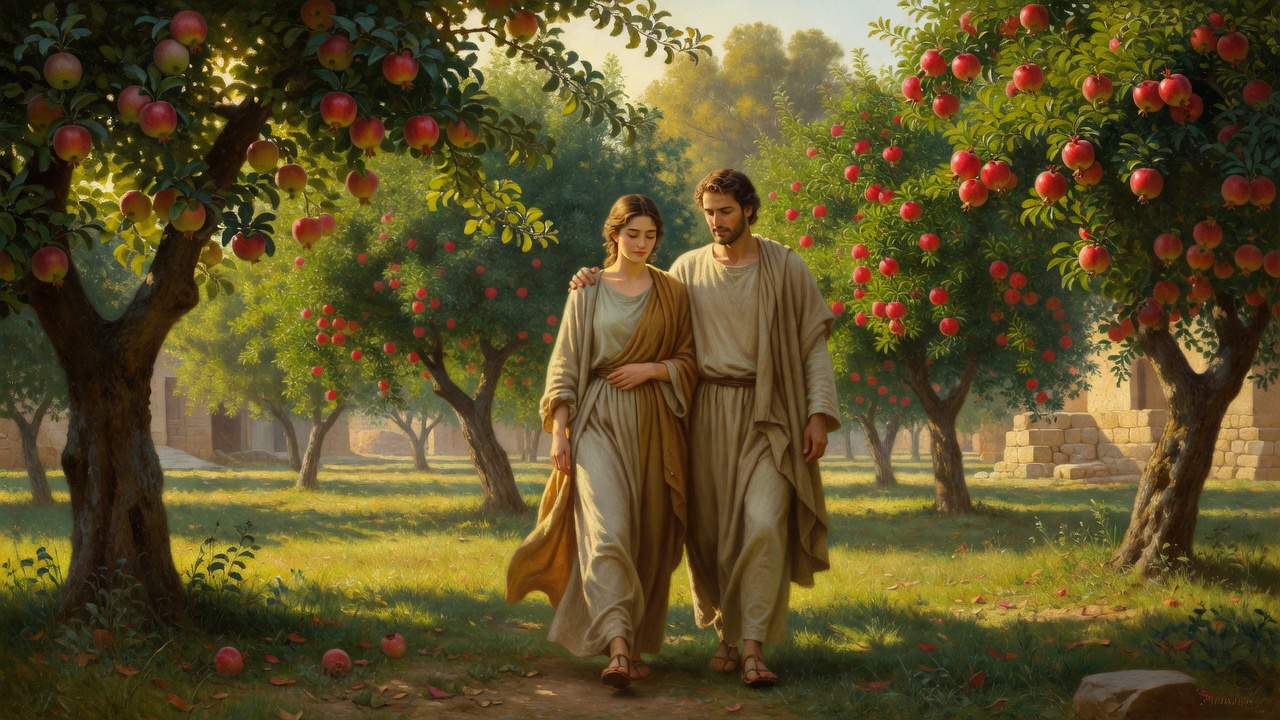
5Who is this that comes up all white, leaning on her kinsman? I raised you up under an apple tree; there your mother brought you forth; there she that bore you brought you forth.
The Bride
6Set me as a seal upon your heart, as a seal upon your arm; for love is strong as death; jealousy is cruel as the grave, her shafts are shafts of fire, even the flames thereof. 7Much water will not be able to quench love, and rivers shall not drown it; if a man would give all his substance for love, men would utterly despise it.
The Friends
8Our sister is little, and has no breasts; what shall we do for our sister, in the day wherein she shall be spoken for? 9If she is a wall, let us build upon her silver bulwarks; and if she is a door, let us carve for her cedar panels.
The Bride
10I am a wall, and my breasts are as towers; I was in their eyes as one that found peace. 11Solomon had a vineyard in Beelamon; he let his vineyard to keepers; every one was to bring for its fruit a thousand pieces of silver. 12My vineyard, even mine, is before me; Solomon shall have a thousand, and they that keep its fruit two hundred.
The Bridegroom
13You that dwell in the gardens, the companions listen to your voice: make me hear it.
The Bride
14Away, my kinsman, and be like a doe or a fawn on the mountains of spices.
¿Sabías que…?
El amor invencible y las viñas reales
- Cantares 8:11 menciona una viña real en Baal-hamón, nombre que significa lugar de una multitud. Geógrafos y eruditos han propuesto diversas identificaciones para este sitio, tales como Hamón en el territorio tribal de Aser o Belamón cerca de Dotán.Fuentes: el propio texto bíblico · Baal-hamon · Solomon
- La petición de ser puesto como un sello sobre el corazón y el brazo del amado evoca la antigua costumbre de llevar sellos personales pegados al cuerpo, como símbolo de pertenencia perpetua, protección y leal afecto.Fuentes: el propio texto bíblico
- El capítulo celebra el amor como una fuerza invencible que no se puede comprar con todas las riquezas de una casa, describiendo su llama como ardiente e imposible de apagar incluso por ríos caudalosos y torrentes.Fuentes: el propio texto bíblico
Notas escritas con ayuda de IA a partir de fuentes abiertas (Theographic Bible Metadata, CC BY-SA 4.0; Easton’s Bible Dictionary, dominio público) y revisadas antes de publicarse.
Lugares de este capítulo
- Jerusalem · 31.777, 35.234 · versículo 4
Solo aparecen lugares identificados con alta confianza (90 % o más según las fuentes académicas reunidas por OpenBible). Mapa de la época: DARE (Digital Atlas of the Roman Empire), CC BY 4.0; mapa actual: © colaboradores de OpenStreetMap; lugares: OpenBible.info (CC BY 4.0).
Créditos y licencia de esta traducción
LXX2012: Septuagint in British/International English 2012
The Septuagint with Apocrypha, translated from Greek to English by Sir Lancelot C. L. Brenton and published in 1885, with some language updates (British/International English)
Public Domain
Language: English
Dialect (if applicable): British
Language in English: English
Translation by: Sir Lancelot Charles Lee Breton
LXX2012: Septuagint in English 2012, British/International English Edition
This is a translation of the Old Testament and Apocrypha/Deuterocanon from Hebrew to Greek to 19th Century British English, with some updates of spelling and word usage to contemporary British/International English. The original English translation was done by Sir Lancelot Charles Lee Brenton and published by Samuel Bagster & Sons, Ltd., in London in 1851. It has entered the Public Domain due to the passage of sufficient time. In the process of scanning and typing the text, the original poetry and prose formatting, as well as peripheral material like introductions and notes, have been omitted.
This edition of the Septuagint has some language updates. Brenton's word order and punctuation has been mostly retained, meaning that quotation marks are not used, and sentences within quotes may not start with capital letters, as was standard usage in 1851. Names transliterated from Greek to those transliterated from Hebrew in the common English Bibles often differ. These language updates are dedicated to the Public Domain by the author of those edits, Michael Paul Johnson. Therefore this edition may be freely copied, published, etc.
Before considering making changes to the text of this work, I recommend that you consult with God, because this is really His Book.
If you find errors in the text, please report them so that we can correct them.
Donations to help with the expenses of operating this web site and thus help others have free access to the Word of God may be made to us, but are not required. Please see http://MLJohnson.org/partner/ for more about that.
Títulos de sección adaptados de la Berean Standard Bible (dominio público); no forman parte del texto bíblico de esta traducción.
Fuente: http://ebible.org/eng-uk-lxx2012/ · eBible.org