Salmos 100
LXX2012: Septuagint in British/International English 2012 · Toca un versículo para ver sus referencias cruzadas.
(101) A Psalm of David.
Make a Joyful Noise
1I will sing to you, O Lord, of mercy and judgement; I will sing a psalm,
2and I will be wise in a blameless way. When will you come to me? I walked in the innocence of my heart, in the midst of my house.
3I have not set before my eyes any unlawful thing; I have hated transgressors.
4A perverse heart has not cleaved to me; I have not known an evil man, forasmuch as he turns away from me.
5Him that privily speaks against his neighbour, him have I driven from me: he that is proud in look and insatiable in heart, —with him I have not eaten.
6My eyes shall be upon the faithful of the land, that they may dwell with me: he that walked in a perfect way, the same ministered to me.
7The proud doer lived not in the midst of my house; the unjust speaker prospered not in my sight.
8Early did I kill all the sinners of the land, that I might destroy out of the city of the Lord all that work iniquity.
¿Sabías que…?
Salmo 100: Un Cántico de Alabanza y Gratitud
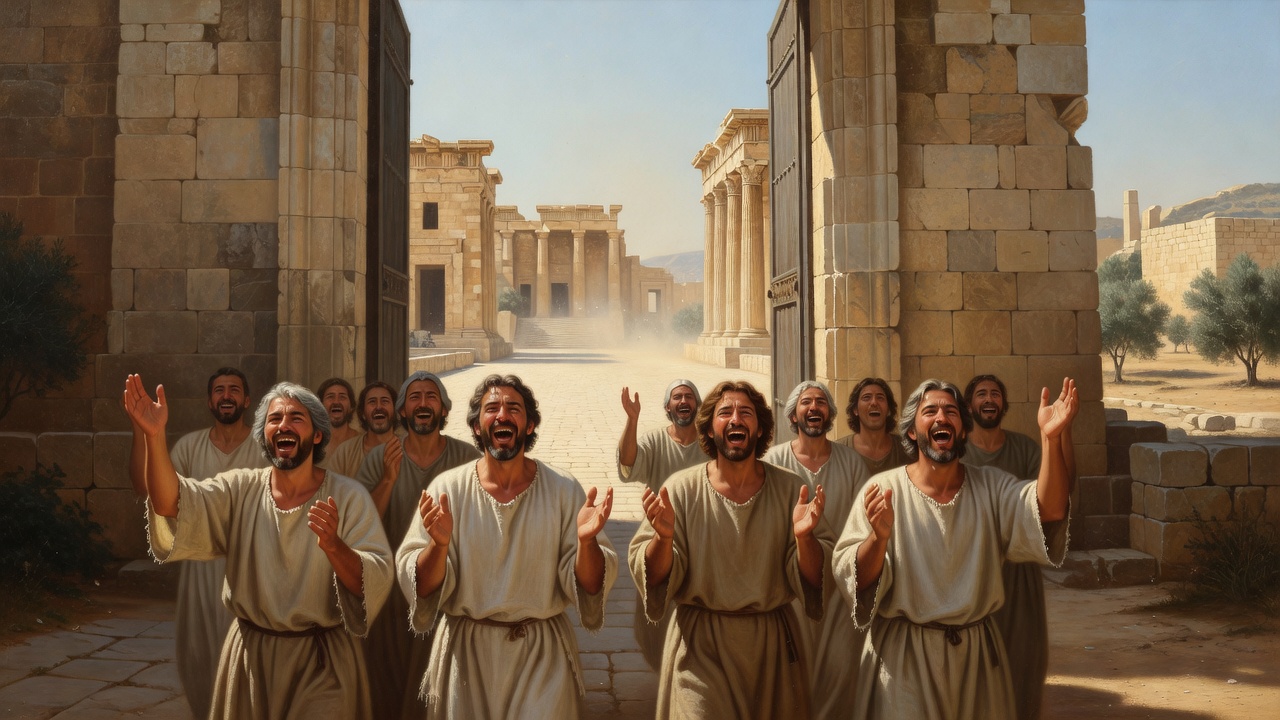
- El Salmo 100 está designado específicamente como un salmo de acción de gracias, invitando no solo a Israel sino a toda la tierra a servir a Dios con alegría y cantar con júbilo.Fuentes: el propio texto bíblico
- El salmo utiliza imágenes del santuario, llamando a los adoradores a entrar por sus puertas y atrios con alabanza, reconociendo a Dios como su Creador y a sí mismos como ovejas de Su prado.Fuentes: el propio texto bíblico
- La razón de esta celebración radica en el carácter mismo de Dios: Su bondad, Su amor leal que perdura para siempre y Su fidelidad que continúa por todas las generaciones.Fuentes: el propio texto bíblico
Notas escritas con ayuda de IA a partir de fuentes abiertas (Theographic Bible Metadata, CC BY-SA 4.0; Easton’s Bible Dictionary, dominio público) y revisadas antes de publicarse.
Créditos y licencia de esta traducción
LXX2012: Septuagint in British/International English 2012
The Septuagint with Apocrypha, translated from Greek to English by Sir Lancelot C. L. Brenton and published in 1885, with some language updates (British/International English)
Public Domain
Language: English
Dialect (if applicable): British
Language in English: English
Translation by: Sir Lancelot Charles Lee Breton
LXX2012: Septuagint in English 2012, British/International English Edition
This is a translation of the Old Testament and Apocrypha/Deuterocanon from Hebrew to Greek to 19th Century British English, with some updates of spelling and word usage to contemporary British/International English. The original English translation was done by Sir Lancelot Charles Lee Brenton and published by Samuel Bagster & Sons, Ltd., in London in 1851. It has entered the Public Domain due to the passage of sufficient time. In the process of scanning and typing the text, the original poetry and prose formatting, as well as peripheral material like introductions and notes, have been omitted.
This edition of the Septuagint has some language updates. Brenton's word order and punctuation has been mostly retained, meaning that quotation marks are not used, and sentences within quotes may not start with capital letters, as was standard usage in 1851. Names transliterated from Greek to those transliterated from Hebrew in the common English Bibles often differ. These language updates are dedicated to the Public Domain by the author of those edits, Michael Paul Johnson. Therefore this edition may be freely copied, published, etc.
Before considering making changes to the text of this work, I recommend that you consult with God, because this is really His Book.
If you find errors in the text, please report them so that we can correct them.
Donations to help with the expenses of operating this web site and thus help others have free access to the Word of God may be made to us, but are not required. Please see http://MLJohnson.org/partner/ for more about that.
Títulos de sección adaptados de la Berean Standard Bible (dominio público); no forman parte del texto bíblico de esta traducción.
Fuente: http://ebible.org/eng-uk-lxx2012/ · eBible.org