Proverbios 6
LXX2012: Septuagint in British/International English 2012 · Toca un versículo para ver sus referencias cruzadas.
Warnings against Foolishness
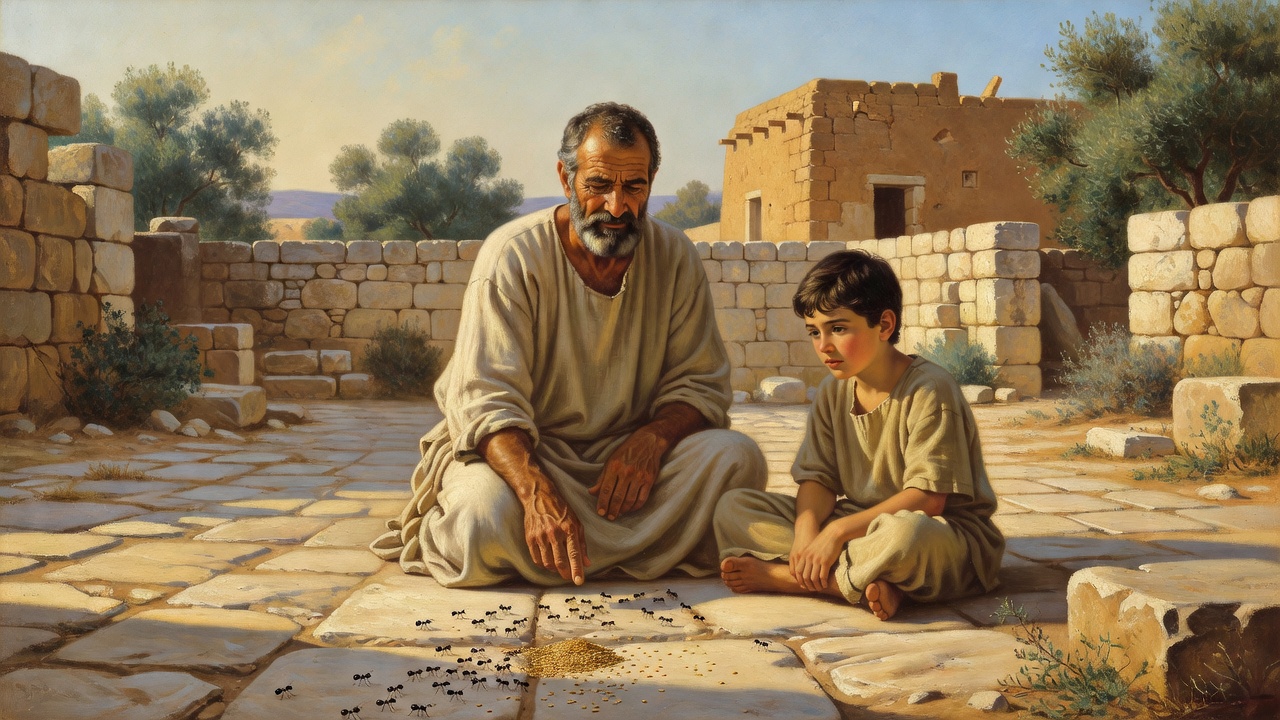
1My son, if you become surety for your friend, you shall deliver your hand to an enemy. 2For a man's own lips become a strong snare to him, and he is caught with the lips of his own mouth. 3My son, do what I command you, and deliver yourself; for on your friend's account you are come into the power of evil men: faint not, but stir up even your friend for whom you are become surety. 4Give not sleep to your eyes, nor slumber with your eyelids; 5that you may deliver yourself as a doe out of the toils, and as a bird out of a snare. 6Go to the ant, O sluggard; and see, and emulate his ways, and become wiser than he. 7For whereas he has no husbandry, nor any one to compel him, and is under no master, 8he prepares food for himself in the summer, and lays by abundant store in harvest. Or go to the bee, and learn how diligent she is, and how earnestly she is engaged in her work; whose labours kings and private men use for health, and she is desired and respected by all: though weak in body, she is advanced by honouring wisdom. 9How long will you lie, O sluggard? and when will you awake out of sleep? 10You sleep a little, and you rest a little, and you slumber a short time, and you fold your arms over your breast a little. 11Then poverty comes upon you as an evil traveller, and lack as a swift courier: but if you be diligent, your harvest shall arrive as a fountain, and poverty shall flee away as a bad courier. 12A foolish man and a transgressor goes in ways that are not good. 13And the same winks with the eye, and makes a sign with his foot, and teaches with the beckonings of his fingers. 14His perverse heart devises evils: at all times such a one causes troubles to a city. 15Therefore his destruction shall come suddenly; overthrow and irretrievable ruin. 16For he rejoices in all things which God hates, and he is ruined by reason of impurity of soul. 17The eye of the haughty, a tongue unjust, hands shedding the blood of the just; 18and a heart devising evil thoughts, and feet hastening to do evil, — are hateful to God. 19An unjust witness kindles falsehoods, and brings on quarrels between brethren.
Warnings against Adultery
20My son, keep the laws of your father, and reject not the ordinances of your mother: 21but bind them upon your soul continually, and hang them as a chain about your neck. 22Whenever you walk, lead this along and let it be with you; that it may talk with you when you wake. 23For the commandment of the law is a lamp and a light; a way of life; reproof also and correction: 24to keep you continually from a married woman, and from the calumny of a strange tongue. 25Let not the desire of beauty overcome you, neither be you caught by your eyes, neither be captivated with her eyelids. 26For the value of a harlot is as much as of one loaf; and a woman hunts for the precious souls of men. 27Shall any one bind fire in his bosom, and not burn his garments? 28or will any one walk on coals of fire, and not burn his feet? 29So is he that goes in to a married woman; he shall not be held guiltless, neither any one that touches her. 30It is not to be wondered at if one should be taken stealing, for he steals that when hungry he may satisfy his soul: 31but if he should be taken, he shall repay sevenfold, and shall deliver himself by giving all his goods. 32But the adulterer through lack of sense procures destruction to his soul. 33He endures both pain and disgrace, and his reproach shall never be wiped off. 34For the soul of her husband is full of jealousy: he will not spare in the day of vengeance. 35He will not forego his enmity for any ransom: neither will he be reconciled for many gifts.
¿Sabías que…?
Advertencias Contra Trampas, Pereza y Discordia
- La expresión estrechar las manos alude a un gesto empleado para cerrar un compromiso o fianza financiera. El pasaje advierte que salir como fiador de otro puede atrapar a una persona, recomendando actuar de inmediato sin dormir para liberarse como gacela o ave.Fuentes: el propio texto bíblico
- El texto señala a la hormiga como un modelo de sabiduría y laboriosidad autónoma, ya que almacena provisiones durante el verano y la cosecha sin tener comandante, capataz o gobernante.Fuentes: el propio texto bíblico
- El capítulo emplea una fórmula numérica progresiva al enumerar seis cosas que el Señor aborrece y siete que le son detestables, condenando sistemáticamente la soberbia, la falsedad, la violencia, la maldad, el falso testimonio y la discordia.Fuentes: el propio texto bíblico
Notas escritas con ayuda de IA a partir de fuentes abiertas (Theographic Bible Metadata, CC BY-SA 4.0; Easton’s Bible Dictionary, dominio público) y revisadas antes de publicarse.
Créditos y licencia de esta traducción
LXX2012: Septuagint in British/International English 2012
The Septuagint with Apocrypha, translated from Greek to English by Sir Lancelot C. L. Brenton and published in 1885, with some language updates (British/International English)
Public Domain
Language: English
Dialect (if applicable): British
Language in English: English
Translation by: Sir Lancelot Charles Lee Breton
LXX2012: Septuagint in English 2012, British/International English Edition
This is a translation of the Old Testament and Apocrypha/Deuterocanon from Hebrew to Greek to 19th Century British English, with some updates of spelling and word usage to contemporary British/International English. The original English translation was done by Sir Lancelot Charles Lee Brenton and published by Samuel Bagster & Sons, Ltd., in London in 1851. It has entered the Public Domain due to the passage of sufficient time. In the process of scanning and typing the text, the original poetry and prose formatting, as well as peripheral material like introductions and notes, have been omitted.
This edition of the Septuagint has some language updates. Brenton's word order and punctuation has been mostly retained, meaning that quotation marks are not used, and sentences within quotes may not start with capital letters, as was standard usage in 1851. Names transliterated from Greek to those transliterated from Hebrew in the common English Bibles often differ. These language updates are dedicated to the Public Domain by the author of those edits, Michael Paul Johnson. Therefore this edition may be freely copied, published, etc.
Before considering making changes to the text of this work, I recommend that you consult with God, because this is really His Book.
If you find errors in the text, please report them so that we can correct them.
Donations to help with the expenses of operating this web site and thus help others have free access to the Word of God may be made to us, but are not required. Please see http://MLJohnson.org/partner/ for more about that.
Títulos de sección adaptados de la Berean Standard Bible (dominio público); no forman parte del texto bíblico de esta traducción.
Fuente: http://ebible.org/eng-uk-lxx2012/ · eBible.org