Números 24
LXX2012: Septuagint in British/International English 2012 · Toca un versículo para ver sus referencias cruzadas.
Balaam’s Third Oracle
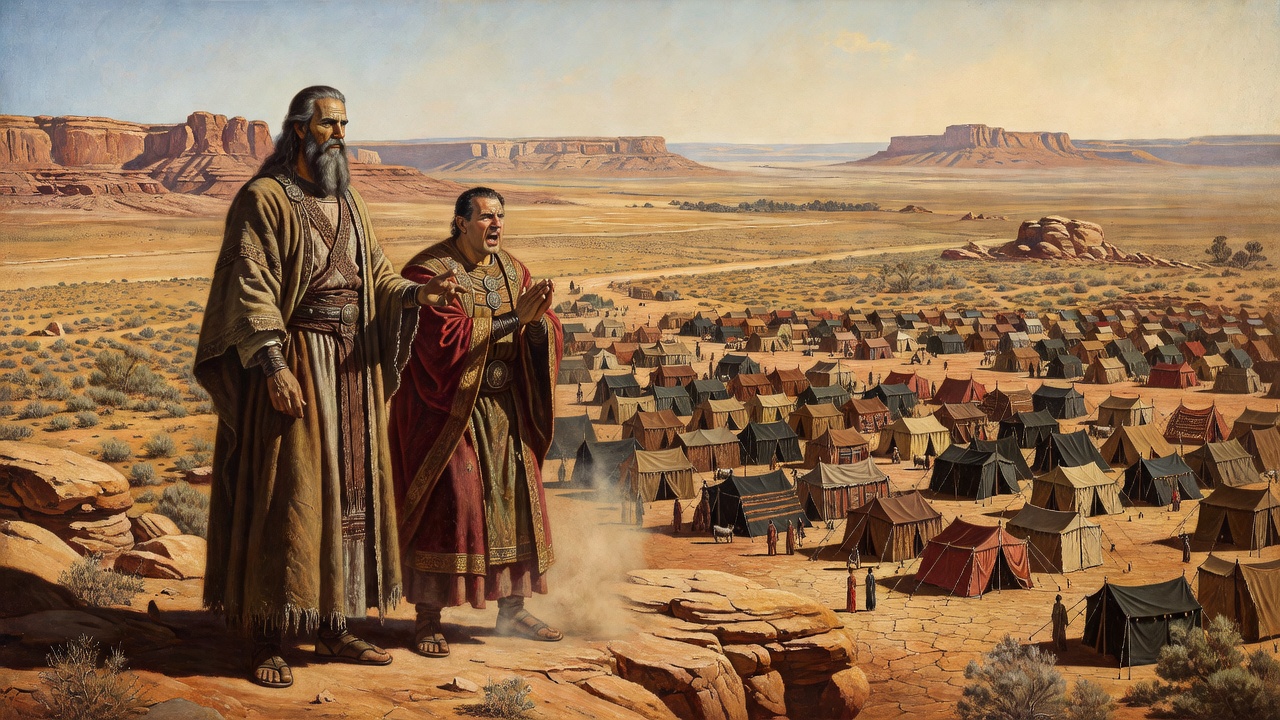
1And when Balaam saw that it pleased God to bless Israel, he did not go according to his custom to meet the omens, but turned his face towards the wilderness. 2And Balaam lifted up his eyes, and sees Israel encamped by their tribes; and the Spirit of God came upon him. 3And he took up his parable and said, Balaam son of Beor says, the man who sees truly says, 4he says who hears the oracle of the Mighty One, who saw a vision of God in sleep; his eyes were opened: 5How goodly are your habitations, Jacob, and your tents, Israel! 6as shady groves, and as gardens by a river, and as tents which God pitched, and as cedars by the waters. 7There shall come a man out of his seed, and he shall rule over many nations; and the kingdom of Gog shall be exalted, and his kingdom shall be increased. 8God led him out of Egypt; he has as it were the glory of a unicorn: he shall consume the nations of his enemies, and he shall drain their marrow, and with his darts he shall shoot through the enemy. 9He lay down, he rested as a lion, and as a young lion; who shall stir him up? they that bless you are blessed, and they that curse you are cursed.
Balak Dismisses Balaam
10And Balac was angry with Balaam, and clapped his hands together; and Balac said to Balaam, I called you to curse my enemy, and behold you have decidedly blessed him this third time. 11Now therefore flee to your place: I said, I will honour you, but now the Lord has deprived you of glory. 12And Balaam said to Balac, Did I not speak to your messengers also whom you sent to me, saying, 13If Balac should give me his house full of silver and gold, I shall not be able to transgress the word of the Lord to make it good or bad by myself; whatever things God shall say, them will I speak. 14And now, behold, I return to my place; come, I will advise you of what this people shall do to your people in the last days.
Balaam’s Fourth Oracle
15And he took up his parable and said, Balaam the son of Beor says, the man who sees truly says, 16hearing the oracles of God, receiving knowledge from the Most High, and having seen a vision of God in sleep; his eyes were opened. 17I will point to him, but not now; I bless him, but he draws not near: a star shall rise out of Jacob, a man shall spring out of Israel; and shall crush the princes of Moab, and shall spoil all the sons of Seth. 18And Edom shall be an inheritance, and Esau his enemy shall be an inheritance of Israel, and Israel wrought valiantly. 19And one shall arise out of Jacob, and destroy out of the city him that escapes.
Balaam’s Final Three Oracles
20And having seen Amalec, he took up his parable and said, Amalec is the first of the nations; yet his seed shall perish. 21And having seen the Kenite, he took up his parable and said, your dwelling-place is strong; yet though you should put your nest in a rock, 22and though Beor should have a skilfully contrived hiding-place, the Assyrians shall carry you away captive. 23And he looked upon Og, and took up his parable and said, Oh, oh, who shall live, when God shall do these things? 24And one shall come forth from the hands of the Citians, and shall afflict Assur, and shall afflict the Hebrews, and they shall perish together. 25And Balaam rose up and departed and returned to his place, and Balac went to his own home.
¿Sabías que…?
Los Últimos Oráculos de Balaam
- A diferencia de sus intentos anteriores, Balaam no recurrió a la adivinación antes de su tercer oráculo, sino que volvió su rostro hacia el desierto. Al ver a Israel acampado tribu por tribu, el Espíritu de Dios vino sobre él para pronunciar una bendición en lugar de una maldición.Fuentes: el propio texto bíblico · Balaam
- Los oráculos de Balaam mencionan a Agag y a Amalec, una tribu nómada que habitaba entre el mar Muerto y el mar Rojo, cuyos reyes llevaban el nombre de Agag. Aunque Amalec fue descrito como la primera de las naciones, Balaam predijo su destrucción final.Fuentes: el propio texto bíblico · Agag · Amalek
- En su profecía final, Balaam miró hacia el futuro distante, anunciando una estrella de Jacob y un cetro de Israel que aplastarían a Moab y tomarían posesión de Edom, la escarpada región montañosa también llamada Seir.Fuentes: el propio texto bíblico · Jacob (Israel) · Edom · Seir
Notas escritas con ayuda de IA a partir de fuentes abiertas (Theographic Bible Metadata, CC BY-SA 4.0; Easton’s Bible Dictionary, dominio público) y revisadas antes de publicarse.
Lugares de este capítulo
- Egypt · 30.129, 31.308 · versículo 8
- Moab · Hoy: Moab 1 · 31.181, 35.701 · versículo 17
- Edom · 30.746, 35.604 · versículo 18
- Amalek · 30.648, 34.422 · versículos 20, 24
- Asshur · Hoy: Assur · 35.457, 43.263 · versículos 22, 24
- Kittim · Hoy: Cyprus · 35.000, 33.000 · versículo 24
Solo aparecen lugares identificados con alta confianza (90 % o más según las fuentes académicas reunidas por OpenBible). Mapa de la época: DARE (Digital Atlas of the Roman Empire), CC BY 4.0; mapa actual: © colaboradores de OpenStreetMap; lugares: OpenBible.info (CC BY 4.0).
Créditos y licencia de esta traducción
LXX2012: Septuagint in British/International English 2012
The Septuagint with Apocrypha, translated from Greek to English by Sir Lancelot C. L. Brenton and published in 1885, with some language updates (British/International English)
Public Domain
Language: English
Dialect (if applicable): British
Language in English: English
Translation by: Sir Lancelot Charles Lee Breton
LXX2012: Septuagint in English 2012, British/International English Edition
This is a translation of the Old Testament and Apocrypha/Deuterocanon from Hebrew to Greek to 19th Century British English, with some updates of spelling and word usage to contemporary British/International English. The original English translation was done by Sir Lancelot Charles Lee Brenton and published by Samuel Bagster & Sons, Ltd., in London in 1851. It has entered the Public Domain due to the passage of sufficient time. In the process of scanning and typing the text, the original poetry and prose formatting, as well as peripheral material like introductions and notes, have been omitted.
This edition of the Septuagint has some language updates. Brenton's word order and punctuation has been mostly retained, meaning that quotation marks are not used, and sentences within quotes may not start with capital letters, as was standard usage in 1851. Names transliterated from Greek to those transliterated from Hebrew in the common English Bibles often differ. These language updates are dedicated to the Public Domain by the author of those edits, Michael Paul Johnson. Therefore this edition may be freely copied, published, etc.
Before considering making changes to the text of this work, I recommend that you consult with God, because this is really His Book.
If you find errors in the text, please report them so that we can correct them.
Donations to help with the expenses of operating this web site and thus help others have free access to the Word of God may be made to us, but are not required. Please see http://MLJohnson.org/partner/ for more about that.
Títulos de sección adaptados de la Berean Standard Bible (dominio público); no forman parte del texto bíblico de esta traducción.
Fuente: http://ebible.org/eng-uk-lxx2012/ · eBible.org