Nehemías 12
LXX2012: Septuagint in British/International English 2012 · Toca un versículo para ver sus referencias cruzadas.
The Priests and Levites Who Returned
1Now these are the priests and the Levites that went up with Zorobabel the son of Salathiel and Jesus: Saraia, Jeremia, Esdra, 2Amaria, Maluch, 3Sechenia. 7These were the chiefs of the priests, and their brethren in the days of Jesus. 8And the Levites were, Jesus, Banui, Cadmiel, Sarabia, Jodae, Matthania: he was over the bands, 9and his brethren were appointed to the daily courses. 10And Jesus begot Joakim, and Joakim begot Eliasib, and Eliasib begot Jodae, 11and Jodae begot Jonathan, and Jonathan begot Jadu. 12And in the days of Joakim, his brethren the priests and the heads of families were, belonging to Saraia, Amaria; to Jeremia, Anania; 13to Esdra, Mesulam; to Amaria, Joanan; 14to Amaluch, Jonathan; to Sechenia, Joseph; 15to Are, Mannas; to Marioth, Elcai; 16to Adadai, Zacharia; to Ganathoth, Mesolam; 17to Abia, Zechri; to Miamin, Maadai; to Pheleti, one; 18to Balgas, Samue; to Semia, Jonathan; 19to Joarib, Matthanai; to Edio, Ozi; 20to Salai, Callai; to Amec, Abed; 21to Elkia, Asabias; to Jedeiu, Nathanael. 22The Levites in the days of Eliasib, Joada, and Joa, and Joanan, and Idua, were recorded heads of families: also the priests, in the reign of Darius the Persian. 23And the sons of Levi, heads of families, were written in the book of the chronicles, even to the days of Joanan son of Elisue. 24And the heads of the Levites were Asabia, and Sarabia, and Jesu: and the sons of Cadmiel, and their brethren over against them, were to sing hymns of praise, according to the commandment of David the man of God, course by course. 25When I gathered the porters, 26it was in the days of Joakim son of Jesus, son of Josedec, and in the days of Neemia: and Esdras the priest was scribe.
The Dedication of the Wall
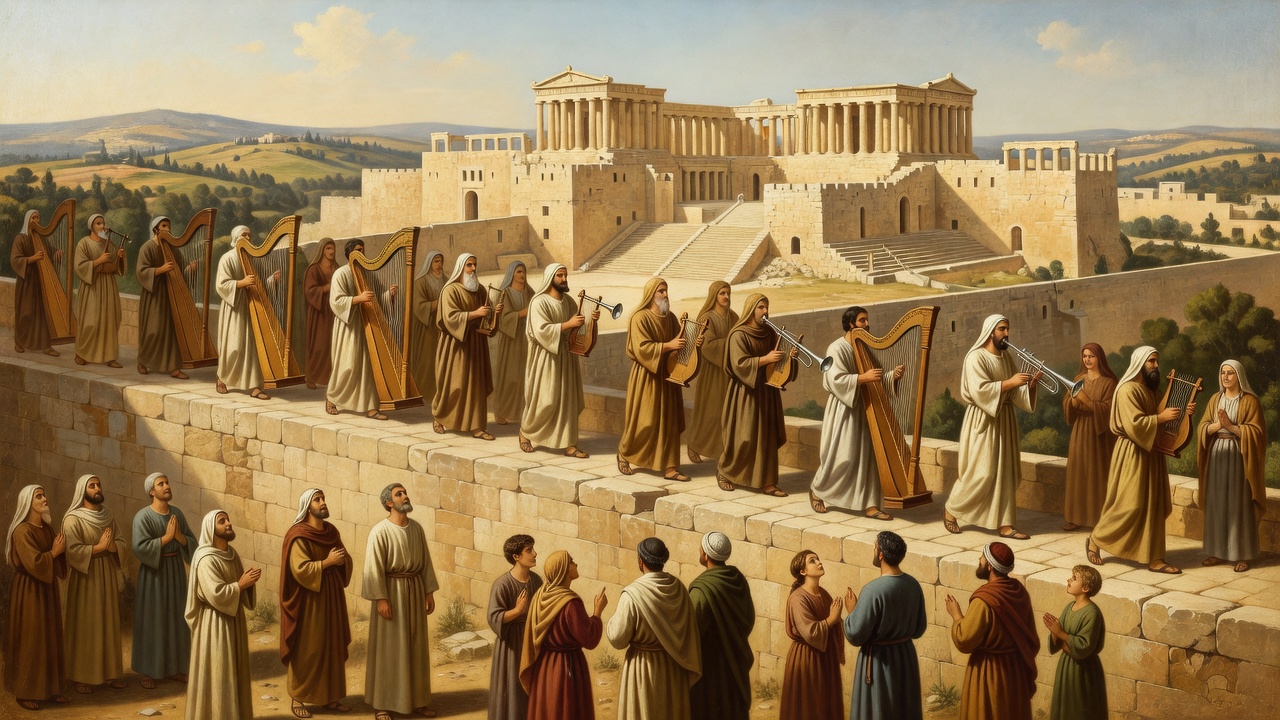
27And at the dedication of the wall of Jerusalem they sought the Levites in their places, to bring them to Jerusalem, to keep a feast of dedication and gladness with thanksgiving, and they sounded cymbals with songs, and had lutes and harps. 28And the sons of the singers were assembled both from the neighbourhood round about to Jerusalem, and from the villages, 29and from the country: for the singers built themselves villages by Jerusalem. 30And the priests and the Levites purified themselves, and they purified the people, and the porters, and the wall. 31And they brought up the princes of Juda on the wall, and they appointed two great companies for thanksgiving, and they passed on the right hand on the wall of the dung-gate. 32And after them went Osaia, and half the princes of Juda, 33and Azarias, and Esdras, and Mesollam, 34and Juda, and Benjamin, and Samaias and Jeremia. 35And some of the sons of the priest with trumpets, Zacharias son of Jonathan, son of Samaias, son of Matthania, son of Michaia, son of Zacchur, son of Asaph: 36and his brethren, Samaia, and Oziel, Gelol, Jama, Aia, Nathanael, and Juda, Anani, to praise with the hymns of David the man of God; and Esdras the scribe was before them, 37at the gate, to praise before them, and they went up by the steps of the city of David, in the ascent of the wall, above the house of David, even to the water-gate 39of Ephraim, and to the fish-gate, and by the tower of Anameel, and as far as the sheep-gate. 42And the singers were heard, and were numbered. 43And in that day they offered great sacrifices, and rejoiced; for God had made them very joyful: and their wives and their children rejoiced: and the joy in Jerusalem was heard from afar off.
Provisions for Temple Worship
44And in that day they appointed men over the treasuries, for the treasures, the first fruits, and the tithes, and for the chiefs of the cities who were assembled amongst them, to furnish portions for the priests and Levites: for there was joy in Juda over the priests and over the Levites that waited. 45And they kept the charges of their God, and the charges of the purification, and ordered the singers and the porters, according to the commandments of David and his son Solomon. 46For in the days of David Asaph was originally first of the singers, and they sang hymns and praise to God. 47And all Israel in the days of Zorobabel, and in the days of Neemias, gave the portions of the singers and the porters, a daily rate: and consecrated them to the Levites: and the Levites consecrated them to the sons of Aaron.
¿Sabías que…?
Dedicación de la muralla y registros sacerdotales
- Para la dedicación de la muralla reconstruida de Jerusalén, se reunió a los levitas y cantores de los poblados circundantes donde se habían establecido, como Bet-gilgal y los campos de Geba y Azmavet. La alabanza musical se organizó en coros alternados con instrumentos dispuestos según las normas del rey David.Fuentes: el propio texto bíblico · Beth-gilgal · Geba · Azmaveth
- La ceremonia de dedicación contó con dos grandes coros de acción de gracias que marchaban sobre lo alto de las murallas recién reparadas en direcciones opuestas. Una procesión fue encabezada por Esdras el escriba hacia la Puerta del Muladar, mientras Nehemías seguía al segundo grupo, hasta que ambos coros se encontraron en la casa de Dios.Fuentes: el propio texto bíblico · Dung Gate · Gate of the Fountain
- El capítulo conserva registros ancestrales de sacerdotes y levitas que abarcan desde el primer retorno bajo Zorobabel y el sumo sacerdote Jesúa a través de varias generaciones hasta el período persa. Estas listas documentaban la línea de los sumos sacerdotes y los jefes de familia encargados del servicio del templo y de la guardia de las puertas.Fuentes: el propio texto bíblico · Zerubbabel · Joshua · Eliashib
Notas escritas con ayuda de IA a partir de fuentes abiertas (Theographic Bible Metadata, CC BY-SA 4.0; Easton’s Bible Dictionary, dominio público) y revisadas antes de publicarse.
Lugares de este capítulo
- Jerusalem · 31.777, 35.234 · versículos 27, 28, 29, 43
- Dung Gate · Hoy: in Jerusalem · 31.777, 35.234 · versículo 31
- City of David · 31.774, 35.236 · versículo 37
- Fountain Gate · Hoy: in Jerusalem · 31.777, 35.234 · versículo 37
- Water Gate · Hoy: in Jerusalem · 31.777, 35.234 · versículo 37
- Broad Wall · 31.776, 35.232 · versículo 38
- Tower of the Ovens · Hoy: in Jerusalem · 31.777, 35.234 · versículo 38
- Ephraim Gate · Hoy: in Jerusalem · 31.777, 35.234 · versículo 39
- Fish Gate · Hoy: in Jerusalem · 31.777, 35.234 · versículo 39
- Gate of the Guard · Hoy: in Jerusalem · 31.777, 35.234 · versículo 39
- Gate of Yeshanah · Hoy: in Jerusalem · 31.777, 35.234 · versículo 39
- Sheep Gate · Hoy: in Jerusalem · 31.777, 35.234 · versículo 39
- Tower of Hananel · Hoy: Antonia Fortress · 31.780, 35.234 · versículo 39
- Tower of the Hundred · Hoy: within 500 m of the Antonia Fortress · 31.780, 35.234 · versículo 39
Solo aparecen lugares identificados con alta confianza (90 % o más según las fuentes académicas reunidas por OpenBible). Mapa de la época: DARE (Digital Atlas of the Roman Empire), CC BY 4.0; mapa actual: © colaboradores de OpenStreetMap; lugares: OpenBible.info (CC BY 4.0).
Créditos y licencia de esta traducción
LXX2012: Septuagint in British/International English 2012
The Septuagint with Apocrypha, translated from Greek to English by Sir Lancelot C. L. Brenton and published in 1885, with some language updates (British/International English)
Public Domain
Language: English
Dialect (if applicable): British
Language in English: English
Translation by: Sir Lancelot Charles Lee Breton
LXX2012: Septuagint in English 2012, British/International English Edition
This is a translation of the Old Testament and Apocrypha/Deuterocanon from Hebrew to Greek to 19th Century British English, with some updates of spelling and word usage to contemporary British/International English. The original English translation was done by Sir Lancelot Charles Lee Brenton and published by Samuel Bagster & Sons, Ltd., in London in 1851. It has entered the Public Domain due to the passage of sufficient time. In the process of scanning and typing the text, the original poetry and prose formatting, as well as peripheral material like introductions and notes, have been omitted.
This edition of the Septuagint has some language updates. Brenton's word order and punctuation has been mostly retained, meaning that quotation marks are not used, and sentences within quotes may not start with capital letters, as was standard usage in 1851. Names transliterated from Greek to those transliterated from Hebrew in the common English Bibles often differ. These language updates are dedicated to the Public Domain by the author of those edits, Michael Paul Johnson. Therefore this edition may be freely copied, published, etc.
Before considering making changes to the text of this work, I recommend that you consult with God, because this is really His Book.
If you find errors in the text, please report them so that we can correct them.
Donations to help with the expenses of operating this web site and thus help others have free access to the Word of God may be made to us, but are not required. Please see http://MLJohnson.org/partner/ for more about that.
Títulos de sección adaptados de la Berean Standard Bible (dominio público); no forman parte del texto bíblico de esta traducción.
Fuente: http://ebible.org/eng-uk-lxx2012/ · eBible.org