Levítico 3
LXX2012: Septuagint in British/International English 2012 · Toca un versículo para ver sus referencias cruzadas.
Laws for Peace Offerings
1And if his gift to the Lord be a peace-offering, if he should bring it of the oxen, whether it be male or whether it be female, he shall bring it unblemished before the Lord. 2And he shall lay his hands on the head of the gift, and shall kill it before the Lord, by the doors of the tabernacle of witness. And the priests the sons of Aaron shall pour the blood on the altar of burnt offerings round about. 3And they shall bring of the peace-offering a burnt sacrifice to the Lord, the fat covering the belly, and all the fat on the belly. 4And the two kidneys and the fat that is upon them; he shall take away that which is on the thighs, and the caul above the liver together with the kidneys. 5And the priests the sons of Aaron shall offer them on the altar on the burnt offering, on the wood which is on the fire upon the altar: it is a burnt offering, a smell of sweet savour to the Lord. 6And if his gift be of the sheep, a peace-offering to the Lord, male or female, he shall bring it unblemished. 7If he bring a lamb for his gift, he shall bring it before the Lord. 8And he shall lay his hands on the head of his offering, and shall kill it by the doors of the tabernacle of witness; and the priests the sons of Aaron shall pour out the blood on the altar round about. 9And he shall bring of the peace-offering a burnt sacrifice to the Lord: the fat and the hinder part unblemished he shall take away with the loins, and having taken away all the fat that covers the belly, and all the fat that is on the belly, 10and both the kidneys and the fat that is upon them, and that which is on the thighs, and the caul which is on the liver with the kidneys, 11the priest shall offer these on the altar: it is a sacrifice of sweet savour, a burnt offering to the Lord. 12And if his offering be of the goats, then shall he bring it before the Lord. 13And he shall lay his hands on its head; and they shall kill it before the Lord by the doors of the tabernacle of witness; and the priests the sons of Aaron shall pour out the blood on the altar round about. 14And he shall offer of it a burnt offering to the Lord, even the fat that covers the belly, and all the fat that is on the belly. 15And both the kidneys, and all the fat that is upon them, that which is upon the thighs, and the caul of the liver with the kidneys, shall he take away. 16And the priest shall offer it upon the altar: it is a burnt offering, a smell of sweet savour to the Lord. All the fat belongs to the Lord. 17It is a perpetual statute throughout your generations, in all your habitations; you⌃ shall eat no fat and no blood.
¿Sabías que…?
Leyes para la Ofrenda de Paz
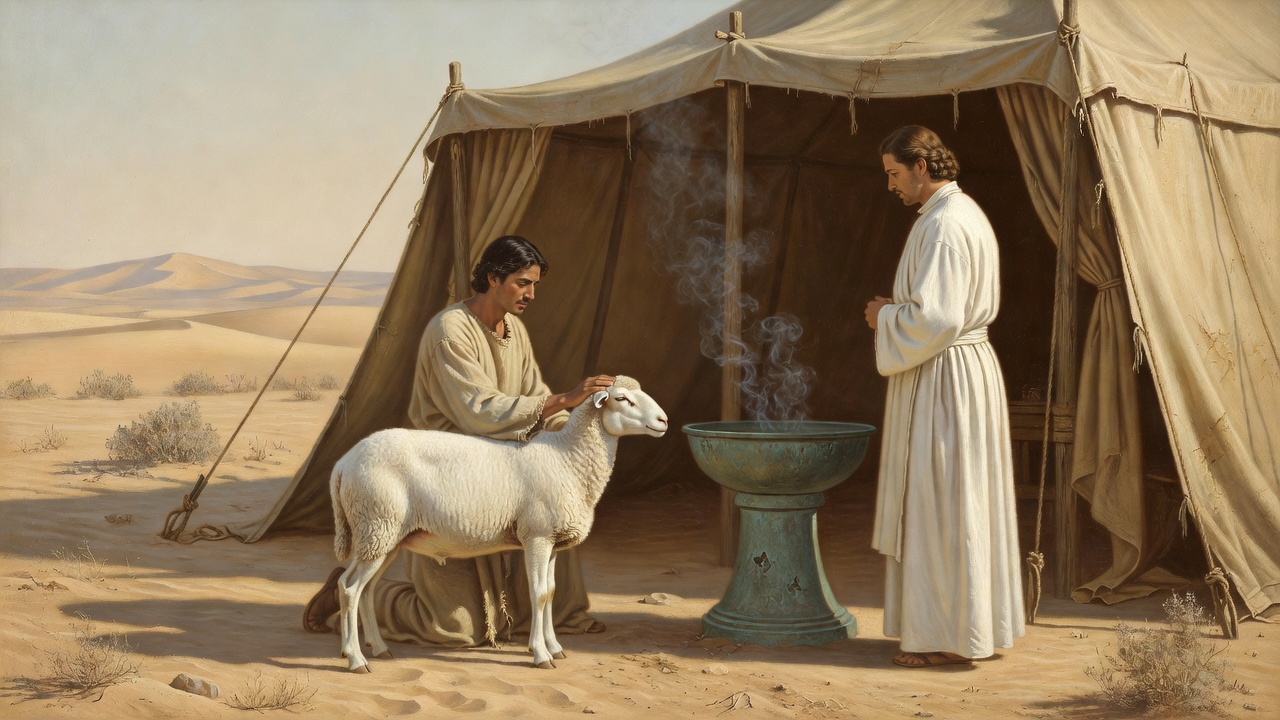
- La ofrenda de paz podía tomarse del ganado mayor o menor, incluidos vacunos, ovejas o cabras. A diferencia de otros sacrificios, el animal presentado podía ser macho o hembra, siempre y cuando no tuviera defecto.Fuentes: el propio texto bíblico
- El oferente participaba directamente en el rito al poner su mano sobre la cabeza del animal y degollarlo a la entrada de la Tienda de Reunión. Los hijos de Aarón, como sacerdotes, rociaban la sangre en derredor del altar y quemaban la grasa interna, los riñones y el lóbulo del hígado.Fuentes: el propio texto bíblico · Aaron
- Las instrucciones concluyen con un estatuto perpetuo para todas las generaciones: se prohibía rigurosamente a los israelitas comer cualquier grasa o sangre, declarando que toda la grasa pertenecía al Señor.Fuentes: el propio texto bíblico
Notas escritas con ayuda de IA a partir de fuentes abiertas (Theographic Bible Metadata, CC BY-SA 4.0; Easton’s Bible Dictionary, dominio público) y revisadas antes de publicarse.
Créditos y licencia de esta traducción
LXX2012: Septuagint in British/International English 2012
The Septuagint with Apocrypha, translated from Greek to English by Sir Lancelot C. L. Brenton and published in 1885, with some language updates (British/International English)
Public Domain
Language: English
Dialect (if applicable): British
Language in English: English
Translation by: Sir Lancelot Charles Lee Breton
LXX2012: Septuagint in English 2012, British/International English Edition
This is a translation of the Old Testament and Apocrypha/Deuterocanon from Hebrew to Greek to 19th Century British English, with some updates of spelling and word usage to contemporary British/International English. The original English translation was done by Sir Lancelot Charles Lee Brenton and published by Samuel Bagster & Sons, Ltd., in London in 1851. It has entered the Public Domain due to the passage of sufficient time. In the process of scanning and typing the text, the original poetry and prose formatting, as well as peripheral material like introductions and notes, have been omitted.
This edition of the Septuagint has some language updates. Brenton's word order and punctuation has been mostly retained, meaning that quotation marks are not used, and sentences within quotes may not start with capital letters, as was standard usage in 1851. Names transliterated from Greek to those transliterated from Hebrew in the common English Bibles often differ. These language updates are dedicated to the Public Domain by the author of those edits, Michael Paul Johnson. Therefore this edition may be freely copied, published, etc.
Before considering making changes to the text of this work, I recommend that you consult with God, because this is really His Book.
If you find errors in the text, please report them so that we can correct them.
Donations to help with the expenses of operating this web site and thus help others have free access to the Word of God may be made to us, but are not required. Please see http://MLJohnson.org/partner/ for more about that.
Títulos de sección adaptados de la Berean Standard Bible (dominio público); no forman parte del texto bíblico de esta traducción.
Fuente: http://ebible.org/eng-uk-lxx2012/ · eBible.org