Levítico 17
LXX2012: Septuagint in British/International English 2012 · Toca un versículo para ver sus referencias cruzadas.
The Place of Sacrifice
1And the Lord spoke to Moses, saying, 2Speak to Aaron and to his sons, and to all the children of Israel, and you shall say to them, This is the word which the Lord has commanded, saying, 3Every man of the children of Israel, or of the strangers dwelling amongst you, who shall kill a calf, or a sheep, or a goat in the camp, or who shall kill it out of the camp, 4and shall not bring it to the door of the tabernacle of witness, so as to sacrifice it for a whole burnt offering or peace-offering to the Lord to be acceptable for a sweet smelling savour: and whoever shall kill it without, and shall not bring it to the door of the tabernacle of witness, so as to offer it as a gift to the Lord before the tabernacle of the Lord; blood shall be imputed to that man, he has shed blood; that soul shall be cut off from his people. 5That the children of Israel may offer their sacrifices, all that they shall kill in the fields, and bring them to the Lord to the doors of the tabernacle of witness to the priest, and they shall sacrifice them as a peace-offering to the Lord. 6And the priest shall pour the blood on the altar round about before the Lord by the doors of the tabernacle of witness, and shall offer the fat for a sweet smelling savour to the Lord. 7And they shall no longer offer their sacrifices to vain gods after which they go a whoring; it shall be a perpetual statute to you for your generations. 8And you shall say to them, Whatever man of the children of Israel, or of the sons of the proselytes dwelling amongst you, shall offer a whole burnt offering or a sacrifice, 9and shall not bring it to the door of the tabernacle of witness to sacrifice it to the Lord, that man shall be destroyed from amongst his people.
Laws against Eating Blood
10And whatever man of the children of Israel, or of the strangers dwelling amongst you, shall eat any blood, I will even set my face against that soul that eats blood, and will destroy it from its people. 11For the life of flesh is its blood, and I have given it to you on the altar to make atonement for your souls; for its blood shall make atonement for the soul. 12Therefore I said to the children of Israel, No soul of you shall eat blood, and the stranger that abides amongst you shall not eat blood. 13And whatever man of the children of Israel, or of the strangers dwelling amongst you shall take any animal in hunting, beast, or bird, which is eaten, then shall he pour out the blood, and cover it in the dust. 14For the blood of all flesh is its life; and I said to the children of Israel, You⌃ shall not eat the blood of any flesh, for the life of all flesh is its blood: every one that eats it shall be destroyed. 15And every soul which eats that which has died of itself, or is taken of beasts, either amongst the natives or amongst the strangers, shall wash his garments, and bathe himself in water, and shall be unclean until evening: then shall he be clean. 16But if he do not wash his garments, and do not bathe his body in water, then shall he bear his iniquity.
¿Sabías que…?
El sacrificio de animales y la santidad de la sangre
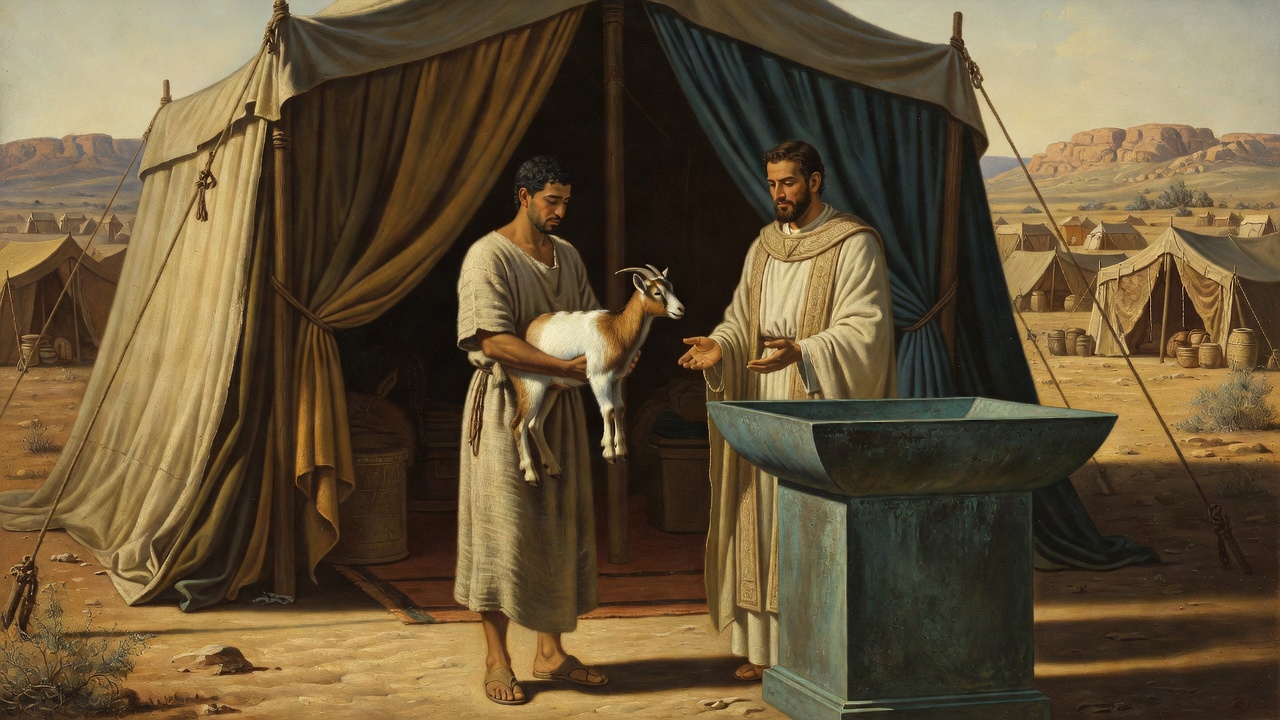
- Levítico ordena que los animales domésticos como bueyes, corderos y cabras sean llevados directamente a la entrada de la Tienda de Reunión en lugar de ser sacrificados en campo abierto. Esta regla aseguraba que los sacrificios se ofrecieran exclusivamente como ofrendas de paz al SEÑOR y ponía fin a los sacrificios ilícitos a demonios en forma de cabra.Fuentes: el propio texto bíblico
- Tanto a los israelitas nativos como a los extranjeros residentes se les prohibía estrictamente comer sangre, bajo pena de ser cortados de su pueblo. El texto fundamenta esta ley en el principio teológico de que la vida de la carne está en la sangre, la cual Dios dispuso específicamente para hacer expiación sobre el altar.Fuentes: el propio texto bíblico
- Al cazar animales salvajes o aves permitidas para el consumo, los israelitas y extranjeros debían drenar la sangre sobre el suelo y cubrirla con tierra. Esta instrucción reforzaba que la vida pertenece a Dios y preservaba la santidad de la sangre fuera del santuario sacrificial.Fuentes: el propio texto bíblico
Notas escritas con ayuda de IA a partir de fuentes abiertas (Theographic Bible Metadata, CC BY-SA 4.0; Easton’s Bible Dictionary, dominio público) y revisadas antes de publicarse.
Créditos y licencia de esta traducción
LXX2012: Septuagint in British/International English 2012
The Septuagint with Apocrypha, translated from Greek to English by Sir Lancelot C. L. Brenton and published in 1885, with some language updates (British/International English)
Public Domain
Language: English
Dialect (if applicable): British
Language in English: English
Translation by: Sir Lancelot Charles Lee Breton
LXX2012: Septuagint in English 2012, British/International English Edition
This is a translation of the Old Testament and Apocrypha/Deuterocanon from Hebrew to Greek to 19th Century British English, with some updates of spelling and word usage to contemporary British/International English. The original English translation was done by Sir Lancelot Charles Lee Brenton and published by Samuel Bagster & Sons, Ltd., in London in 1851. It has entered the Public Domain due to the passage of sufficient time. In the process of scanning and typing the text, the original poetry and prose formatting, as well as peripheral material like introductions and notes, have been omitted.
This edition of the Septuagint has some language updates. Brenton's word order and punctuation has been mostly retained, meaning that quotation marks are not used, and sentences within quotes may not start with capital letters, as was standard usage in 1851. Names transliterated from Greek to those transliterated from Hebrew in the common English Bibles often differ. These language updates are dedicated to the Public Domain by the author of those edits, Michael Paul Johnson. Therefore this edition may be freely copied, published, etc.
Before considering making changes to the text of this work, I recommend that you consult with God, because this is really His Book.
If you find errors in the text, please report them so that we can correct them.
Donations to help with the expenses of operating this web site and thus help others have free access to the Word of God may be made to us, but are not required. Please see http://MLJohnson.org/partner/ for more about that.
Títulos de sección adaptados de la Berean Standard Bible (dominio público); no forman parte del texto bíblico de esta traducción.
Fuente: http://ebible.org/eng-uk-lxx2012/ · eBible.org