Job 8
LXX2012: Septuagint in British/International English 2012 · Toca un versículo para ver sus referencias cruzadas.
Bildad: Job Should Repent
1Then Baldad the Sauchite answered, and said, 2How long will you speak these things, how long shall the breath of your mouth be abundant in words? 3Will the Lord be unjust when he judges; or will he that has made all things pervert justice? 4If your sons have sinned before him, he has cast them away because of their transgression. 5But be you early in prayer to the Lord Almighty. 6If you are pure and true, he will listen to your supplication, and will restore to you the habitation of righteousness. 7Though then your beginning should be small, yet your end should be unspeakably great. 8For ask of the former generation, and search diligently amongst the race of our fathers: 9(for we are of yesterday, and know nothing; for our life upon the earth is a shadow:) 10shall not these teach you, and report to you, and bring out words from their heart? 11Does the rush flourish without water, or shall the flag grow up without moisture? 12When it is yet on the root, and though it has not been cut down, does not any herb wither before it has received moisture? 13Thus then shall be the end of all that forget the Lord: for the hope of the ungodly shall perish. 14For his house shall be without inhabitants, and his tent shall prove a spider's web. 15If he should prop up his house, it shall not stand: and when he has taken hold of it, it shall not remain. 16For it is moist under the sun, and his branch shall come forth out of his dung-heap. 17He lies down upon a gathering of stones, and shall live in the mist of flints. 18If God should destroy him, his place shall deny him. Have you not seen such things, 19that such is the overthrow of the ungodly? and out of the earth another shall grow. 20For the Lord will by no means reject the harmless man; but he will not receive any gift of the ungodly. 21But he will fill with laughter the mouth of the sincere, and their lips with thanksgiving. 22But their adversaries shall clothe themselves with shame; and the habitation of the ungodly shall perish.
¿Sabías que…?
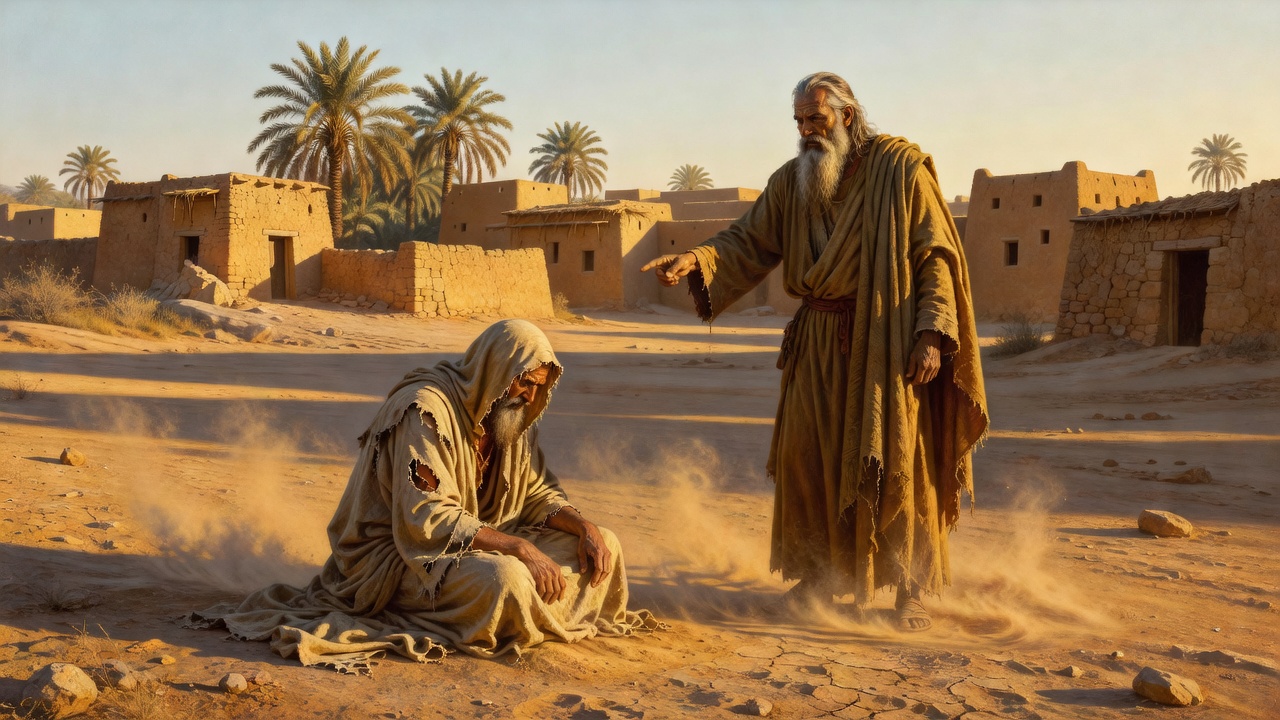
El llamado de Bildad a la sabiduría antigua
- Bildad es identificado como suhita, lo que probablemente lo vincula con Súa, una región árabe poblada por los descendientes de Abraham y Cetura. En este capítulo, pronuncia el primero de sus tres discursos severos a Job, afirmando que la justicia divina es absoluta e inalterable.Fuentes: Bildad · el propio texto bíblico
- En lugar de recurrir a su propia experiencia, Bildad apela al conocimiento acumulado de las generaciones pasadas, comparando los días humanos con una sombra pasajera. Para ilustrar la ruina del impío, utiliza metáforas de la naturaleza como juncos que se marchitan sin agua y la fragilidad de una telaraña.Fuentes: el propio texto bíblico
Notas escritas con ayuda de IA a partir de fuentes abiertas (Theographic Bible Metadata, CC BY-SA 4.0; Easton’s Bible Dictionary, dominio público) y revisadas antes de publicarse.
Créditos y licencia de esta traducción
LXX2012: Septuagint in British/International English 2012
The Septuagint with Apocrypha, translated from Greek to English by Sir Lancelot C. L. Brenton and published in 1885, with some language updates (British/International English)
Public Domain
Language: English
Dialect (if applicable): British
Language in English: English
Translation by: Sir Lancelot Charles Lee Breton
LXX2012: Septuagint in English 2012, British/International English Edition
This is a translation of the Old Testament and Apocrypha/Deuterocanon from Hebrew to Greek to 19th Century British English, with some updates of spelling and word usage to contemporary British/International English. The original English translation was done by Sir Lancelot Charles Lee Brenton and published by Samuel Bagster & Sons, Ltd., in London in 1851. It has entered the Public Domain due to the passage of sufficient time. In the process of scanning and typing the text, the original poetry and prose formatting, as well as peripheral material like introductions and notes, have been omitted.
This edition of the Septuagint has some language updates. Brenton's word order and punctuation has been mostly retained, meaning that quotation marks are not used, and sentences within quotes may not start with capital letters, as was standard usage in 1851. Names transliterated from Greek to those transliterated from Hebrew in the common English Bibles often differ. These language updates are dedicated to the Public Domain by the author of those edits, Michael Paul Johnson. Therefore this edition may be freely copied, published, etc.
Before considering making changes to the text of this work, I recommend that you consult with God, because this is really His Book.
If you find errors in the text, please report them so that we can correct them.
Donations to help with the expenses of operating this web site and thus help others have free access to the Word of God may be made to us, but are not required. Please see http://MLJohnson.org/partner/ for more about that.
Títulos de sección adaptados de la Berean Standard Bible (dominio público); no forman parte del texto bíblico de esta traducción.
Fuente: http://ebible.org/eng-uk-lxx2012/ · eBible.org