Job 37
LXX2012: Septuagint in British/International English 2012 · Toca un versículo para ver sus referencias cruzadas.
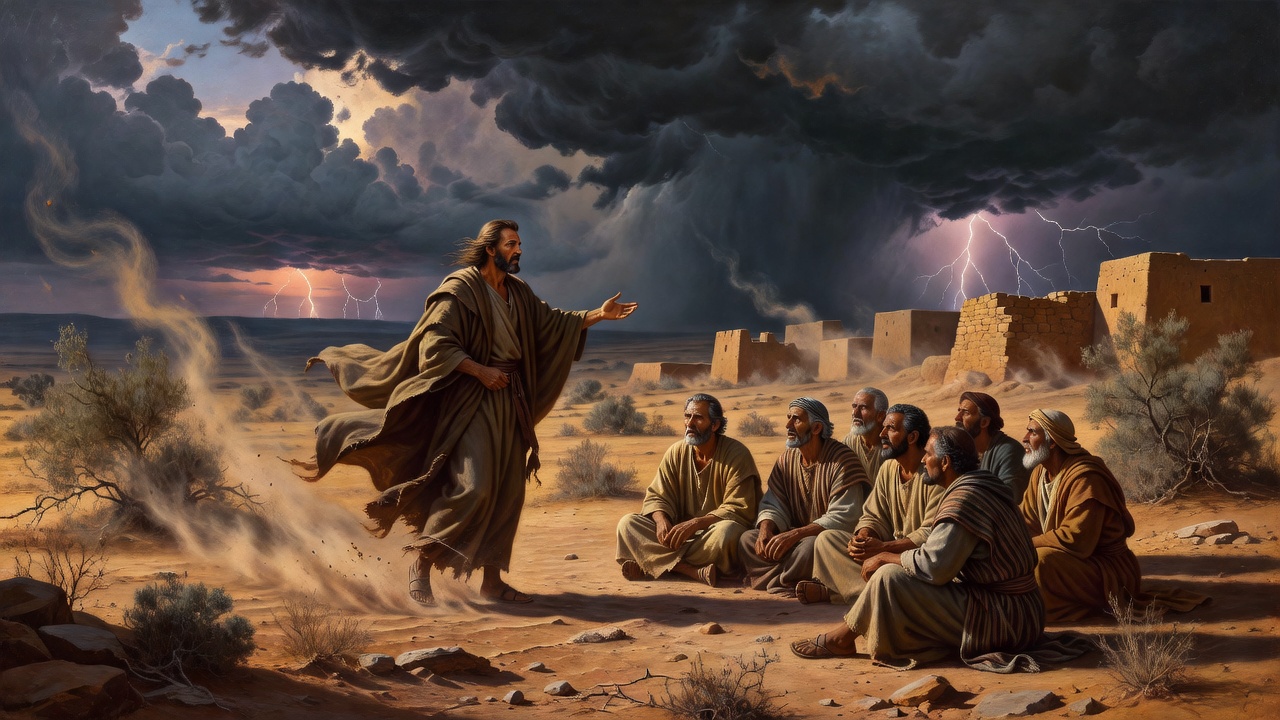
Elihu Proclaims God’s Majesty
1At this also my heart is troubled, and moved out of its place. 2Hear you a report by the anger of the Lord's wrath, and a discourse shall come out of his mouth. 3His dominion is under the whole heaven, and his light is at the extremities of the earth. 4After him shall be a cry with a loud voice; he shall thunder with the voice of his excellency, yet he shall not cause men to pass away, for one shall hear his voice. 5The Mighty One shall thunder wonderfully with his voice: for he has done great things which we knew not; 6commanding the snow, Be you upon the earth, and the stormy rain, and the storm of the showers of his might. 7He seals up the hand of every man, that every man may know his own weakness. 8And the wild beasts come in under the covert, and rest in their lair. 9Troubles come on out of the secret chambers, and cold from the mountain-tops. 10And from the breath of the Mighty One he will send frost; and he guides the water in whatever way he pleases. 11And if a cloud obscures what is precious to him, his light will disperse the cloud. 12And he will carry round the encircling clouds by his governance, to perform their works: whatever he shall command them, 13this has been appointed by him on the earth, whether for correction, or for his land, or if he shall find him an object for mercy. 14Listen to this, O Job: stand still, and be admonished of the power of the Lord. 15We know that god has disposed his works, having made light out of darkness. 16And he knows the divisions of the clouds, and the signal overthrows of the ungodly. 17But your robe is warm, and there is quiet upon the land. 18Will you establish with him foundations for the ancient heavens? they are strong as a molten mirror. 19Therefore teach me, what shall we say to him? and let us cease from saying much. 20Have I a book or a scribe my me, that I may stand and put man to silence? 21But the light is not visible to all: it shines afar off in the heavens, as that which is from him in the clouds. 22From the north come the clouds shining like gold: in these great are the glory and honour of the Almighty; 23and we do not find another his equal in strength: as for him that judges justly, do you not think that he listens? 24Therefore men shall fear him; and the wise also in heart shall fear him.
¿Sabías que…?
La Majestad de Dios en la Tormenta y los Cielos
- Eliú utiliza descripciones vívidas de los fenómenos meteorológicos —como relámpagos, truenos resonantes, nieve, hielo y los vientos del norte y del sur— para mostrar que la naturaleza opera bajo el mandato soberano de Dios.Fuentes: el propio texto bíblico
- La mención de Eliú de extender los cielos 'como un espejo de bronce' alude a la práctica antigua de fabricar espejos de metal fundido y pulido, mucho antes del uso del vidrio.Fuentes: el propio texto bíblico
Notas escritas con ayuda de IA a partir de fuentes abiertas (Theographic Bible Metadata, CC BY-SA 4.0; Easton’s Bible Dictionary, dominio público) y revisadas antes de publicarse.
Créditos y licencia de esta traducción
LXX2012: Septuagint in British/International English 2012
The Septuagint with Apocrypha, translated from Greek to English by Sir Lancelot C. L. Brenton and published in 1885, with some language updates (British/International English)
Public Domain
Language: English
Dialect (if applicable): British
Language in English: English
Translation by: Sir Lancelot Charles Lee Breton
LXX2012: Septuagint in English 2012, British/International English Edition
This is a translation of the Old Testament and Apocrypha/Deuterocanon from Hebrew to Greek to 19th Century British English, with some updates of spelling and word usage to contemporary British/International English. The original English translation was done by Sir Lancelot Charles Lee Brenton and published by Samuel Bagster & Sons, Ltd., in London in 1851. It has entered the Public Domain due to the passage of sufficient time. In the process of scanning and typing the text, the original poetry and prose formatting, as well as peripheral material like introductions and notes, have been omitted.
This edition of the Septuagint has some language updates. Brenton's word order and punctuation has been mostly retained, meaning that quotation marks are not used, and sentences within quotes may not start with capital letters, as was standard usage in 1851. Names transliterated from Greek to those transliterated from Hebrew in the common English Bibles often differ. These language updates are dedicated to the Public Domain by the author of those edits, Michael Paul Johnson. Therefore this edition may be freely copied, published, etc.
Before considering making changes to the text of this work, I recommend that you consult with God, because this is really His Book.
If you find errors in the text, please report them so that we can correct them.
Donations to help with the expenses of operating this web site and thus help others have free access to the Word of God may be made to us, but are not required. Please see http://MLJohnson.org/partner/ for more about that.
Títulos de sección adaptados de la Berean Standard Bible (dominio público); no forman parte del texto bíblico de esta traducción.
Fuente: http://ebible.org/eng-uk-lxx2012/ · eBible.org