Job 10
LXX2012: Septuagint in British/International English 2012 · Toca un versículo para ver sus referencias cruzadas.
Job’s Plea to God
1Weary in my soul, I will pour my words with groans upon him: I will speak being straitened in the bitterness of my soul. 2And I will say to the Lord, Do not teach me to be impious; and therefore have you thus judged me? 3Is it good before you if I be unrighteous? for you have disowned the work of your hands, and attended to the counsel of the ungodly. 4Or do you see as a mortal sees? or will you look as a man sees? 5Or is your life human, or your years the years of a man, 6that you have enquired into my iniquity, and searched out my sins? 7For you know that I have not committed iniquity: but who is he that can deliver out of your hands? 8Your hands have formed me and made me; afterwards you did change your mind, and strike me. 9Remember that you have made me as clay, and you do turn me again to earth. 10Have you not poured me out like milk, and curdled me like cheese? 11And you did clothe me with skin and flesh, and frame me with bones and sinews. 12And you did bestow upon me life and mercy, and your oversight has preserved my spirit. 13Having these things in yourself, I know that you can do all things; for nothing is impossible with you. 14And if I should sin, you watch me; and you have not cleared me from iniquity. 15Or if I should be ungodly, woe is me: and if I should be righteous, I can’t lift myself up, for I am full of dishonour. 16For I am hunted like a lion for slaughter; for again you have changed and are terribly destroying me; 17renewing against me my torture: and you have dealt with me in great anger, and you have brought trials upon me. 18Why then did you bring me out of the womb? and why did I not die, and no eye see me, 19and I become as if I had not been? for why was I not carried from the womb to the grave? 20Is not the time of my life short? suffer me to rest a little, 21before I go whence I shall not return, to a land of darkness and gloominess; 22to a land of perpetual darkness, where there is no light, neither can any one see the life of mortals.
¿Sabías que…?
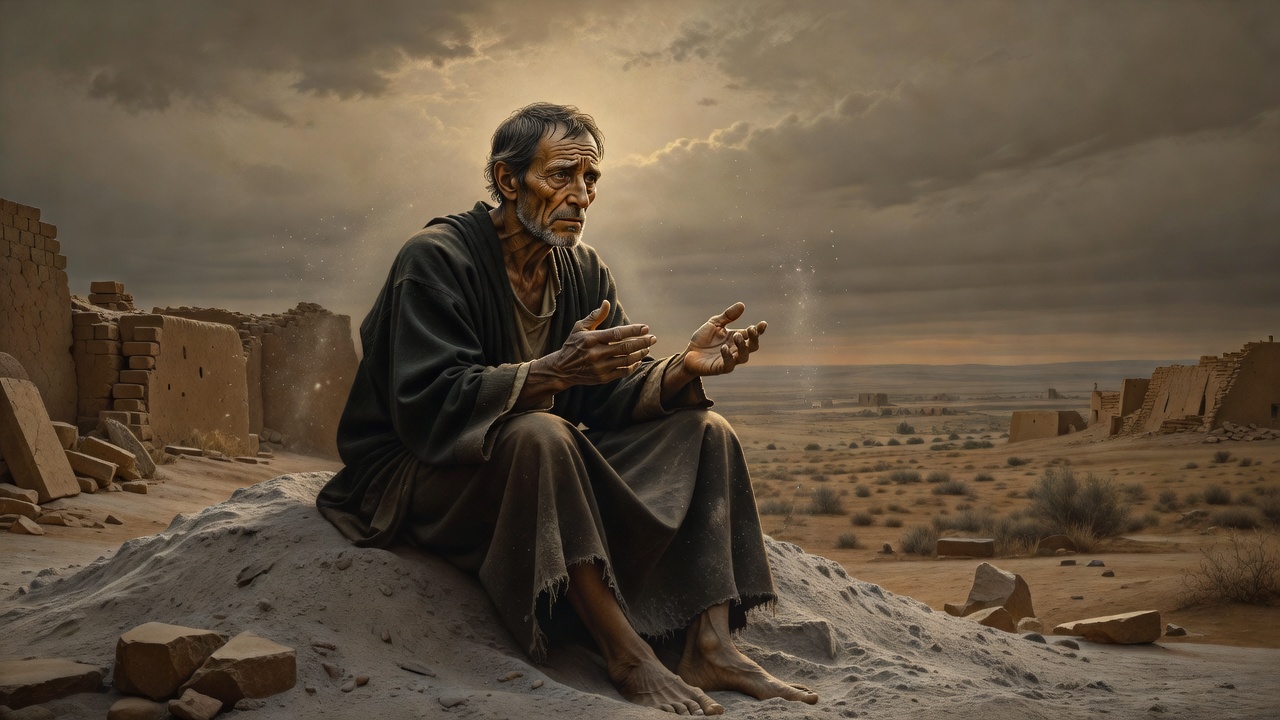
El clamor de Job sobre su creación y mortalidad
- En su clamor a Dios, Job recurre a imágenes domésticas antiguas como la elaboración del queso y la alfarería para describir la formación de la vida en el vientre, describiendo a Dios como quien moldea el barro, cuaja la leche y teje la carne y los huesos.Fuentes: el propio texto bíblico
- Job describe el reino de los muertos como una tierra de densa oscuridad, sombras y desorden, suplicando a Dios un breve respiro de consuelo antes de descender a un destino sin retorno.Fuentes: el propio texto bíblico
Notas escritas con ayuda de IA a partir de fuentes abiertas (Theographic Bible Metadata, CC BY-SA 4.0; Easton’s Bible Dictionary, dominio público) y revisadas antes de publicarse.
Créditos y licencia de esta traducción
LXX2012: Septuagint in British/International English 2012
The Septuagint with Apocrypha, translated from Greek to English by Sir Lancelot C. L. Brenton and published in 1885, with some language updates (British/International English)
Public Domain
Language: English
Dialect (if applicable): British
Language in English: English
Translation by: Sir Lancelot Charles Lee Breton
LXX2012: Septuagint in English 2012, British/International English Edition
This is a translation of the Old Testament and Apocrypha/Deuterocanon from Hebrew to Greek to 19th Century British English, with some updates of spelling and word usage to contemporary British/International English. The original English translation was done by Sir Lancelot Charles Lee Brenton and published by Samuel Bagster & Sons, Ltd., in London in 1851. It has entered the Public Domain due to the passage of sufficient time. In the process of scanning and typing the text, the original poetry and prose formatting, as well as peripheral material like introductions and notes, have been omitted.
This edition of the Septuagint has some language updates. Brenton's word order and punctuation has been mostly retained, meaning that quotation marks are not used, and sentences within quotes may not start with capital letters, as was standard usage in 1851. Names transliterated from Greek to those transliterated from Hebrew in the common English Bibles often differ. These language updates are dedicated to the Public Domain by the author of those edits, Michael Paul Johnson. Therefore this edition may be freely copied, published, etc.
Before considering making changes to the text of this work, I recommend that you consult with God, because this is really His Book.
If you find errors in the text, please report them so that we can correct them.
Donations to help with the expenses of operating this web site and thus help others have free access to the Word of God may be made to us, but are not required. Please see http://MLJohnson.org/partner/ for more about that.
Títulos de sección adaptados de la Berean Standard Bible (dominio público); no forman parte del texto bíblico de esta traducción.
Fuente: http://ebible.org/eng-uk-lxx2012/ · eBible.org