Jeremías 46
LXX2012: Septuagint in British/International English 2012 · Toca un versículo para ver sus referencias cruzadas.
Judgment on Egypt
1And it came to pass in the ninth month of Sedekias king of Juda, that Nabuchodonosor king of Babylon came, and all his host, against Jerusalem, and they besieged it. 2And in the eleventh year of Sedekiass, in the fourth month, on the ninth day of the month, the city was broken up. 3And all the leaders of the king of Babylon went in, and sat in the middle gate, Marganasar, and Samagoth, and Nabusachar, and Nabusaris, Nagargas, Naserrabamath, and the rest of the leaders of the king of Babylon, 14and they sent, and took Jeremias out of the court of the prison, and gave him in charge to Godolias the son of Achicam, the son of Saphan: and they brought him out, and he sat in the midst of the people. 15And the word of the Lord came to Jeremias in the court of the prison, saying, 16Go and say to Abdemelech the Ethiopian, Thus said the Lord God of Israel; Behold, I will bring my words upon this city for evil, and not for good. 17But I will save you in that day, and I will by no means deliver you into the hands of the men before whom you are afraid. 18For I will surely save you, and you shall by no means fall by the sword; and you shall find your life, because you did trust in me, says the Lord.
¿Sabías que…?
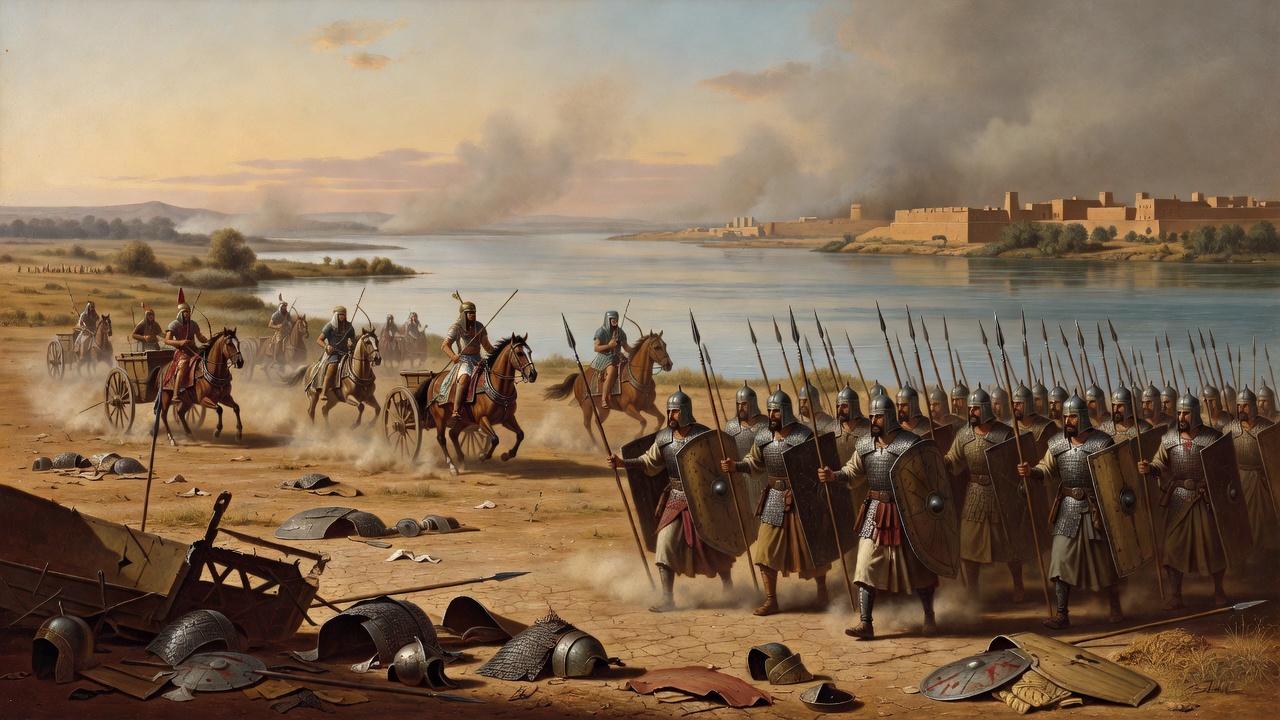
El juicio sobre Egipto y la Batalla de Carquemis
- Jeremías fecha esta profecía en el cuarto año del rey Joacim de Judá, cuando Nabucodonosor de Babilonia derrotó al faraón Necao de Egipto en Carquemis, junto al río Éufrates. Este enfrentamiento decisivo marcó un cambio trascendental de poder en la región, poniendo fin al dominio egipcio sobre las tierras vecinas.Fuentes: el propio texto bíblico · Carchemish · Jehoiakim
- El capítulo utiliza la crecida anual del río Nilo como imagen del orgulloso avance militar de Egipto sobre la tierra. También advierte a destacadas ciudades egipcias como Menfis (llamada Nof en hebreo), la antigua capital del Bajo Egipto, sobre la devastación y el exilio venideros.Fuentes: el propio texto bíblico · Nile · Memphis
- La profecía predice una invasión babilónica directa contra Egipto bajo el mando de Nabucodonosor. El juicio anunciado se dirigía no solo contra el faraón y sus tropas, sino también contra Amón, la deidad principal de Tebas, y los demás dioses de Egipto.Fuentes: el propio texto bíblico · Nebuchadnezzar
Notas escritas con ayuda de IA a partir de fuentes abiertas (Theographic Bible Metadata, CC BY-SA 4.0; Easton’s Bible Dictionary, dominio público) y revisadas antes de publicarse.
Lugares de este capítulo
- Babylon · 32.543, 44.422 · versículos 2, 13, 18, 26
- Egypt · 30.129, 31.308 · versículos 2, 8, 9, 11, 13, 14, 17, 18, 19, 20, 21, 22, 23, 24, 25, 26
- Euphrates · Hoy: Euphrates River · 31.004, 47.442 · versículos 2, 6, 10
- Nile · Hoy: Nile River · 31.465, 30.367 · versículos 7, 8
- Cush · Hoy: Cush 1 · 16.935, 33.751 · versículo 9
- Gilead · Hoy: Gilead 1 · 32.187, 35.692 · versículo 11
- Memphis · 29.849, 31.253 · versículos 14, 19
- Tahpanhes · Hoy: Tell Defenneh · 30.861, 32.171 · versículo 14
- Mount Carmel · 32.672, 35.023 · versículo 18
- Mount Tabor · Hoy: Jebel et Tur · 32.686, 35.393 · versículo 18
- Thebes · 25.721, 32.610 · versículo 25
Solo aparecen lugares identificados con alta confianza (90 % o más según las fuentes académicas reunidas por OpenBible). Mapa de la época: DARE (Digital Atlas of the Roman Empire), CC BY 4.0; mapa actual: © colaboradores de OpenStreetMap; lugares: OpenBible.info (CC BY 4.0).
Créditos y licencia de esta traducción
LXX2012: Septuagint in British/International English 2012
The Septuagint with Apocrypha, translated from Greek to English by Sir Lancelot C. L. Brenton and published in 1885, with some language updates (British/International English)
Public Domain
Language: English
Dialect (if applicable): British
Language in English: English
Translation by: Sir Lancelot Charles Lee Breton
LXX2012: Septuagint in English 2012, British/International English Edition
This is a translation of the Old Testament and Apocrypha/Deuterocanon from Hebrew to Greek to 19th Century British English, with some updates of spelling and word usage to contemporary British/International English. The original English translation was done by Sir Lancelot Charles Lee Brenton and published by Samuel Bagster & Sons, Ltd., in London in 1851. It has entered the Public Domain due to the passage of sufficient time. In the process of scanning and typing the text, the original poetry and prose formatting, as well as peripheral material like introductions and notes, have been omitted.
This edition of the Septuagint has some language updates. Brenton's word order and punctuation has been mostly retained, meaning that quotation marks are not used, and sentences within quotes may not start with capital letters, as was standard usage in 1851. Names transliterated from Greek to those transliterated from Hebrew in the common English Bibles often differ. These language updates are dedicated to the Public Domain by the author of those edits, Michael Paul Johnson. Therefore this edition may be freely copied, published, etc.
Before considering making changes to the text of this work, I recommend that you consult with God, because this is really His Book.
If you find errors in the text, please report them so that we can correct them.
Donations to help with the expenses of operating this web site and thus help others have free access to the Word of God may be made to us, but are not required. Please see http://MLJohnson.org/partner/ for more about that.
Títulos de sección adaptados de la Berean Standard Bible (dominio público); no forman parte del texto bíblico de esta traducción.
Fuente: http://ebible.org/eng-uk-lxx2012/ · eBible.org