Jueces 2
LXX2012: Septuagint in British/International English 2012 · Toca un versículo para ver sus referencias cruzadas.
Israel Rebuked at Bochim
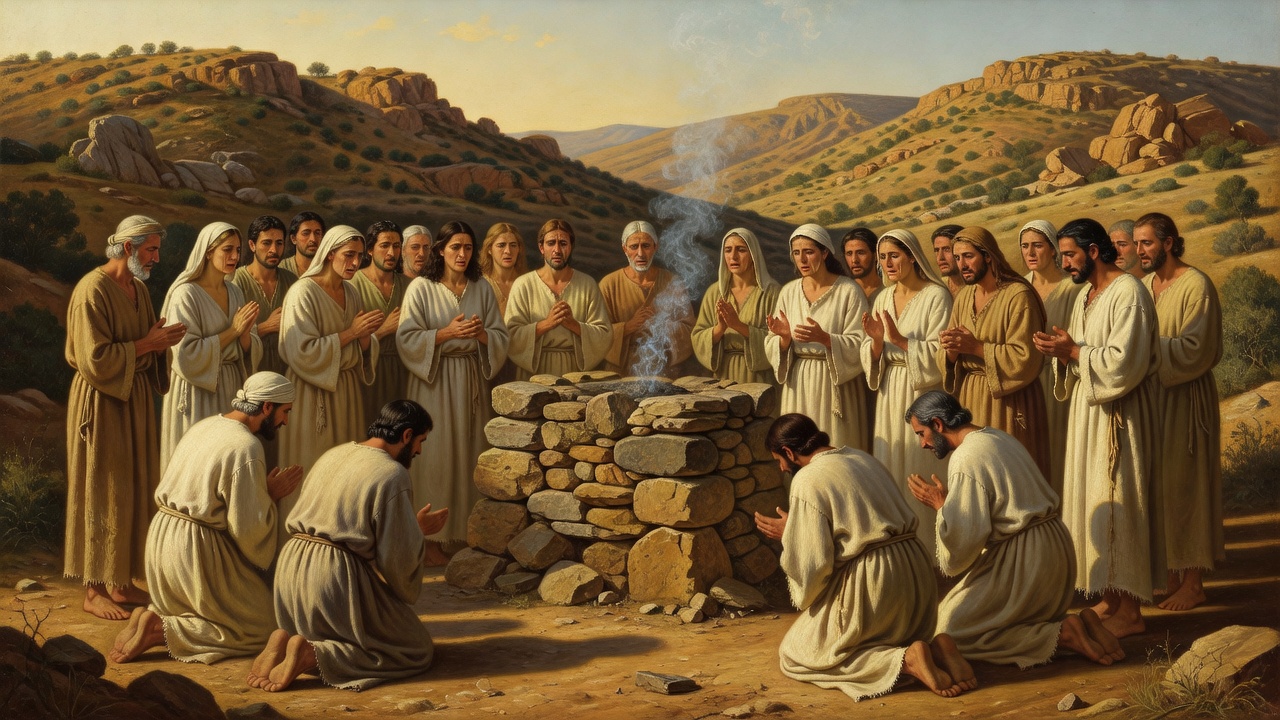
1And an angel of the Lord went up from Galgal to the place of weeping, and to Baethel, and to the house of Israel, and said to them, Thus says the Lord, I brought you up out of Egypt, and I brought you into the land which I swore to your fathers; and I said, I will never break my covenant that I have made with you. 2And you⌃ shall make no covenant with them that dwell in this land, neither shall you⌃ worship their gods; but you⌃ shall destroy their graven images, you⌃ shall pull down their altars: but you⌃ listened not to my voice, for you⌃ did these things. 3And I said, I will not drive them out from before you, but they shall be for a distress to you, and their gods shall be to you for an offence. 4And it came to pass when the angel of the Lord spoke these words to all the children of Israel, that the people lifted up their voice, and wept. 5And they named the name of that place Weepings; and they sacrificed there to the Lord.
Joshua’s Death and Burial
6And Joshua dismissed the people, and they went every man to his inheritance, to inherit the land. 7And the people served the Lord all the days of Joshua, and all the days of the elders that lived many days with Joshua, as many as knew all the great work of the Lord, what things he had wrought in Israel. 8And Joshua the son of Naue, the servant of the Lord, died, one hundred and ten years old. 9And they buried him in the border of his inheritance, in Thamnathares, in mount Ephraim, on the north of the mountain of Gaas.
Israel’s Unfaithfulness
10And all that generation were laid to their fathers: and another generation rose up after them, who knew not the Lord, nor yet the work which he wrought in Israel. 11And the children of Israel wrought evil before the Lord, and served Baalim. 12And they forsook the Lord God of their fathers, who brought them out of the land of Egypt, and walked after other gods, of the gods of the nations round about them; and they worshipped them. 13And they provoked the Lord, and forsook him, and served Baal and the Astartes. 14And the Lord was very angry with Israel; and he gave them into the hands of the spoilers, and they spoiled them; and he sold them into the hands of their enemies round about, and they could not any longer resist their enemies, 15amongst whoever they went; and the hand of the Lord was against them for evil, as the Lord spoke, and as the Lord swore to them; and he greatly afflicted them.
Judges Raised Up
16And the Lord raised up judges, and the Lord save them out of the hands of them that spoiled them: and yet they listened not to the judges, 17for they went a whoring after other gods, and worshipped them; and they turned quickly out of the way in which their fathers walked to listen to the words of the Lord; they did not so. 18And because the Lord raised them up judges, so the Lord was with the judge, and saved them out of the hand of their enemies all the days of the judge; for the Lord was moved at their groaning by reason of them that besieged them and afflicted them. 19And it came to pass when the judge died, that they went back, and again corrupted themselves worse than their fathers to go after other gods to serve them and to worship them: they abandoned not their devices nor their stubborn ways. 20And the Lord was very angry with Israel, and said, Forasmuch as this nation has forsaken my covenant which I commanded their fathers, and has not listened to my voice, 21therefore I will not any more cast out a man of the nations before their face, which Joshua the son of Naue left in the land. And the Lord left them, 22to prove Israel with them, whether they would keep the way of the Lord, to walk in it, as their fathers kept it, or no. 23So the Lord will leave these nations, so as not to cast them out suddenly; and he delivered them not into the hand of Joshua.
¿Sabías que…?
El ciclo de desobediencia de Israel y los jueces
- El nombre Boquim significa "los que lloran". El lugar, probablemente situado entre Gilgal y Silo, recibió este nombre después de que los israelitas lloraron en voz alta cuando el ángel del Señor los reprendió por pactar con los habitantes de la tierra.Fuentes: Bochim · el propio texto bíblico
- Josué fue sepultado en Timnat-serah (o Timnat-heres, "porción del sol"), al norte del monte Gaas, en la región montañosa de Efraín. Había liderado a los israelitas tras la muerte de Moisés y murió a la edad de 110 años.Fuentes: Timnath-heres · Gaash · Joshua · el propio texto bíblico
- El término baales es la forma plural que alude a las diversas manifestaciones locales de Baal, la principal deidad masculina de los fenicios. Jueces 2 establece el ciclo recurrente del libro: Israel abandona al Señor por dioses ajenos, cae ante sus enemigos y es librado cuando Dios levanta un juez.Fuentes: Baal · el propio texto bíblico
Notas escritas con ayuda de IA a partir de fuentes abiertas (Theographic Bible Metadata, CC BY-SA 4.0; Easton’s Bible Dictionary, dominio público) y revisadas antes de publicarse.
Lugares de este capítulo
Solo aparecen lugares identificados con alta confianza (90 % o más según las fuentes académicas reunidas por OpenBible). Mapa de la época: DARE (Digital Atlas of the Roman Empire), CC BY 4.0; mapa actual: © colaboradores de OpenStreetMap; lugares: OpenBible.info (CC BY 4.0).
Créditos y licencia de esta traducción
LXX2012: Septuagint in British/International English 2012
The Septuagint with Apocrypha, translated from Greek to English by Sir Lancelot C. L. Brenton and published in 1885, with some language updates (British/International English)
Public Domain
Language: English
Dialect (if applicable): British
Language in English: English
Translation by: Sir Lancelot Charles Lee Breton
LXX2012: Septuagint in English 2012, British/International English Edition
This is a translation of the Old Testament and Apocrypha/Deuterocanon from Hebrew to Greek to 19th Century British English, with some updates of spelling and word usage to contemporary British/International English. The original English translation was done by Sir Lancelot Charles Lee Brenton and published by Samuel Bagster & Sons, Ltd., in London in 1851. It has entered the Public Domain due to the passage of sufficient time. In the process of scanning and typing the text, the original poetry and prose formatting, as well as peripheral material like introductions and notes, have been omitted.
This edition of the Septuagint has some language updates. Brenton's word order and punctuation has been mostly retained, meaning that quotation marks are not used, and sentences within quotes may not start with capital letters, as was standard usage in 1851. Names transliterated from Greek to those transliterated from Hebrew in the common English Bibles often differ. These language updates are dedicated to the Public Domain by the author of those edits, Michael Paul Johnson. Therefore this edition may be freely copied, published, etc.
Before considering making changes to the text of this work, I recommend that you consult with God, because this is really His Book.
If you find errors in the text, please report them so that we can correct them.
Donations to help with the expenses of operating this web site and thus help others have free access to the Word of God may be made to us, but are not required. Please see http://MLJohnson.org/partner/ for more about that.
Títulos de sección adaptados de la Berean Standard Bible (dominio público); no forman parte del texto bíblico de esta traducción.
Fuente: http://ebible.org/eng-uk-lxx2012/ · eBible.org