Isaías 35
LXX2012: Septuagint in British/International English 2012 · Toca un versículo para ver sus referencias cruzadas.
The Glory of Zion
1Be glad, you thirsty desert: let the wilderness exult, and flower as the lily. 2And the desert places of Jordan shall blossom and rejoice; the glory of Libanus has been given to it, and the honour of Carmel; and my people shall see the glory of the Lord, and the majesty of God. 3Be strong, you⌃ relaxed hands and palsied knees. 4Comfort one another, you⌃ faint-hearted; be strong, fear not; behold, our God renders judgement, and he will render it; he will come and save us. 5Then shall the eyes of the blind be opened, and the ears of the deaf shall hear. 6Then shall the lame man leap as an hart, and the tongue of the stammerers shall speak plainly; for water has burst forth in the desert, and a channel of water in a thirsty land. 7And the dry land shall become pools, and a fountain of water shall be poured into the thirsty land; there shall there be a joy of birds, ready habitations and marshes. 8There shall be there a pure way, and it shall be called a holy way; and there shall not pass by there any unclean person, neither shall there be there an unclean way; but the dispersed shall walk on it, and they shall not go astray. 9And there shall be no lion there, neither shall any evil beast go up upon it, nor at all be found there; but the redeemed and gathered on the Lord's behalf, shall walk in it, 10and shall return, and come to Sion with joy, and everlasting joy shall be over their head; for on their head shall be praise and exultation, and joy shall take possession of them: sorrow and pain, and groaning have fled away.
¿Sabías que…?
La transformación del desierto y el Camino de Santidad
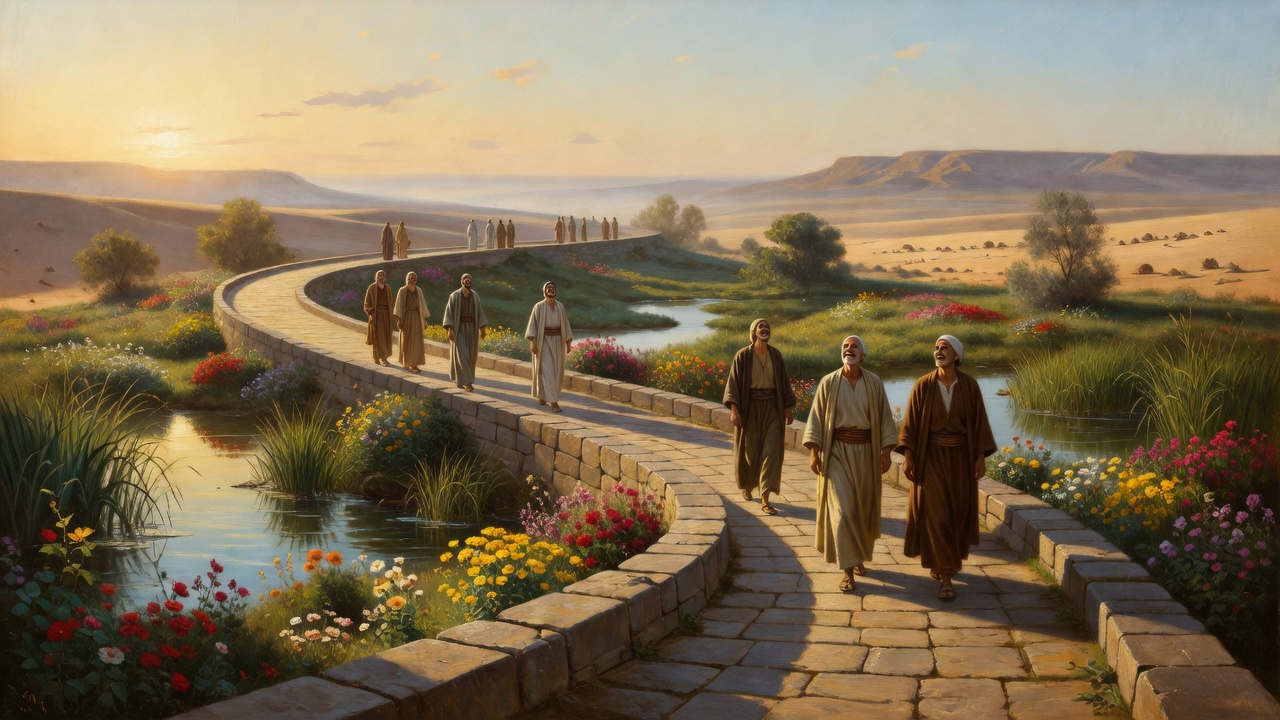
- La poesía profética de este capítulo contrasta el desierto árido con regiones célebres en el antiguo Levante por su exuberante vegetación y grandeza: las altas y boscosas montañas del Líbano y la fértil llanura costera de Sarón. La profecía contempla al desierto floreciendo con el esplendor y la fertilidad tradicionalmente asociados a estos paisajes prósperos.Fuentes: Lebanon · Saron · el propio texto bíblico
- El capítulo culmina con la imagen de los redimidos avanzando por una calzada llamada el Camino de Santidad hacia el monte Sion, la colina fortificada del sureste de Jerusalén donde el rey David estableció su ciudadela. Este camino se presenta libre de fieras peligrosas, permitiendo a los viajeros regresar con cánticos y gozo.Fuentes: Zion · el propio texto bíblico
Notas escritas con ayuda de IA a partir de fuentes abiertas (Theographic Bible Metadata, CC BY-SA 4.0; Easton’s Bible Dictionary, dominio público) y revisadas antes de publicarse.
Lugares de este capítulo
- Lebanon · 33.540, 35.584 · versículo 2
- Mount Carmel · 32.672, 35.023 · versículo 2
- Sharon · Hoy: Sharon Plain · 32.400, 34.883 · versículo 2
- Way of Holiness · Hoy: within 10 km of Jerusalem · 31.777, 35.234 · versículo 8
- Zion · Hoy: Jerusalem · 31.777, 35.234 · versículo 10
Solo aparecen lugares identificados con alta confianza (90 % o más según las fuentes académicas reunidas por OpenBible). Mapa de la época: DARE (Digital Atlas of the Roman Empire), CC BY 4.0; mapa actual: © colaboradores de OpenStreetMap; lugares: OpenBible.info (CC BY 4.0).
Créditos y licencia de esta traducción
LXX2012: Septuagint in British/International English 2012
The Septuagint with Apocrypha, translated from Greek to English by Sir Lancelot C. L. Brenton and published in 1885, with some language updates (British/International English)
Public Domain
Language: English
Dialect (if applicable): British
Language in English: English
Translation by: Sir Lancelot Charles Lee Breton
LXX2012: Septuagint in English 2012, British/International English Edition
This is a translation of the Old Testament and Apocrypha/Deuterocanon from Hebrew to Greek to 19th Century British English, with some updates of spelling and word usage to contemporary British/International English. The original English translation was done by Sir Lancelot Charles Lee Brenton and published by Samuel Bagster & Sons, Ltd., in London in 1851. It has entered the Public Domain due to the passage of sufficient time. In the process of scanning and typing the text, the original poetry and prose formatting, as well as peripheral material like introductions and notes, have been omitted.
This edition of the Septuagint has some language updates. Brenton's word order and punctuation has been mostly retained, meaning that quotation marks are not used, and sentences within quotes may not start with capital letters, as was standard usage in 1851. Names transliterated from Greek to those transliterated from Hebrew in the common English Bibles often differ. These language updates are dedicated to the Public Domain by the author of those edits, Michael Paul Johnson. Therefore this edition may be freely copied, published, etc.
Before considering making changes to the text of this work, I recommend that you consult with God, because this is really His Book.
If you find errors in the text, please report them so that we can correct them.
Donations to help with the expenses of operating this web site and thus help others have free access to the Word of God may be made to us, but are not required. Please see http://MLJohnson.org/partner/ for more about that.
Títulos de sección adaptados de la Berean Standard Bible (dominio público); no forman parte del texto bíblico de esta traducción.
Fuente: http://ebible.org/eng-uk-lxx2012/ · eBible.org