Isaías 13
LXX2012: Septuagint in British/International English 2012 · Toca un versículo para ver sus referencias cruzadas.
The Burden against Babylon
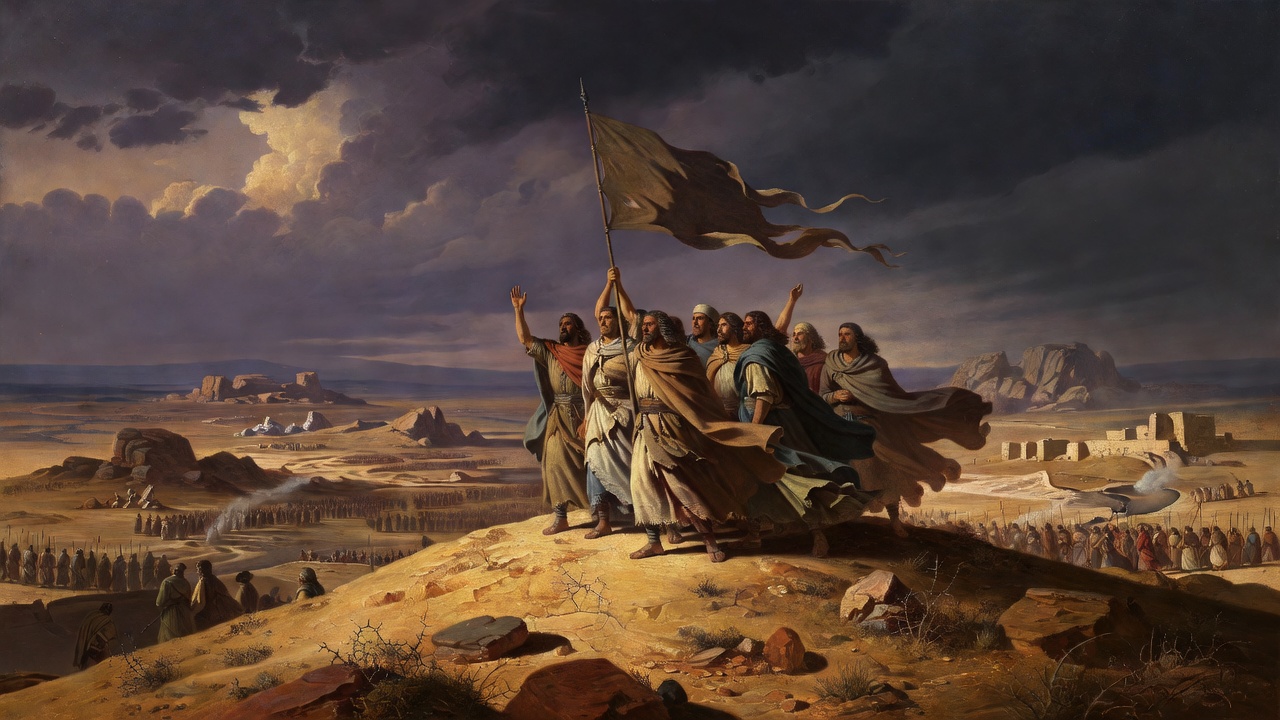
1THE VISION WHICH ESAIAS SON OF AMOS SAW AGAINST BABYLON. 2Lift up a standard on the mountain of the plain, exalt the voice to them, beckon with the hand, open the gates, you⌃ rulers. 3I give command, and I bring them: giants are coming to fulfil my wrath, rejoicing at the same time and insulting. 4A voice of many nations on the mountains, even like to that of many nations; a voice of kings and nations gathered together: the Lord of hosts has given command to a warlike nation, 5to come from a land afar off, from the utmost foundation of heaven; the Lord and his warriors are coming to destroy all the world. 6Howl you⌃, for the day of the Lord is near, and destruction from God shall arrive. 7Therefore every hand shall become powerless, and every soul of man shall be dismayed. 8The elders shall be troubled, and pangs shall seize them, as of a woman in travail: and they shall mourn one to another, and shall be amazed, and shall change their countenance as a flame. 9For behold! the day of the Lord is coming which can’t be escaped, a day of wrath and anger, to make the world desolate, and to destroy sinners out of it. 10For the stars of heaven, and Orion, and all the host of heaven, shall not give their light; and it shall be dark at sunrise, and the moon shall not give her light. 11And I will command evils for the whole world, and will visit their sins on the ungodly: and I will destroy the pride of transgressors, and will bring low the pride of the haughty. 12And they that are left shall be more precious than gold tried in the fire; and a man shall be more precious than the stone that is in Suphir. 13For the heaven shall be enraged, and the earth shall be shaken from her foundation, because of the fierce anger of the Lord of hosts, in the day in which his wrath shall come on. 14And they that are left shall be as a fleeing fawn, and as a stray sheep, and there shall be none to gather them: so that a man shall turn back to his people, and a man shall flee to his own land. 15For whoever shall be taken shall be overcome; and they that are gathered together shall fall by the sword. 16And they shall dash their children before their eyes; and they shall spoil their houses, and shall take their wives. 17Behold, I will stir up against you the Medes, who do not regard silver, neither have they need of gold. 18They shall break the bows of the young men; and they shall have no mercy on your children; nor shall their eyes spare your children. 19And Babylon, which is called glorious by the king of the Chaldeans, shall be as when God overthrew Sodoma, and Gomorrha. 20It shall never be inhabited, neither shall any enter into it for many generations: neither shall the Arabians pass through it; nor shall shepherds at all rest in it. 21But wild beasts shall rest there; and the houses shall be filled with howling; and monsters shall rest there, and devils shall dance there, and satyrs shall dwell there; and hedgehogs shall make their nests in their houses. It will come soon, and will not wait.
¿Sabías que…?
El juicio contra Babilonia
- Isaías, hijo de Amoz, proclama un oráculo de juicio inminente contra Babilonia, anunciando que los medos se levantarían contra ella. La desolación total de la ciudad imperial se compara con la antigua y proverbial destrucción de Sodoma y Gomorra.Fuentes: el propio texto bíblico · Isaiah · Sodom · Gomorrah
- La profecía describe a los sobrevivientes volviéndose más escasos que el oro puro de Ofir. Ofir era célebre en todo el antiguo Cercano Oriente por su rico oro, y diversas tradiciones y comentaristas la han ubicado en Arabia, la India u otras regiones comerciales lejanas.Fuentes: el propio texto bíblico · Ophir
- Situada sobre el río Éufrates, Babilonia era celebrada como joya de los reinos y el orgullo de los caldeos. Isaías retrata su futura desolación como total, prediciendo que sus lujosos palacios y fortalezas serían habitados únicamente por chacales, hienas y criaturas salvajes del desierto.Fuentes: el propio texto bíblico · Babylon
Notas escritas con ayuda de IA a partir de fuentes abiertas (Theographic Bible Metadata, CC BY-SA 4.0; Easton’s Bible Dictionary, dominio público) y revisadas antes de publicarse.
Lugares de este capítulo
- Babylon · 32.543, 44.422 · versículos 1, 2, 14, 17, 19, 20, 22
- Chaldea · 30.962, 46.104 · versículo 19
Solo aparecen lugares identificados con alta confianza (90 % o más según las fuentes académicas reunidas por OpenBible). Mapa de la época: DARE (Digital Atlas of the Roman Empire), CC BY 4.0; mapa actual: © colaboradores de OpenStreetMap; lugares: OpenBible.info (CC BY 4.0).
Créditos y licencia de esta traducción
LXX2012: Septuagint in British/International English 2012
The Septuagint with Apocrypha, translated from Greek to English by Sir Lancelot C. L. Brenton and published in 1885, with some language updates (British/International English)
Public Domain
Language: English
Dialect (if applicable): British
Language in English: English
Translation by: Sir Lancelot Charles Lee Breton
LXX2012: Septuagint in English 2012, British/International English Edition
This is a translation of the Old Testament and Apocrypha/Deuterocanon from Hebrew to Greek to 19th Century British English, with some updates of spelling and word usage to contemporary British/International English. The original English translation was done by Sir Lancelot Charles Lee Brenton and published by Samuel Bagster & Sons, Ltd., in London in 1851. It has entered the Public Domain due to the passage of sufficient time. In the process of scanning and typing the text, the original poetry and prose formatting, as well as peripheral material like introductions and notes, have been omitted.
This edition of the Septuagint has some language updates. Brenton's word order and punctuation has been mostly retained, meaning that quotation marks are not used, and sentences within quotes may not start with capital letters, as was standard usage in 1851. Names transliterated from Greek to those transliterated from Hebrew in the common English Bibles often differ. These language updates are dedicated to the Public Domain by the author of those edits, Michael Paul Johnson. Therefore this edition may be freely copied, published, etc.
Before considering making changes to the text of this work, I recommend that you consult with God, because this is really His Book.
If you find errors in the text, please report them so that we can correct them.
Donations to help with the expenses of operating this web site and thus help others have free access to the Word of God may be made to us, but are not required. Please see http://MLJohnson.org/partner/ for more about that.
Títulos de sección adaptados de la Berean Standard Bible (dominio público); no forman parte del texto bíblico de esta traducción.
Fuente: http://ebible.org/eng-uk-lxx2012/ · eBible.org