Génesis 23
LXX2012: Septuagint in British/International English 2012 · Toca un versículo para ver sus referencias cruzadas.
The Death and Burial of Sarah
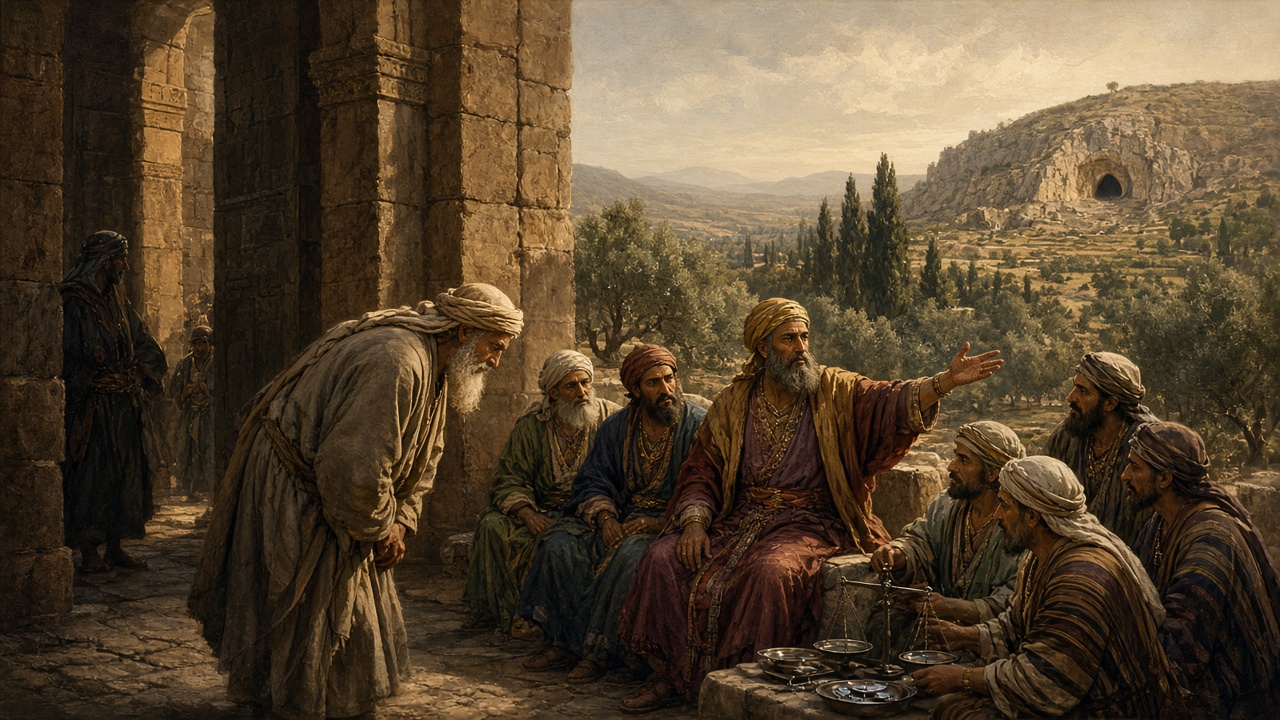
1And the life of Sarrha was one hundred and twenty-seven years. 2And Sarrha died in the city of Arboc, which is in the valley, this is Chebron in the land of Chanaan; and Abraam came to lament for Sarrha and to mourn. 3And Abraam stood up from before his dead; and Abraam spoke to the sons of Chet, saying, 4I am a sojourner and a stranger amongst you, give me therefore possession of a burying-place amongst you, and I will bury my dead away from me. 5And the sons of Chet answered to Abraam, saying, Not so, Sir, 6but hear us; you are in the midst of us a king from God; bury your dead in our choice sepulchres, for not one of us will by any means withhold his sepulchre from you, so that you should not bury your dead there. 7And Abraam rose up and did obeisance to the people of the land, to the sons of Chet. 8And Abraam spoke to them, saying, If you⌃ have it in your mind that I should bury my dead out of my sight, listen to me, and speak for me to Ephron the son Saar. 9And let him give me the double cave which he has, which is in a part of his field, let him give it me for the money it is worth for possession of a burying-place amongst you. 10Now Ephron was sitting in the midst of the children of Chet, and Ephron the Chettite answered Abraam and spoke in the hearing of the sons of Chet, and of all who entered the city, saying, 11Attend to me, my lord, and hear me, I give to you the field and the cave which is in it; I have given it you before all my country men; bury your dead. 12And Abraam did obeisance before the people of the land. 13And he said in the ears of Ephron before the people of the land, Since you are on my side, hear me; take the price of the field from me, and I will bury my dead there. 14But Ephron answered Abraam, saying, 15Nay, my lord, I have heard indeed, the land is worth four hundred silver didrachmas, but what can this be between me and you? nay, do you bury your dead. 16And Abraam listened to Ephron, and Abraam rendered to Ephron the money, which he mentioned in the ears of the sons of Chet, four hundred didrachmas of silver approved with merchants. 17And the field of Ephron, which was in Double Cave, which is opposite Mambre, the field and the cave, which was in it, and every tree which was in the field, and whatever is in its borders round about, were made sure in its borders round about, were made sure 18to Abraam for a possession, before the sons of Chet, and all that entered into the city. 19After this Abraam buried Sarrha his wife in the Double Cave of the field, which is opposite Mambre, this is Chebron in the land of Chanaan. 20So the field and the cave which was in it were made sure to Abraam for possession of a burying place, by the sons of Chet.
¿Sabías que…?
La muerte de Sara y la cueva de Macpela
- Sara murió a los 127 años en Quiriat-arba, es decir, Hebrón, en la tierra de Canaán. El Easton's Bible Dictionary (1897) señala que este es el único lugar de las Escrituras donde se registra la edad de una mujer, y que su muerte llevó a Abraham a comprar la cueva de Macpela como sepulcro familiar.Fuentes: el propio texto bíblico · Sarah
- Abraham dijo a los hijos de Het —los hititas, descendientes de Canaán por medio de Het y habitantes de las cercanías de Hebrón— que era un extranjero entre ellos y necesitaba un lugar de sepultura. A la puerta de la ciudad, ante los hititas reunidos allí, compró el campo y la cueva de Efrón, hijo de Zohar, por cuatrocientos siclos de plata, pesados según el patrón de los mercaderes.Fuentes: el propio texto bíblico · Heth · Ephron
- El nombre Macpela se explica como “porción” o “cueva doble”. La cueva que Abraham compró estaba en el campo de Efrón, cerca de Mamre, en la ladera de un monte al este de Hebrón, y en ese mismo lugar fueron depositados después los cuerpos de Abraham y Sara, Isaac y Rebeca, y Jacob y Lea.Fuentes: Machpelah · el propio texto bíblico
Notas escritas con ayuda de IA a partir de fuentes abiertas (Theographic Bible Metadata, CC BY-SA 4.0; Easton’s Bible Dictionary, dominio público) y revisadas antes de publicarse.
Lugares de este capítulo
- Canaan · 32.767, 35.333 · versículos 2, 19
- Hebron · Hoy: Tel Rumeida · 31.525, 35.102 · versículos 2, 19
- Machpelah · Hoy: Cave of the Patriarchs · 31.525, 35.111 · versículos 9, 17, 19
Solo aparecen lugares identificados con alta confianza (90 % o más según las fuentes académicas reunidas por OpenBible). Mapa de la época: DARE (Digital Atlas of the Roman Empire), CC BY 4.0; mapa actual: © colaboradores de OpenStreetMap; lugares: OpenBible.info (CC BY 4.0).
Créditos y licencia de esta traducción
LXX2012: Septuagint in British/International English 2012
The Septuagint with Apocrypha, translated from Greek to English by Sir Lancelot C. L. Brenton and published in 1885, with some language updates (British/International English)
Public Domain
Language: English
Dialect (if applicable): British
Language in English: English
Translation by: Sir Lancelot Charles Lee Breton
LXX2012: Septuagint in English 2012, British/International English Edition
This is a translation of the Old Testament and Apocrypha/Deuterocanon from Hebrew to Greek to 19th Century British English, with some updates of spelling and word usage to contemporary British/International English. The original English translation was done by Sir Lancelot Charles Lee Brenton and published by Samuel Bagster & Sons, Ltd., in London in 1851. It has entered the Public Domain due to the passage of sufficient time. In the process of scanning and typing the text, the original poetry and prose formatting, as well as peripheral material like introductions and notes, have been omitted.
This edition of the Septuagint has some language updates. Brenton's word order and punctuation has been mostly retained, meaning that quotation marks are not used, and sentences within quotes may not start with capital letters, as was standard usage in 1851. Names transliterated from Greek to those transliterated from Hebrew in the common English Bibles often differ. These language updates are dedicated to the Public Domain by the author of those edits, Michael Paul Johnson. Therefore this edition may be freely copied, published, etc.
Before considering making changes to the text of this work, I recommend that you consult with God, because this is really His Book.
If you find errors in the text, please report them so that we can correct them.
Donations to help with the expenses of operating this web site and thus help others have free access to the Word of God may be made to us, but are not required. Please see http://MLJohnson.org/partner/ for more about that.
Títulos de sección adaptados de la Berean Standard Bible (dominio público); no forman parte del texto bíblico de esta traducción.
Fuente: http://ebible.org/eng-uk-lxx2012/ · eBible.org