Génesis 14
LXX2012: Septuagint in British/International English 2012 · Toca un versículo para ver sus referencias cruzadas.
The War of the Kings
1And it came to pass in the reign of Amarphal king of Sennaar, and Arioch king of Ellasar, that Chodollogomor king of Elam, and Thargal king of nations, 2made war with Balla king of Sodom, and with Barsa king of Gomorrha, and with Sennaar, king of Adama, and with Symobor king of Seboim and the king of Balac, this is Segor. 3All these met with one consent at the salt valley; this is now the sea of salt. 4Twelve years they served Chodollogomor, and the thirteenth year they revolted. 5And in the fourteenth year came Chodollogomor, and the kings with him, and cut to pieces the giants in Astaroth, and Carnain, and strong nations with them, and the Ommaeans in the city Save. 6And the Chorrhaeans in the mountains of Seir, to the turpentine tree of Pharan, which is in the desert. 7And having turned back they came to the well of judgement; this is Cades, and they cut in pieces all the princes of Amalec, and the Amorites dwelling in Asasonthamar. 8And the king of Sodom went out, and the king of Gomorrha, and king of Adama, and king of Seboim, and king of Balac, this is Segor, and they set themselves in array against them for war in the salt valley, 9against Chodollogomor king of Elam, and Thargal king of nations, and Amarphal king of Sennaar, and Arioch king of Ellasar, the four kings against the five.
Abram Rescues Lot
10Now the salt valley consists of slime-pits. And the king of Sodom fled and the king of Gomorrha, and they fell in there: and they that were left fled to the mountain country. 11And they took all the cavalry of Sodom and Gomorrha, and all their provisions, and departed. 12And they took also Lot the son of Abram's brother, and his baggage, and departed, for he lived in Sodom. 13And one of them that had been rescued came and told Abram the Hebrew; and he lived by the oak of Mamre the Amorite the brother of Eschol, and the brother of Aunan, who were confederates with Abram. 14And Abram having heard that Lot his nephew had been taken captive, numbered his own home-born servants three hundred and eighteen, and pursued after them to Dan. 15And he came upon them by night, he and his servants, and he struck them and pursued them as far as Choba, which is on the left of Damascus. 16And he recovered all the cavalry of Sodom, and he recovered Lot his nephew, and all his possessions, and the women and the people.
Melchizedek Blesses Abram
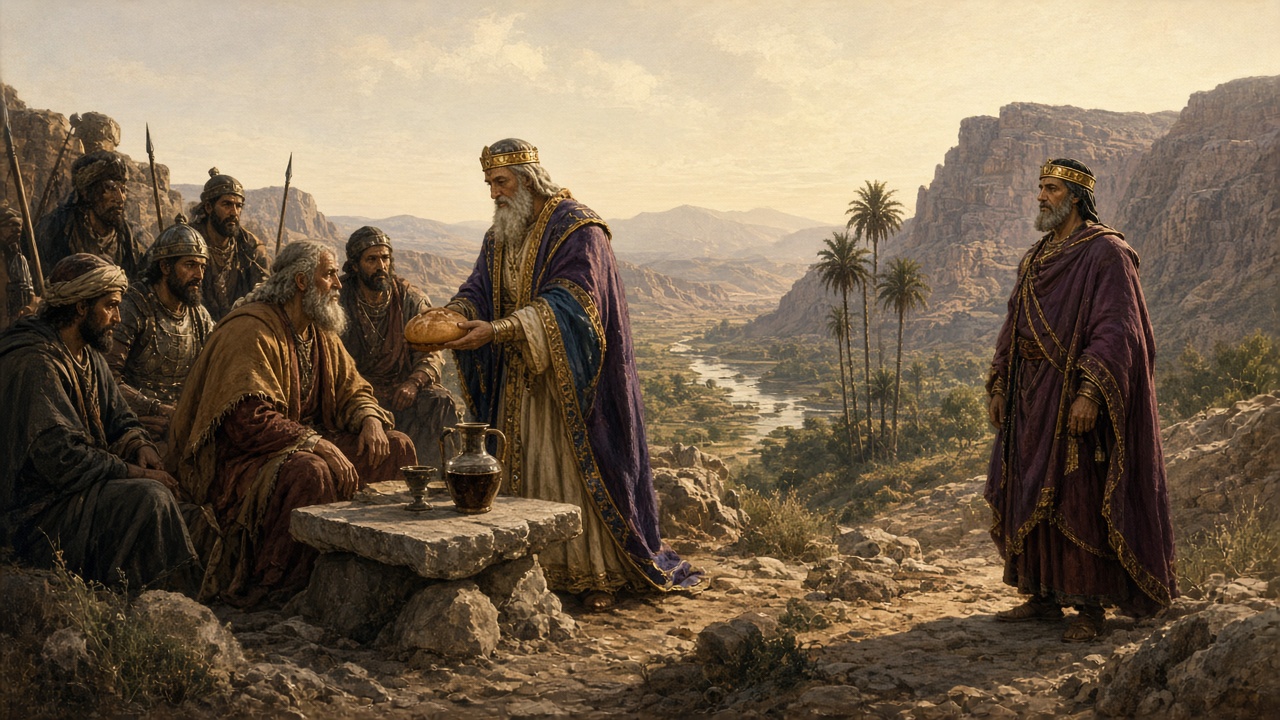
17And the king of Sodom went out to meet him, after he returned from the slaughter of Chodollogomor, and the kings with him, to the valley of Saby; this was the plain of the kings. 18And Melchisedec king of Salem brought forth loaves and wine, and he was the priest of the most high God. 19And he blessed Abram, and said, Blessed be Abram of the most high God, who made heaven and earth, 20and blessed be the most high God who delivered your enemies into your power. And Abram gave him the tithe of all. 21And the king of Sodom said to Abram, Give me the men, and take the horses to yourself. 22And Abram said to the king of Sodom, I will stretch out my hand to the Lord the most high God, who made the heaven and the earth, 23that I will not take from all your goods from a string to a shoe-latchet, lest you should say, I have made Abram rich. 24Except what things the young men have eaten, and the portion of the men that went with me, Eschol, Aunan, Mambre, these shall take a portion.
¿Sabías que…?
La campaña de los cuatro reyes
- El Diccionario Bíblico de Easton (1897) identifica a los cuatro reyes invasores con nombres de inscripciones antiguas: Quedorlaomer con Khudur-Lagamar, de Elam; Amrafel con Khammu-rabi, de Sinar (Caldea meridional); Arioc, rey de Elasar, con Eri-Aku, de Larsa; y Tidal con Tudkhula. Explica Eri-Aku como un nombre elamita que significa “siervo del dios de la luna”, cambiado después a Rimsin, y entiende Goim — “naciones” — como Gutium, al este del Tigris y al norte de Elam.Fuentes: Chedorlaomer · Amraphel · Arioch (king of Ellasar) · Tidal
- Los cinco reyes locales se formaron para la batalla en el valle de Sidim, que este capítulo identifica con el mar Salado, y el valle estaba lleno de pozos de brea, en los que cayeron algunos de los hombres que huían. El Diccionario Bíblico de Easton sitúa ese valle en el extremo sur del mar Muerto, entre Engedi y las ciudades de la llanura, y llama a esos pozos pozos de betún.Fuentes: el propio texto bíblico · Vale of Siddim
- Abram vivía cerca de las encinas de Mamre el amorreo, hermano de Escol y de Aner, y los tres estaban ligados a él por un tratado. El Diccionario Bíblico de Easton llama a Mamre y a Escol jefes amorreos y a Aner jefe cananeo, y señala que acompañaron a Abram en la persecución de Quedorlaomer y en la recuperación de Lot.Fuentes: el propio texto bíblico · Mamre · Eshcol · Aner
Notas escritas con ayuda de IA a partir de fuentes abiertas (Theographic Bible Metadata, CC BY-SA 4.0; Easton’s Bible Dictionary, dominio público) y revisadas antes de publicarse.
Lugares de este capítulo
- Elam · 32.189, 48.258 · versículos 1, 9
- Shinar · Hoy: Babylonia · 32.543, 44.422 · versículos 1, 9
- Salt Sea · Hoy: Dead Sea · 31.500, 35.500 · versículo 3
- Shaveh-kiriathaim · Hoy: within 1 km of Al Qurayyat · 31.541, 35.686 · versículo 5
- Dan · Hoy: Tel Dan · 33.249, 35.652 · versículo 14
- Damascus · 33.511, 36.306 · versículo 15
- Valley of Shaveh · Hoy: intersection of Kidron Valley and Valley of Hinnom · 31.767, 35.236 · versículo 17
- Salem · Hoy: Jerusalem · 31.777, 35.234 · versículo 18
Solo aparecen lugares identificados con alta confianza (90 % o más según las fuentes académicas reunidas por OpenBible). Mapa de la época: DARE (Digital Atlas of the Roman Empire), CC BY 4.0; mapa actual: © colaboradores de OpenStreetMap; lugares: OpenBible.info (CC BY 4.0).
Créditos y licencia de esta traducción
LXX2012: Septuagint in British/International English 2012
The Septuagint with Apocrypha, translated from Greek to English by Sir Lancelot C. L. Brenton and published in 1885, with some language updates (British/International English)
Public Domain
Language: English
Dialect (if applicable): British
Language in English: English
Translation by: Sir Lancelot Charles Lee Breton
LXX2012: Septuagint in English 2012, British/International English Edition
This is a translation of the Old Testament and Apocrypha/Deuterocanon from Hebrew to Greek to 19th Century British English, with some updates of spelling and word usage to contemporary British/International English. The original English translation was done by Sir Lancelot Charles Lee Brenton and published by Samuel Bagster & Sons, Ltd., in London in 1851. It has entered the Public Domain due to the passage of sufficient time. In the process of scanning and typing the text, the original poetry and prose formatting, as well as peripheral material like introductions and notes, have been omitted.
This edition of the Septuagint has some language updates. Brenton's word order and punctuation has been mostly retained, meaning that quotation marks are not used, and sentences within quotes may not start with capital letters, as was standard usage in 1851. Names transliterated from Greek to those transliterated from Hebrew in the common English Bibles often differ. These language updates are dedicated to the Public Domain by the author of those edits, Michael Paul Johnson. Therefore this edition may be freely copied, published, etc.
Before considering making changes to the text of this work, I recommend that you consult with God, because this is really His Book.
If you find errors in the text, please report them so that we can correct them.
Donations to help with the expenses of operating this web site and thus help others have free access to the Word of God may be made to us, but are not required. Please see http://MLJohnson.org/partner/ for more about that.
Títulos de sección adaptados de la Berean Standard Bible (dominio público); no forman parte del texto bíblico de esta traducción.
Fuente: http://ebible.org/eng-uk-lxx2012/ · eBible.org