Éxodo 9
LXX2012: Septuagint in British/International English 2012 · Toca un versículo para ver sus referencias cruzadas.
The Fifth Plague: Livestock
1And the Lord said to Moses, Go in to Pharao, and you shall say to him, These things says the Lord God of the Hebrews; Send my people away that they may serve me. 2If however you will not send my people away, but yet detain them: 3behold, the hand of the Lord shall be upon your cattle in the fields, both on the horses, and on the asses, and on the camels and oxen and sheep, a very great mortality. 4And I will make a marvellous distinction in that time between the cattle of the Egyptians, and the cattle of the children of Israel: nothing shall die of all that is of the children's of Israel. 5And God fixed a limit, saying, To-morrow the Lord will do this thing on the land. 6And the Lord did this thing on the next day, and all the cattle of the Egyptians died, but of the cattle of the children of Israel there died not one. 7And when Pharao saw, that of all the cattle of the children of Israel there died not one, the heart of Pharao was hardened, and he did not let the people go.
The Sixth Plague: Boils
8And the Lord spoke to Moses and Aaron, saying, Take you handfuls of ashes of the furnace, and let Moses scatter it towards heaven before Pharao, and before his servants. 9And let it become dust over all the land of Egypt, and there shall be upon men and upon beasts sore blains breaking forth both on men and on beasts, in all the land of Egypt. 10So he took of the ashes of the furnace before Pharao, and Moses scattered it towards heaven, and it became sore blains breaking forth both on men and on beasts. 11And the sorcerers could not stand before Moses because of the sores, for the sores were on the sorcerers, and in all the land of Egypt. 12And the Lord hardened Pharao's heart, and he listened not to them, as the Lord appointed.
The Seventh Plague: Hail
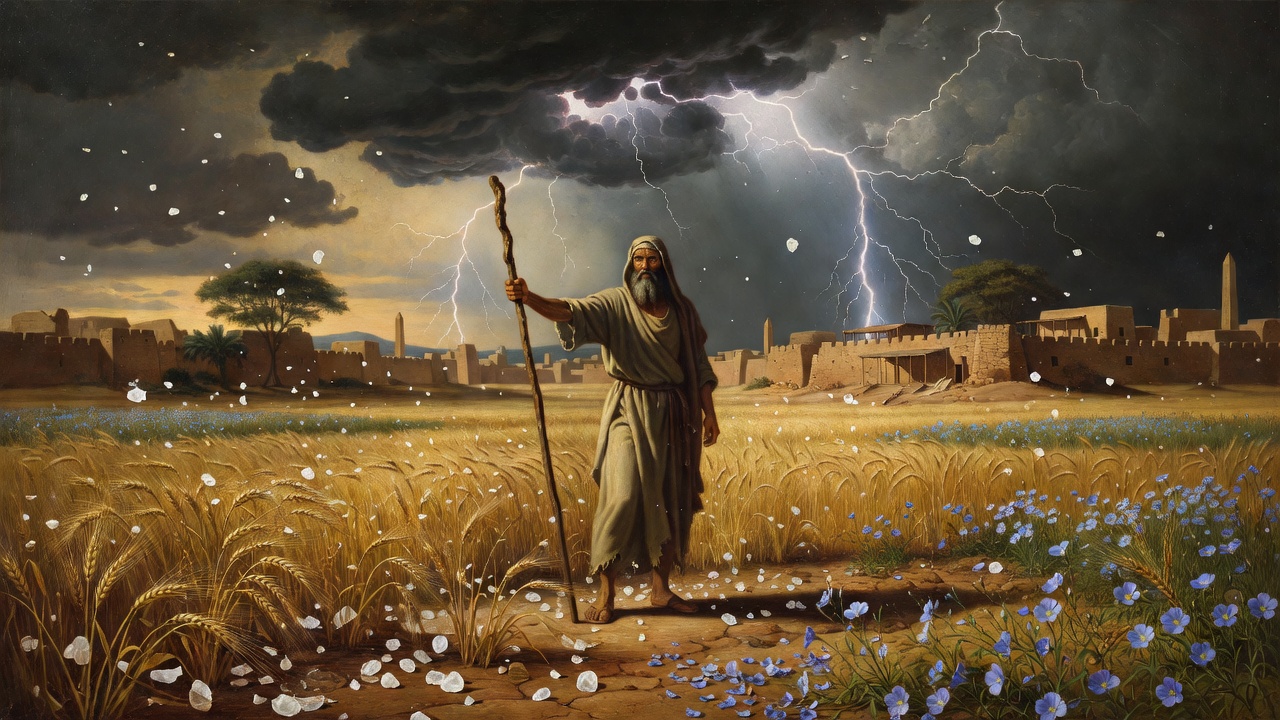
13And the Lord said to Moses, Rise up early in the morning, and stand before Pharao; and you shall say to him, These things says the Lord God of the Hebrews, Send away my people that they may serve me. 14For at this present time do I send forth all my plagues into your heart, and the heart of your servants and of your people; that you may know that there is not another such as I in all the earth. 15For now I will stretch forth my hand and strike you and kill your people, and you shall be consumed from off the earth. 16And for this purpose have you been preserved, that I might display in you my strength, and that my name might be published in all the earth. 17Do you then yet exert yourself to hinder my people, so as not to let them go? 18Behold, to-morrow at this hour I will rain a very great hail, such as has not been in Egypt, from the time it was created until this day. 19Now then hasten to gather your cattle, and all that you have in the fields; for all the men and cattle as many as shall be found in the fields, and shall not enter into a house, (but the hail shall fall upon them,) shall die. 20He of the servants of Pharao that feared the word of the Lord, gathered his cattle into the houses. 21And he that did not attend in his mind to the word of the Lord, left the cattle in the fields. 22And the Lord said to Moses, Stretch out your hand to heaven, and there shall be hail on all the land of Egypt, both on the men and on the cattle, and on all the herbage on the land. 23And Moses stretched forth his hand to heaven, and the Lord sent thunderings and hail; and the fire ran along upon the ground, and the Lord rained hail on all the land of Egypt. 24So there was hail and flaming fire mingled with hail; and the hail was very great, such as was not in Egypt, from the time there was a nation upon it. 25And the hail struck in all the land of Egypt both man and beast, and the hail struck all the grass in the field, and the hail broke in pieces all the trees in the field. 26Only in the land of Gesem where the children of Israel were, the hail was not. 27And Pharao sent and called Moses and Aaron, and said to them, I have sinned this time: the Lord is righteous, and I and my people are wicked. 28Pray then for me to the Lord, and let him cause the thunderings of God to cease, and the hail and the fire, and I will send you forth and you⌃ shall remain no longer. 29And Moses said to him, When I shall have departed from the city, I will stretch out my hands to the Lord, and the thunderings shall cease, and the hail and the rain shall be no longer, that you may know that the earth is the Lord's. 30But as for you and your servants, I know that you⌃ have not yet feared the Lord. 31And the flax and the barley were struck, for the barley was advanced, and the flax was seeding. 32But the wheat and the rye were not struck, for they were late. 33And Moses went forth from Pharao out of the city, and stretched out his hands to the Lord, and the thunders ceased and the hail, and the rain did not drop on the earth. 34And when Pharao saw that the rain and the hail and the thunders ceased, he continued to sin; and he hardened his heart, and the heart of his servants. 35And the heart of Pharao was hardened, and he did not send forth the children of Israel, as the Lord said to Moses.
¿Sabías que…?
Ganado, úlceras y granizo
- Este capítulo traza una línea clara entre Egipto y los israelitas: muere todo el ganado de los egipcios, pero no muere ni un animal de los israelitas, y el granizo cae en toda la tierra de Egipto excepto en Gosén, donde vivían los israelitas. Gosén, llamada también tierra de Ramsés, quedaba al este del Nilo y, al parecer, no lejos de la residencia real, y había sido asignada a la familia de Jacob como la mejor parte de la tierra.Fuentes: el propio texto bíblico · Goshen · Moses
- El faraón ante quien se presentan Moisés y Aarón no es nombrado en el capítulo. El Diccionario Bíblico de Easton (1897) lo identifica como probablemente Menephtah I, hijo de Ramsés II, que vivía en Zoán, donde tuvieron lugar sus entrevistas con Moisés y Aarón, y señala que algunos prefieren a Seti II. Después del granizo, Moisés sale de la ciudad y extiende las manos al Señor hasta que cesan el trueno y el granizo.Fuentes: el propio texto bíblico · Pharaoh (of the Exodus)
- El granizo destruyó el lino y la cebada, pero no el trigo ni la espelta. El relato explica la diferencia: la cebada ya estaba madura y el lino en flor, mientras que el trigo y la espelta eran cultivos tardíos.Fuentes: el propio texto bíblico
Notas escritas con ayuda de IA a partir de fuentes abiertas (Theographic Bible Metadata, CC BY-SA 4.0; Easton’s Bible Dictionary, dominio público) y revisadas antes de publicarse.
Lugares de este capítulo
- Egypt · 30.129, 31.308 · versículos 4, 6, 9, 18, 22, 23, 24, 25
- Goshen · Hoy: Goshen 1 · 30.799, 31.834 · versículo 26
Solo aparecen lugares identificados con alta confianza (90 % o más según las fuentes académicas reunidas por OpenBible). Mapa de la época: DARE (Digital Atlas of the Roman Empire), CC BY 4.0; mapa actual: © colaboradores de OpenStreetMap; lugares: OpenBible.info (CC BY 4.0).
Créditos y licencia de esta traducción
LXX2012: Septuagint in British/International English 2012
The Septuagint with Apocrypha, translated from Greek to English by Sir Lancelot C. L. Brenton and published in 1885, with some language updates (British/International English)
Public Domain
Language: English
Dialect (if applicable): British
Language in English: English
Translation by: Sir Lancelot Charles Lee Breton
LXX2012: Septuagint in English 2012, British/International English Edition
This is a translation of the Old Testament and Apocrypha/Deuterocanon from Hebrew to Greek to 19th Century British English, with some updates of spelling and word usage to contemporary British/International English. The original English translation was done by Sir Lancelot Charles Lee Brenton and published by Samuel Bagster & Sons, Ltd., in London in 1851. It has entered the Public Domain due to the passage of sufficient time. In the process of scanning and typing the text, the original poetry and prose formatting, as well as peripheral material like introductions and notes, have been omitted.
This edition of the Septuagint has some language updates. Brenton's word order and punctuation has been mostly retained, meaning that quotation marks are not used, and sentences within quotes may not start with capital letters, as was standard usage in 1851. Names transliterated from Greek to those transliterated from Hebrew in the common English Bibles often differ. These language updates are dedicated to the Public Domain by the author of those edits, Michael Paul Johnson. Therefore this edition may be freely copied, published, etc.
Before considering making changes to the text of this work, I recommend that you consult with God, because this is really His Book.
If you find errors in the text, please report them so that we can correct them.
Donations to help with the expenses of operating this web site and thus help others have free access to the Word of God may be made to us, but are not required. Please see http://MLJohnson.org/partner/ for more about that.
Títulos de sección adaptados de la Berean Standard Bible (dominio público); no forman parte del texto bíblico de esta traducción.
Fuente: http://ebible.org/eng-uk-lxx2012/ · eBible.org