Ester 7
LXX2012: Septuagint in British/International English 2012 · Toca un versículo para ver sus referencias cruzadas.
Esther Pleads for Her People
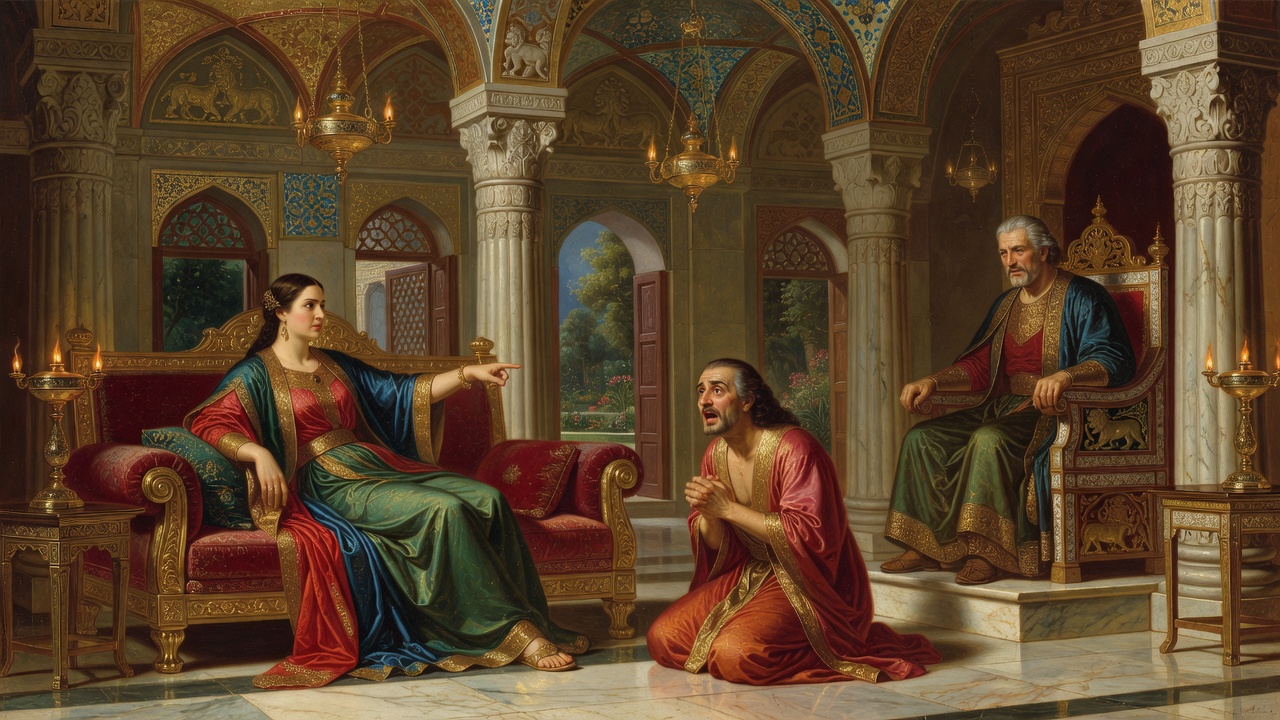
1So the king and Aman went in to drink with the queen. 2And the king said to Esther at the banquet on the second day, What is it, queen Esther? and what is your request, and what is your petition? and it shall be done for you, to the half of my kingdom. 3And she answered and said, If I have found favour in the sight of the king, let my life be granted to my petition, and my people to my request. 4For both I and my people are sold for destruction, and pillage, and slavery; both we and our children for bondmen and bondwomen: and I consented not to it, for the is not worthy of the king's palace. 5And the king said, Who is this that has dared to do this thing? 6And Esther said, the adversary is Aman, this wicked man. Then Aman was troubled before the king and the queen.
The Hanging of Haman
7And the king rose up from the banquet to go into the garden: and Aman began to entreat the queen; for he saw that he was in an evil case. 8And the king returned from the garden; and Aman had fallen upon the bed, intreating the queen. And the king said, Will you even force my wife in my house? And when Aman heard it, he changed countenance. 9And Bugathan, one of the chamberlains, said to the king, Behold, Aman has also prepared a gallows for Mardochaeus, who spoke concerning the king, and a gallows of fifty cubits high has been set up in the premises of Aman. And the king said, Let him be hanged thereon. 10So Aman was hanged on the gallows that had been prepared for Mardochaeus: and then the king's wrath was appeased.
¿Sabías que…?
Ester Desenmascara el Complot de Amán
- En el segundo banquete de vino, la reina Ester reveló que ella y su pueblo habían sido sentenciados a la destrucción y al exterminio. Cuando el rey preguntó quién se había atrevido a tramar tal plan, ella señaló directamente a Amán, el alto oficial del soberano, como el malvado adversario.Fuentes: el propio texto bíblico · Esther · Haman
- Al regresar enfurecido del jardín del palacio, el rey Asuero halló a Amán desplomado sobre el diván donde Ester descansaba para rogar por su vida. El rey interpretó esta acción como un ultraje contra la reina, y los sirvientes cubrieron de inmediato el rostro de Amán.Fuentes: el propio texto bíblico · Ahasuerus
- Harbona, uno de los eunucos de la corte, informó al rey que Amán había levantado en su casa una horca de cincuenta codos para Mardoqueo, quien antes había salvado la vida del monarca. Asuero ordenó al instante que el propio Amán fuera ejecutado en la estructura que había preparado.Fuentes: el propio texto bíblico · Mordecai · Harbonah
Notas escritas con ayuda de IA a partir de fuentes abiertas (Theographic Bible Metadata, CC BY-SA 4.0; Easton’s Bible Dictionary, dominio público) y revisadas antes de publicarse.
Créditos y licencia de esta traducción
LXX2012: Septuagint in British/International English 2012
The Septuagint with Apocrypha, translated from Greek to English by Sir Lancelot C. L. Brenton and published in 1885, with some language updates (British/International English)
Public Domain
Language: English
Dialect (if applicable): British
Language in English: English
Translation by: Sir Lancelot Charles Lee Breton
LXX2012: Septuagint in English 2012, British/International English Edition
This is a translation of the Old Testament and Apocrypha/Deuterocanon from Hebrew to Greek to 19th Century British English, with some updates of spelling and word usage to contemporary British/International English. The original English translation was done by Sir Lancelot Charles Lee Brenton and published by Samuel Bagster & Sons, Ltd., in London in 1851. It has entered the Public Domain due to the passage of sufficient time. In the process of scanning and typing the text, the original poetry and prose formatting, as well as peripheral material like introductions and notes, have been omitted.
This edition of the Septuagint has some language updates. Brenton's word order and punctuation has been mostly retained, meaning that quotation marks are not used, and sentences within quotes may not start with capital letters, as was standard usage in 1851. Names transliterated from Greek to those transliterated from Hebrew in the common English Bibles often differ. These language updates are dedicated to the Public Domain by the author of those edits, Michael Paul Johnson. Therefore this edition may be freely copied, published, etc.
Before considering making changes to the text of this work, I recommend that you consult with God, because this is really His Book.
If you find errors in the text, please report them so that we can correct them.
Donations to help with the expenses of operating this web site and thus help others have free access to the Word of God may be made to us, but are not required. Please see http://MLJohnson.org/partner/ for more about that.
Títulos de sección adaptados de la Berean Standard Bible (dominio público); no forman parte del texto bíblico de esta traducción.
Fuente: http://ebible.org/eng-uk-lxx2012/ · eBible.org