Deuteronomio 20
LXX2012: Septuagint in British/International English 2012 · Toca un versículo para ver sus referencias cruzadas.
Laws of Warfare
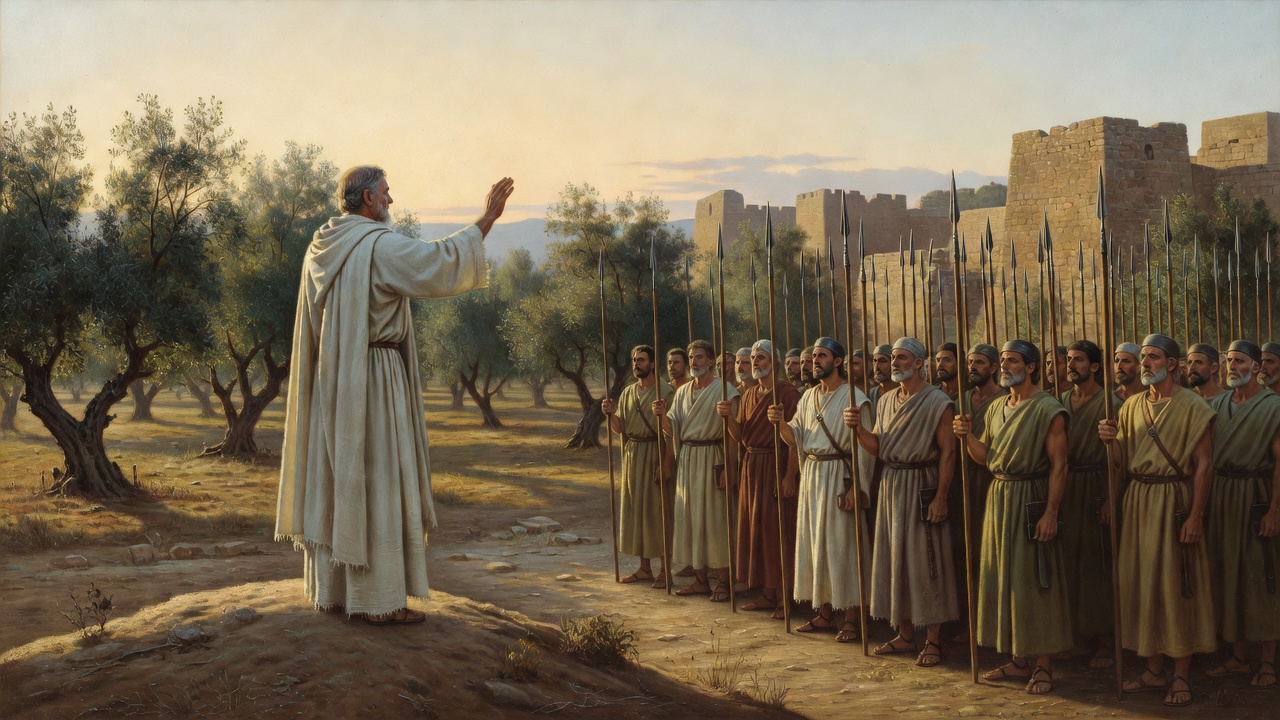
1And if you should go forth to war against your enemies, and should see horse, and rider, and a people more numerous than yourself; you shall not be afraid of them, for the Lord your God is with you, who brought you up out of the land of Egypt. 2And it shall come to pass whenever you shall draw near to battle, that the priest shall draw near and speak to the people, and shall say to them, 3Hear, O Israel; you⌃ are going this day to battle against your enemies: let not your heart faint, fear not, neither be confounded, neither turn aside from their face. 4For it is the Lord your God who advances with you, to fight with you against your enemies, and to save you. 5And the scribes shall speak to the people, saying, What man is he that has built a new house, and has not dedicated it? let him go and return to his house, lest he die in the war, and another man dedicate it. 6And what man is he that has planted a vineyard, and not been made merry with it? let him go and return to his house, lest he die in the battle, and another man be made merry with it. 7And what man is he that has betrothed a wife, and has not taken her? let him go and return to his house, lest he die in the battle, and another man take her. 8And the scribes shall speak further to the people, and say, What man is he that fears and is cowardly in his heart? Let him go and return to his house, lest he make the heart of his brother fail, as his own. 9And it shall come to pass when the scribes shall have ceased speaking to the people, that they shall appoint generals of the army to be leaders of the people. 10And if you shall draw near to a city to overcome them by war, then call them out peaceably. 11If then they should answer peaceably to you, and open to you, it shall be that all the people found in it shall be tributary and subject to you. 12But if they will not listen to you, but wage war against you, you shall invest it; 13until the Lord your God shall deliver it into your hands, and you shall strike every male of it with the edge of the sword: 14except the women and the stuff: and all the cattle, and whatever shall be in the city, and all the plunder you shall take as spoil for yourself, and shall eat all the plunder of your enemies whom the Lord your God gives you. 15Thus shall you do to all the cities that are very far off from you, not being of the cities of these nations which the Lord your God gives you to inherit their land. 16Of these you⌃ shall not take any thing alive; 17but you⌃ shall surely curse them, the Chettite, and the Amorite, and the Chananite, and the Pherezite, and the Evite, and the Jebusite, and the Gergesite; as the Lord your God commanded you: 18that they may not teach you to do all their abominations, which they did to their gods, and so you⌃ should sin before the Lord your God. 19And if you should besiege a city many days to prevail against it by war to take it, you shall not destroy its trees, by applying an iron tool to them, but you shall eat of it, and shall not cut it down: Is the tree that is in the field a man, to enter before you into the work of the siege? 20But the tree which you know to be not fruit-bearing, this you shall destroy and cut down; and you shall construct a mound against the city, which makes war against you, until it be delivered up.
¿Sabías que…?
Leyes sobre la Guerra
- Antes de entrar en combate, los oficiales israelitas anunciaban exenciones específicas del servicio militar, liberando a los hombres que hubieran construido una casa aún no dedicada, plantado una viña aún no cosechada, estuvieran comprometidos para casarse o sintieran temor.Fuentes: el propio texto bíblico
- La ley establecía normas de guerra distintas para las ciudades lejanas en comparación con las de la Tierra Prometida; a las ciudades lejanas se les ofrecían primero términos de paz, mientras que los habitantes de las naciones locales debían ser destruidos por completo para evitar la idolatría.Fuentes: el propio texto bíblico
- Durante asedios prolongados, se prohibía a las fuerzas israelitas talar árboles frutales para construir obras de asedio, limitando la tala únicamente a los árboles que sabían que no producían alimento.Fuentes: el propio texto bíblico
Notas escritas con ayuda de IA a partir de fuentes abiertas (Theographic Bible Metadata, CC BY-SA 4.0; Easton’s Bible Dictionary, dominio público) y revisadas antes de publicarse.
Lugares de este capítulo
- Egypt · 30.129, 31.308 · versículo 1
Solo aparecen lugares identificados con alta confianza (90 % o más según las fuentes académicas reunidas por OpenBible). Mapa de la época: DARE (Digital Atlas of the Roman Empire), CC BY 4.0; mapa actual: © colaboradores de OpenStreetMap; lugares: OpenBible.info (CC BY 4.0).
Créditos y licencia de esta traducción
LXX2012: Septuagint in British/International English 2012
The Septuagint with Apocrypha, translated from Greek to English by Sir Lancelot C. L. Brenton and published in 1885, with some language updates (British/International English)
Public Domain
Language: English
Dialect (if applicable): British
Language in English: English
Translation by: Sir Lancelot Charles Lee Breton
LXX2012: Septuagint in English 2012, British/International English Edition
This is a translation of the Old Testament and Apocrypha/Deuterocanon from Hebrew to Greek to 19th Century British English, with some updates of spelling and word usage to contemporary British/International English. The original English translation was done by Sir Lancelot Charles Lee Brenton and published by Samuel Bagster & Sons, Ltd., in London in 1851. It has entered the Public Domain due to the passage of sufficient time. In the process of scanning and typing the text, the original poetry and prose formatting, as well as peripheral material like introductions and notes, have been omitted.
This edition of the Septuagint has some language updates. Brenton's word order and punctuation has been mostly retained, meaning that quotation marks are not used, and sentences within quotes may not start with capital letters, as was standard usage in 1851. Names transliterated from Greek to those transliterated from Hebrew in the common English Bibles often differ. These language updates are dedicated to the Public Domain by the author of those edits, Michael Paul Johnson. Therefore this edition may be freely copied, published, etc.
Before considering making changes to the text of this work, I recommend that you consult with God, because this is really His Book.
If you find errors in the text, please report them so that we can correct them.
Donations to help with the expenses of operating this web site and thus help others have free access to the Word of God may be made to us, but are not required. Please see http://MLJohnson.org/partner/ for more about that.
Títulos de sección adaptados de la Berean Standard Bible (dominio público); no forman parte del texto bíblico de esta traducción.
Fuente: http://ebible.org/eng-uk-lxx2012/ · eBible.org