Daniel 8
LXX2012: Septuagint in British/International English 2012 · Toca un versículo para ver sus referencias cruzadas.
Daniel’s Vision of the Ram and the Goat
1In the third year of the reign of king Baltasar a vision appeared to me, even to me Daniel, after that which appeared to me at the first. 2And I was in Susa the palace, which is in the land of Aelam, and I was on the bank of Ubal. 3And I lifted up my eyes, and saw, and, behold, a ram standing in front of the Ubal; and he had high horns; and one was higher than the other, and the high one came up last. 4And I saw the ram butting westward, and northward, and southward; and no beast could stand before him, and there was none that could deliver out of his hand; and he did according to his will, and became great. 5And I was considering, and, behold, a he-goat came from the southwest on the face of the whole earth, and touched not the earth: and the goat had a horn between his eyes. 6And he came to the ram that had the horns, which I had seen standing in front of the Ubal, and he ran at him with the violence of his strength. 7And I saw him coming up close to the ram, and he was furiously enraged against him, and he struck the ram, and broke both his horns: and there was no strength in the ram to stand before him, but he cast him on the ground, and trampled on him; and there was none that could deliver the ram out of his hand. 8And the he-goat grew exceedingly great: and when he was strong, his great horn was broken; and four other horns rose up in its place towards the four winds of heaven. 9And out of one of them came forth one strong horn, and it grew very great towards the south, and towards the host: 10and it magnified itself to the host of heaven; and there fell to the earth some of the host of heaven and of the stars, and they trampled on them. 11And this shall be until the chief captain shall have delivered the captivity: and by reason of him the sacrifice was disturbed, and he prospered; and the holy place shall be made desolate. 12And a sin-offering was given for the sacrifice, and righteousness was cast down to the ground; and it practised, and prospered. 13And I heard one saint speaking, and a saint said to a certain one speaking, How long shall the vision continue, even the removal of the sacrifice, and the bringing in of the sin of desolation; and how long shall the sanctuary and host be trampled? 14And he said to him, Evening and morning there shall be two thousand and four hundred days; and then the sanctuary shall be cleansed.
Gabriel Interprets Daniel’s Vision
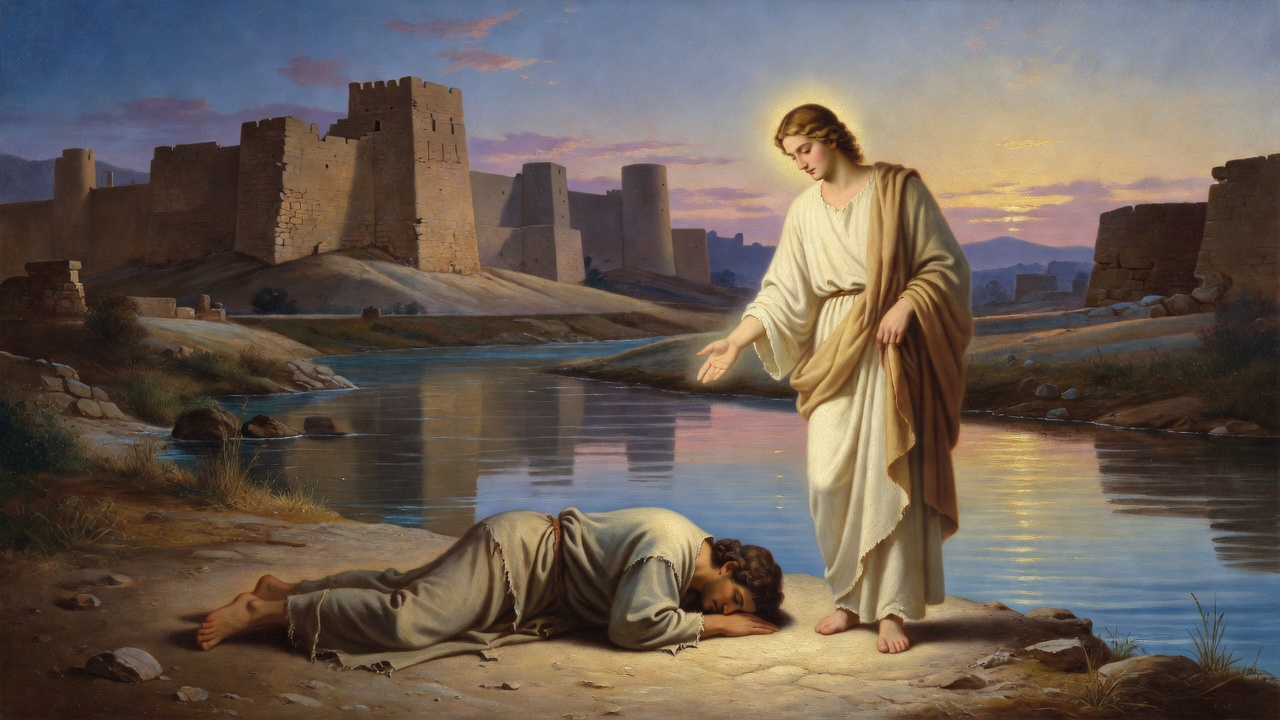
15And it came to pass, as I, even I Daniel, saw the vision, and sought to understand it, that, behold, there stood before me as the appearance of a man. 16And I heard the voice of a man between the banks of the Ubal; and he called, and said, Gabriel, cause that man to understand the vision. 17And he came and stood near where I stood: and when he came, I was struck with awe, and fell upon my face: but he said to me, Understand, son of man: for yet the vision is for an appointed time. 18And while he spoke with me, I fell upon my face to the earth: and he touched me, and set me on my feet. 19And he said, Behold, I make you know the things that shall come to pass at the end of the wrath: for the vision is yet for an appointed time. 20The ram which you saw that had the horns is the king of the Medes and Persians. 21The he-goat is the King of the Greeks: and the great horn which was between his eyes, he is the first king. 22And as for the one that was broken, in whose place there stood up four horns, four kings shall arise out of his nation, but not in their own strength. 23And at the latter time of their kingdom, when their sins are coming to the full, there shall arise a king bold in countenance, and understanding riddles. 24And his power shall be great, and he shall destroy wonderfully, and prosper, and practise, and shall destroy mighty men, and the holy people. 25And the yoke of his chain shall prosper: there is craft in his hand; and he shall magnify himself in his heart, and by craft shall destroy many, and he shall stand up for the destruction of many, and shall crush them as eggs in his hand. 26And the vision of the evening and morning that was mentioned is true: and do you seal the vision; for it is for many days. 27And I Daniel fell asleep, and was sick: then I arose, and did the king's business; and I wondered at the vision, and there was none that understood it.
¿Sabías que…?
La visión del carnero y del macho cabrío
- En su visión, Daniel se ve en la ciudadela de Susa, en la provincia de Elam, junto al canal de Ulai. Susa era la antigua capital de Elam, y el Ulai, llamado por los griegos Eulaus, era un río que se dividía en dos brazos cerca de la ciudad.Fuentes: el propio texto bíblico · Susa · Ulai · Elam
- Este pasaje contiene la primera mención bíblica del ángel Gabriel por su nombre propio. Se le ordena a Gabriel explicar la visión profética a Daniel, quien cae atemorizado antes de que el ángel lo ponga de pie.Fuentes: el propio texto bíblico · Gabriel
- La visión ofrece identificaciones geopolíticas explícitas: el carnero de dos cuernos representa a los reyes de Media y de Persia, mientras que el macho cabrío representa al rey de Grecia.Fuentes: el propio texto bíblico · Media · Persia · Greece
Notas escritas con ayuda de IA a partir de fuentes abiertas (Theographic Bible Metadata, CC BY-SA 4.0; Easton’s Bible Dictionary, dominio público) y revisadas antes de publicarse.
Lugares de este capítulo
- Elam · 32.189, 48.258 · versículo 2
- Susa · Hoy: Shush · 32.189, 48.258 · versículo 2
- Canaan · 32.767, 35.333 · versículo 9
- Media · 34.806, 48.516 · versículo 20
- Persia · 34.806, 48.516 · versículo 20
- Greece · 37.972, 23.727 · versículo 21
Solo aparecen lugares identificados con alta confianza (90 % o más según las fuentes académicas reunidas por OpenBible). Mapa de la época: DARE (Digital Atlas of the Roman Empire), CC BY 4.0; mapa actual: © colaboradores de OpenStreetMap; lugares: OpenBible.info (CC BY 4.0).
Créditos y licencia de esta traducción
LXX2012: Septuagint in British/International English 2012
The Septuagint with Apocrypha, translated from Greek to English by Sir Lancelot C. L. Brenton and published in 1885, with some language updates (British/International English)
Public Domain
Language: English
Dialect (if applicable): British
Language in English: English
Translation by: Sir Lancelot Charles Lee Breton
LXX2012: Septuagint in English 2012, British/International English Edition
This is a translation of the Old Testament and Apocrypha/Deuterocanon from Hebrew to Greek to 19th Century British English, with some updates of spelling and word usage to contemporary British/International English. The original English translation was done by Sir Lancelot Charles Lee Brenton and published by Samuel Bagster & Sons, Ltd., in London in 1851. It has entered the Public Domain due to the passage of sufficient time. In the process of scanning and typing the text, the original poetry and prose formatting, as well as peripheral material like introductions and notes, have been omitted.
This edition of the Septuagint has some language updates. Brenton's word order and punctuation has been mostly retained, meaning that quotation marks are not used, and sentences within quotes may not start with capital letters, as was standard usage in 1851. Names transliterated from Greek to those transliterated from Hebrew in the common English Bibles often differ. These language updates are dedicated to the Public Domain by the author of those edits, Michael Paul Johnson. Therefore this edition may be freely copied, published, etc.
Before considering making changes to the text of this work, I recommend that you consult with God, because this is really His Book.
If you find errors in the text, please report them so that we can correct them.
Donations to help with the expenses of operating this web site and thus help others have free access to the Word of God may be made to us, but are not required. Please see http://MLJohnson.org/partner/ for more about that.
Títulos de sección adaptados de la Berean Standard Bible (dominio público); no forman parte del texto bíblico de esta traducción.
Fuente: http://ebible.org/eng-uk-lxx2012/ · eBible.org