Daniel 3
LXX2012: Septuagint in British/International English 2012 · Toca un versículo para ver sus referencias cruzadas.
Nebuchadnezzar’s Golden Statue
1In his eighteenth year Nabuchodonosor the king made a golden image, its height was sixty cubits, its breadth six cubits: and he set it up in the plain of Deira, in the province of Babylon. 2And he sent forth to gather the governors, and the captains, and the heads of provinces, chiefs, and princes, and those who were in authority, and all the rulers of districts, to come to the dedication of the image. 3So the heads of provinces, the governors, the captains, the chiefs, the great princes, those who were in authority, and all the rulers of districts, were gathered to the dedication of the image which king Nabuchodonosor had set up; and they stood before the image. 4Then a herald cried aloud, To you it is commanded, you⌃ peoples, tribes, and languages, 5at what hour you⌃ shall hear the sound of the trumpet, and pipe, and harp, and sackbut, and lute, and every kind of music, you⌃ shall fall down and worship the golden image which king Nabuchodonosor has set up. 6And whoever shall not fall down and worship, in the same hour he shall be cast into the burning fiery furnace. 7And it came to pass when the nations heard the sound of the trumpet, and pipe, and harp, and sackbut, and lute, and all kinds of music, all the nations, tribes, and languages, fell down and worshipped the golden image which king Nabuchodonosor had set up.
Shadrach, Meshach, and Abednego Accused
8Then came near certain Chaldeans, and accused the Jews to the king, saying, 9O king, live for ever. 10You, O king, have made a decree that every man who shall hear the sound of the trumpet, and pipe, and harp, sackbut, and lute, and all kinds of music, 11and shall not fall down and worship the golden image, shall be cast into the burning fiery furnace. 12There are certain Jews whom you have appointed over the affairs of the province of Babylon, Sedrach, Misach, and Abdenago, who have not obeyed your decree, O king: they serve not your gods, and worship not the golden image which you have set up. 13Then Nabuchodonosor in wrath and anger commanded to bring Sedrach, Misach, and Abdenago: and they were brought before the king. 14And Nabuchodonosor answered and said to them, Is it true, Sedrach, Misach, and Abdenago, that you⌃ serve not my gods, and worship not the golden image which I have set up? 15Now then if you⌃ be ready, whenever you⌃ shall hear the sound of the trumpet, and pipe, and harp, and sackbut, and lute, and harmony, and every kind of music, to fall down and worship the golden image which I have made; well: but if you⌃ worship not, in the same hour you⌃ shall be cast into the burning fiery furnace; and who is the God that shall deliver you out of my hand? 16Then answered Sedrach, Misach and Abdenago and said to king Nabuchodonosor, We have no need to answer you concerning this matter. 17For our God whom we serve is in the heavens, able to deliver us from the burning fiery furnace, and he will rescue us from your hands, O king. 18But if not, be it known to you, O king, that we will not serve your gods, nor worship the image which you have set up.
The Fiery Furnace
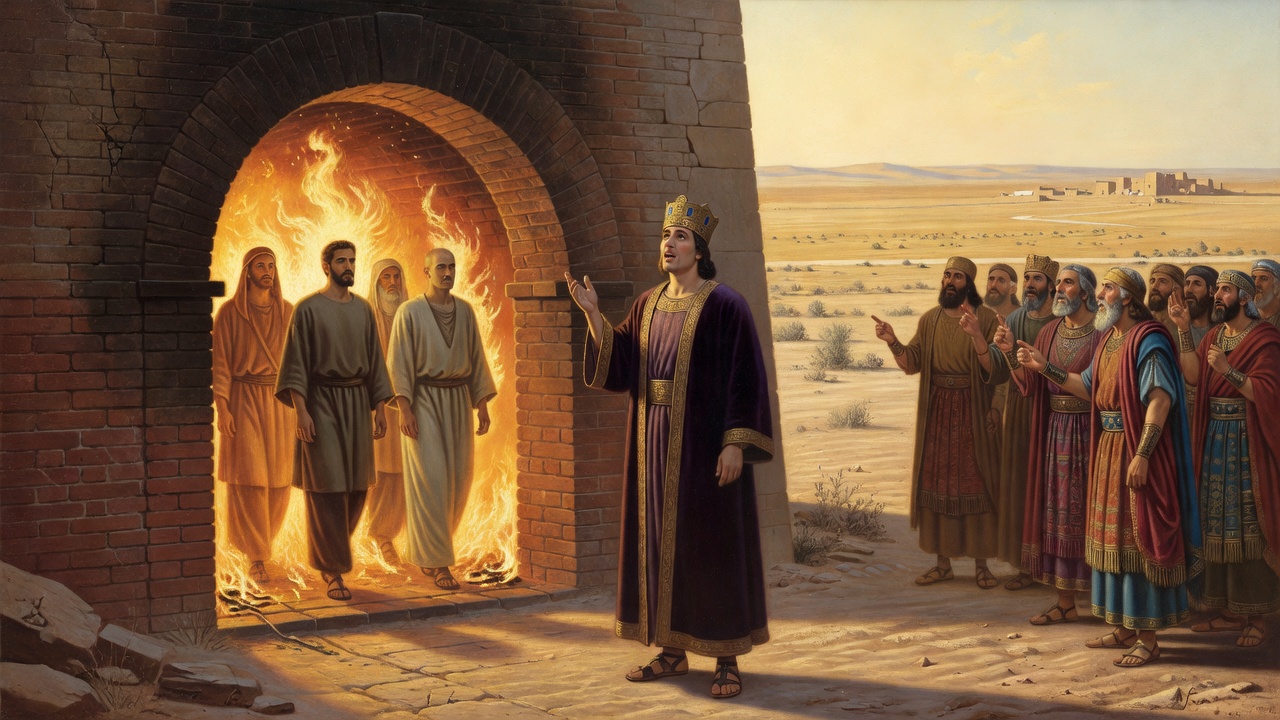
19Then Nabuchodonosor was filled with wrath, and the form of his countenance was changed towards Sedrach, Misach, and Abdenago: and he gave orders to heat the furnace seven times more than usual, until it should burn to the uttermost. 20And he commanded mighty men to bind Sedrach, Misach, and Abdenago, and to cast them into the burning fiery furnace. 21Then those men were bound with their coats, and caps, and hose, and were cast into the midst of the burning fiery furnace, 22forasmuch as the king's word prevailed; and the furnace was made exceeding hot. 23Then these three men, Sedrach, Misach, and Abdenago, fell bound into the midst of the burning furnace, and walked in the midst of the flame, singing praise to God, and blessing the Lord. 24And Nabuchodonosor heard them singing praises; and he wondered, and rose up in haste, and said to his nobles, Did we not cast three men bound into the midst of the fire? and they said to the king, Yes, O king. 25And the king said, But I see four men loose, and walking in the midst of the fire, and there has no harm happened to them; and the appearance of the fourth is like the Son of God. 26Then Nabuchodonosor drew near to the door of the burning fiery furnace, and said, Sedrach, Misach, and Abdenago, you⌃ servants of the most high God, proceed forth, and come here. So Sedrach, Misach, and Abdenago, came forth out of the midst of the fire. 27Then were assembled the satraps, and captains, and heads of provinces, and the royal princes; and they saw the men, and perceived that the fire had not had power against their bodies, and the hair of their head was not burnt, and their coats were not scorched, nor was the smell of fire upon them. 28And king Nabuchodonosor answered and said, Blessed be the God of Sedrach, Misach, and Abdenago, who has sent his angel, and delivered his servants, because they trusted in him; and they have changed the king's word, and delivered their bodies to be burnt, that they might not serve nor worship any god, except their own God. 29Therefore I publish a decree: Every people, tribe, or language, that shall speak reproachfully against the God of Sedrach, Misach, and Abdenago shall be destroyed, and their houses shall be plundered: because there is no other God who shall be able to deliver thus. 30Then the king promoted Sedrach, Misach, and Abdenago, in the province of Babylon, and advanced them, and gave them authority to rule over all the Jews who were in his kingdom. 31King Nabuchodonosor to all nations, tribes, and tongues, who dwell in all the earth; Peace be multiplied to you. 32It seemed good to me to declare to you the signs and wonders which the most high God has wrought with me, 33how great and mighty they are: his kingdom is an everlasting kingdom, and his power to all generations.
¿Sabías que…?
La estatua de oro y el horno ardiente
- La llanura de Dura, cuyo nombre significa "el círculo", se encontraba cerca de Babilonia, donde el rey Nabucodonosor levantó una estatua de oro de sesenta codos de alto y seis de ancho. En uno de los montículos del lugar se halló la base de una estatua colosal, considerada por investigadores como el pedestal de esta imagen de oro.Fuentes: Dura · el propio texto bíblico
- Sadrac y Mesac eran nombres babilónicos dados a los jóvenes hebreos cautivos Ananías y Misael, quienes fueron educados en Babilonia y puestos a cargo de la provincia. A pesar de su posición oficial, ellos y su compañero Abed-nego prefirieron ser arrojados al horno de fuego ardiente antes que adorar la estatua del rey.Fuentes: Shadrach · Meshach · el propio texto bíblico
- El rey Nabucodonosor, cuyo nombre en babilonio significa "¡Nebo, protege la corona!", fue el poderoso soberano que sucedió a su padre Nabopolasar. En inscripciones reales se llamaba a sí mismo "el favorito de Nebo", reflejando el entorno religioso babilónico frente al cual los tres hebreos mantuvieron su lealtad.Fuentes: Nebuchadnezzar · el propio texto bíblico
Notas escritas con ayuda de IA a partir de fuentes abiertas (Theographic Bible Metadata, CC BY-SA 4.0; Easton’s Bible Dictionary, dominio público) y revisadas antes de publicarse.
Lugares de este capítulo
Solo aparecen lugares identificados con alta confianza (90 % o más según las fuentes académicas reunidas por OpenBible). Mapa de la época: DARE (Digital Atlas of the Roman Empire), CC BY 4.0; mapa actual: © colaboradores de OpenStreetMap; lugares: OpenBible.info (CC BY 4.0).
Créditos y licencia de esta traducción
LXX2012: Septuagint in British/International English 2012
The Septuagint with Apocrypha, translated from Greek to English by Sir Lancelot C. L. Brenton and published in 1885, with some language updates (British/International English)
Public Domain
Language: English
Dialect (if applicable): British
Language in English: English
Translation by: Sir Lancelot Charles Lee Breton
LXX2012: Septuagint in English 2012, British/International English Edition
This is a translation of the Old Testament and Apocrypha/Deuterocanon from Hebrew to Greek to 19th Century British English, with some updates of spelling and word usage to contemporary British/International English. The original English translation was done by Sir Lancelot Charles Lee Brenton and published by Samuel Bagster & Sons, Ltd., in London in 1851. It has entered the Public Domain due to the passage of sufficient time. In the process of scanning and typing the text, the original poetry and prose formatting, as well as peripheral material like introductions and notes, have been omitted.
This edition of the Septuagint has some language updates. Brenton's word order and punctuation has been mostly retained, meaning that quotation marks are not used, and sentences within quotes may not start with capital letters, as was standard usage in 1851. Names transliterated from Greek to those transliterated from Hebrew in the common English Bibles often differ. These language updates are dedicated to the Public Domain by the author of those edits, Michael Paul Johnson. Therefore this edition may be freely copied, published, etc.
Before considering making changes to the text of this work, I recommend that you consult with God, because this is really His Book.
If you find errors in the text, please report them so that we can correct them.
Donations to help with the expenses of operating this web site and thus help others have free access to the Word of God may be made to us, but are not required. Please see http://MLJohnson.org/partner/ for more about that.
Títulos de sección adaptados de la Berean Standard Bible (dominio público); no forman parte del texto bíblico de esta traducción.
Fuente: http://ebible.org/eng-uk-lxx2012/ · eBible.org