2 Crónicas 13
LXX2012: Septuagint in British/International English 2012 · Toca un versículo para ver sus referencias cruzadas.
Abijah Reigns in Judah
1In the eighteenth year of the reign of Jeroboam Abia began to reign over Juda. 2He reigned three years in Jerusalem. And his mother's name was Maacha, daughter of Uriel of Gabaon. And there was war between Abia and Jeroboam. 3And Abia set the battle in array with an army, with mighty men of war, even four hundred thousand mighty men: and Jeroboam set the battle in array against him with eight hundred thousand, they were mighty warriors of the host.
Civil War against Jeroboam
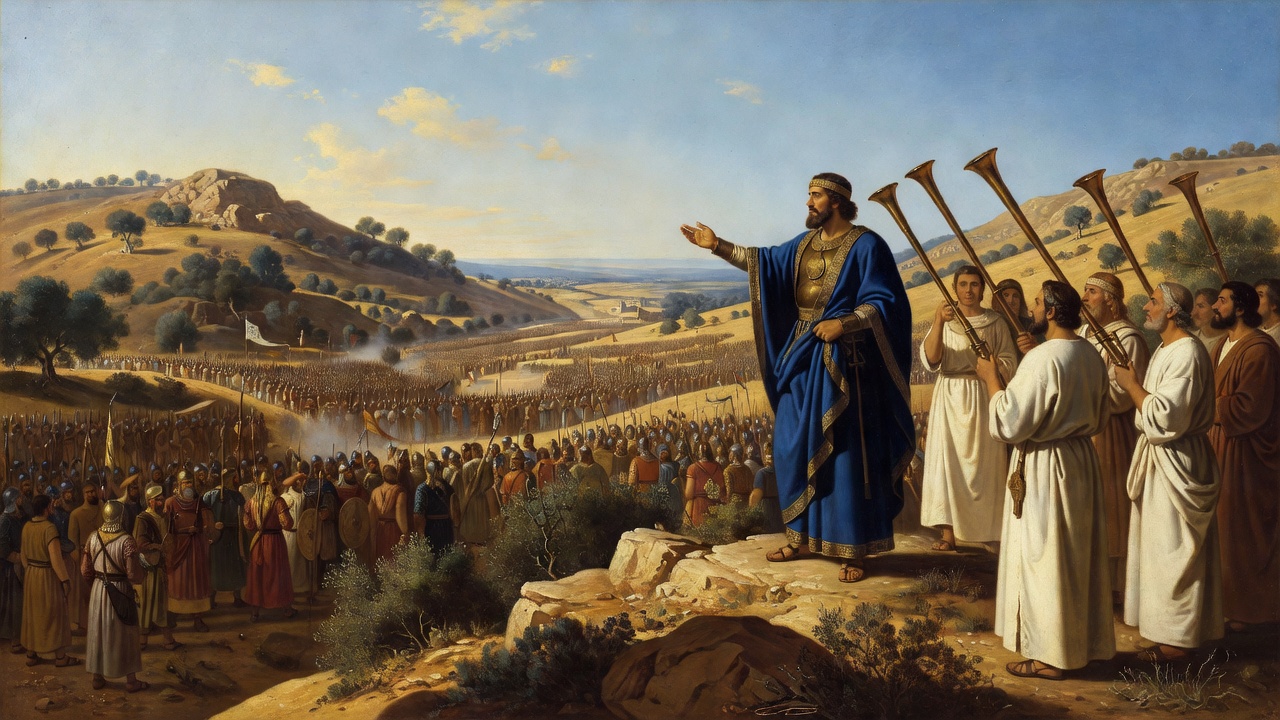
4And Abia rose up from the mount Somoron, which is in mount Ephraim, and said, Hear you⌃, Jeroboam, and all Israel: 5Is it not for you to know that the Lord God of Israel has given a king over Israel for ever to David, and to his sons, by a covenant of salt? 6But Jeroboam the son of Nabat, the servant of Solomon the son of David, is risen up, and has revolted from his master: 7and there are gathered to him pestilent men, transgressors, and he has risen up against Roboam the son of Solomon, while Roboam was young and fearful in heart, and he withstood him not. 8And now you⌃ profess to resist the kingdom of the Lord in the hand of the sons of David; and you⌃ are a great multitude, and with you are golden calves, which Jeroboam made you for gods. 9Did you⌃ not cast out the priests of the Lord, the sons of Aaron, and the Levites, and make to yourselves priests of the people of any other land? whoever came to consecrate himself with a calf of the heard and seven rams, he forthwith became a priest to that which is no god. 10But we have not forsaken the Lord our God, and his priests, the sons of Aaron, and the Levites, minister to the Lord; and in their daily courses 11they sacrifice to the Lord whole burnt offering, morning and evening, and compound incense, and set the show bread on the pure table; and there is the golden candlestick, and the lamps for burning, to light in the evening: for we keep the charge of the Lord God of our fathers; but you⌃ have forsaken him. 12And, behold, the Lord and his priests are with us at our head, and the signal trumpets to sound an alarm over us. Children of Israel, fight not against the Lord God of our fathers; for you⌃ shall not prosper. 13Now Jeroboam had caused an ambush to come round upon him from behind: and he himself was before Juda, and the ambush behind. 14And Juda looked back, and, behold, the battle was against them before and behind: and they cried to the Lord, and the priests sounded with the trumpets. 15And the men of Juda shouted: and it came to pass, when the men of Juda shouted, that the Lord struck Jeroboam and Israel before Abia and Juda. 16And the children of Israel fled from before Juda; and the Lord delivered them into their hands. 17And Abia and his people struck them with a great slaughter: and there fell slain of Israel five hundred thousand mighty men. 18So the children of Israel were brought low in that day, and the children of Juda prevailed, because they trusted on the Lord God of their fathers. 19And Abia pursued after Jeroboam, and he took from him the cities, Baethel and her towns, and Jesyna and her towns, and Ephron and her towns. 20And Jeroboam did not recover strength again all the days of Abia: and the Lord struck him, and he died. 21But Abia strengthened himself, and took to himself fourteen wives, and he begot twenty-two sons, and sixteen daughters. 22And the rest of the acts of Abia, and his deeds, and his sayings, are written in the book of the prophet Addo.
¿Sabías que…?
La victoria de Abías sobre Jeroboam
- Antes de la batalla, el rey Abías de Judá se situó en el monte Zemaraim, en la región montañosa de Efraín, para hablar a Jeroboam y a Israel, defendiendo la dinastía davídica mediante un pacto perpetuo de sal.Fuentes: el propio texto bíblico · Mount Zemaraim · Abijah
- Abías contrastó las prácticas religiosas de ambos reinos, señalando que Judá conservaba el sacerdocio aarónico y los rituales regulares del templo, mientras que Jeroboam había expulsado a los levitas y consagrado sacerdotes para los becerros de oro.Fuentes: el propio texto bíblico · Aaron
- Aunque Jeroboam tendió una emboscada por la retaguardia del ejército de Judá, Judá prevaleció tras clamar a Dios y hacer sonar las trompetas sagradas, tomando posteriormente ciudades como Betel, Jesaná y Efrón.Fuentes: el propio texto bíblico · Bethel (of Palestine) · Jeshanah
Notas escritas con ayuda de IA a partir de fuentes abiertas (Theographic Bible Metadata, CC BY-SA 4.0; Easton’s Bible Dictionary, dominio público) y revisadas antes de publicarse.
Lugares de este capítulo
- Jerusalem · 31.777, 35.234 · versículo 2
- Jeshanah · Hoy: Burj el Isaneh · 31.999, 35.260 · versículo 19
Solo aparecen lugares identificados con alta confianza (90 % o más según las fuentes académicas reunidas por OpenBible). Mapa de la época: DARE (Digital Atlas of the Roman Empire), CC BY 4.0; mapa actual: © colaboradores de OpenStreetMap; lugares: OpenBible.info (CC BY 4.0).
Créditos y licencia de esta traducción
LXX2012: Septuagint in British/International English 2012
The Septuagint with Apocrypha, translated from Greek to English by Sir Lancelot C. L. Brenton and published in 1885, with some language updates (British/International English)
Public Domain
Language: English
Dialect (if applicable): British
Language in English: English
Translation by: Sir Lancelot Charles Lee Breton
LXX2012: Septuagint in English 2012, British/International English Edition
This is a translation of the Old Testament and Apocrypha/Deuterocanon from Hebrew to Greek to 19th Century British English, with some updates of spelling and word usage to contemporary British/International English. The original English translation was done by Sir Lancelot Charles Lee Brenton and published by Samuel Bagster & Sons, Ltd., in London in 1851. It has entered the Public Domain due to the passage of sufficient time. In the process of scanning and typing the text, the original poetry and prose formatting, as well as peripheral material like introductions and notes, have been omitted.
This edition of the Septuagint has some language updates. Brenton's word order and punctuation has been mostly retained, meaning that quotation marks are not used, and sentences within quotes may not start with capital letters, as was standard usage in 1851. Names transliterated from Greek to those transliterated from Hebrew in the common English Bibles often differ. These language updates are dedicated to the Public Domain by the author of those edits, Michael Paul Johnson. Therefore this edition may be freely copied, published, etc.
Before considering making changes to the text of this work, I recommend that you consult with God, because this is really His Book.
If you find errors in the text, please report them so that we can correct them.
Donations to help with the expenses of operating this web site and thus help others have free access to the Word of God may be made to us, but are not required. Please see http://MLJohnson.org/partner/ for more about that.
Títulos de sección adaptados de la Berean Standard Bible (dominio público); no forman parte del texto bíblico de esta traducción.
Fuente: http://ebible.org/eng-uk-lxx2012/ · eBible.org