1 Samuel 19
LXX2012: Septuagint in British/International English 2012 · Toca un versículo para ver sus referencias cruzadas.
Saul Tries to Kill David
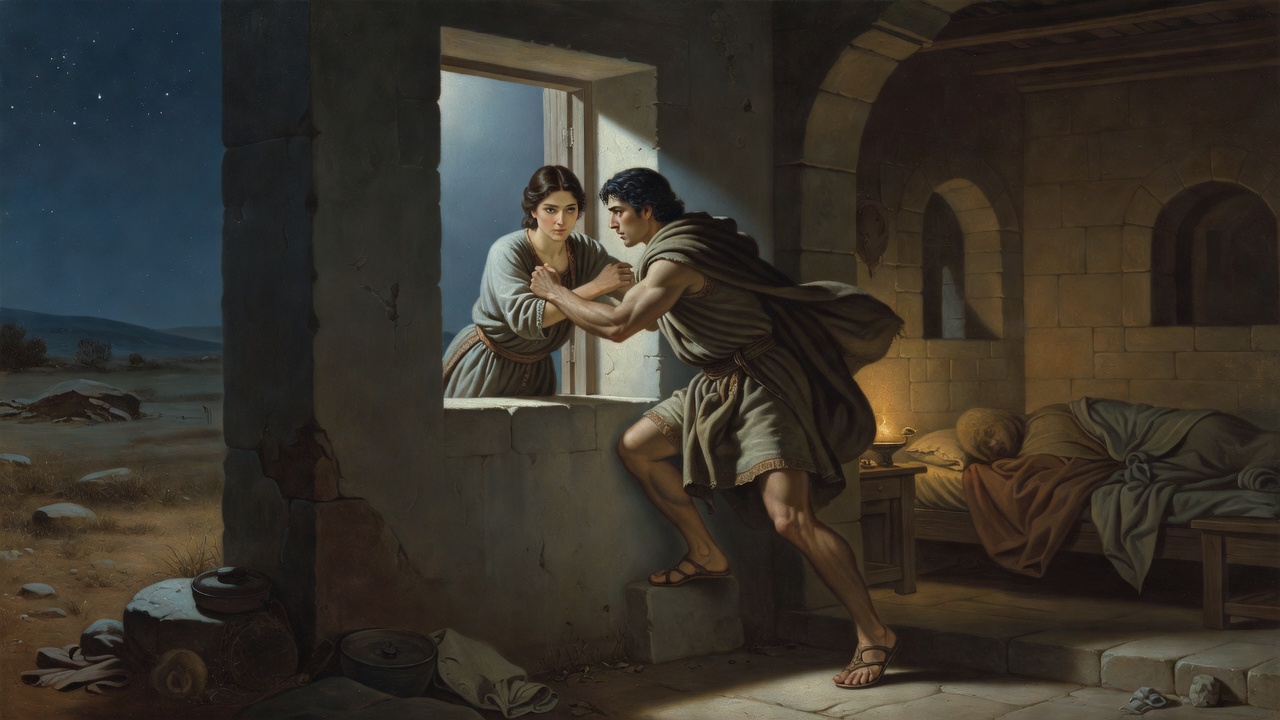
1And Saul spoke to Jonathan his son, and to all his servants, to kill David. 2And Jonathan, Saul's son, loved David much: and Jonathan told David, saying, Saul seeks to kill you: take heed to yourself therefore to-morrow morning, and hide yourself, and dwell in secret. 3And I will go forth, and stand near my father in the field where you shall be, and I will speak concerning you to my father; and I will see what his answer may be, and I will tell you. 4And Jonathan spoke favourably concerning David to Saul his father, and said to him, Let not the king sin against your servant David, for he has not sinned against you, and his deeds are very good. 5And he put his life in his hand, and struck the Philistine, and the Lord wrought a great deliverance; and all Israel saw, and rejoined: why then do you sin against innocent blood, to kill David without a cause? 6And Saul listened to the voice of Jonathan; and Saul swore, saying, As the Lord lives, he shall not die. 7And Jonathan called David, and told him all these words; and Jonathan brought David in to Saul, and he was before him as in former times. 8And there was again war against Saul; and David did valiantly, and fought against the Philistines, and struck them with a very great slaughter, and they fled from before him. 9And an evil spirit from God was upon Saul, and he was resting in his house, and a spear was in his hand, and David was playing on the harp with his hands. 10And Saul sought to strike David with the spear; and David withdrew suddenly from the presence of Saul; and he drove the spear into the wall; and David retreated and escaped. 11And it came to pass in that night, that Saul sent messengers to the house of David to watch him, in order to kill him in the morning; and Melchol David's wife told him, saying, Unless you save your life this night, to-morrow you shall be slain. 12So Melchol lets David down by the window, and he departed, and fled, and escaped. 13And Melchol took images, and laid them on the bed, and she put the liver of a goat by his head, and covered them with clothes. 14And Saul sent messengers to take David; and they say that he is sick. 15And he sends to David, saying, Bring him to me on the bed, that I may kill him. 16And the messengers come, and, behold, the images were on the bed, and the goat's liver at his head. 17And Saul said to Melchol, Why have you thus deceived me, and suffered my enemy to depart, and he has escaped? and Melchol said to Saul, He said, let me go, and if not, I will kill you. 18So David fled, and escaped, and comes to Samuel to Armathaim, and tells him all that Saul had done to him: and Samuel and David went, and lived in Navath in Rama. 19And it was told Saul, saying, Behold, David is in Navath in Rama. 20And Saul sent messengers to take David, and they saw the assembly of the prophets, and Samuel stood as appointed over them; and the Spirit of God came upon the messengers of Saul, and they prophesy. 21And it was told Saul, and he sent other messengers, and they also prophesied: and Saul sent again a third set of messengers, and they also prophesied. 22And Saul was very angry, and went himself also to Armathaim, and he comes as far as the well of the threshing floor that is in Sephi; and he asked and said, Where are Samuel and David? And they said, Behold, in Navath in Rama. 23And he went thence to Navath in Rama: and there came the Spirit of God upon him also, and he went on prophesying till he came to Navath in Rama. 24And he took off his clothes, and prophesied before them; and lay down naked all that day and all that night: therefore they said, Is Saul also amongst the prophets?
¿Sabías que…?
Las huidas de David de Saúl
- Cuando Saúl envió mensajeros para matar a David en su casa, Mical, la esposa de David, lo ayudó a escapar por una ventana. Luego colocó un ídolo doméstico disfrazado con pelo de cabra y mantos en la cama para retrasar a los mensajeros y darle tiempo a David para huir.Fuentes: el propio texto bíblico · Michal
- David huyó hacia el profeta Samuel en Ramá y fue con él a Naiot. El nombre Naiot significa moradas y se refiere a un asentamiento cerca de Ramá donde vivía una comunidad de profetas bajo la dirección de Samuel.Fuentes: el propio texto bíblico · Naioth · Samuel
- Al perseguir a David hacia Ramá, Saúl se detuvo a pedir información junto a la gran cisterna de Secú, un lugar situado en una colina entre Guibeá y Ramá.Fuentes: el propio texto bíblico · Secu
Notas escritas con ayuda de IA a partir de fuentes abiertas (Theographic Bible Metadata, CC BY-SA 4.0; Easton’s Bible Dictionary, dominio público) y revisadas antes de publicarse.
Lugares de este capítulo
- Secu · Hoy: between Gibeah and Ramah · 31.937, 35.145 · versículo 22
Solo aparecen lugares identificados con alta confianza (90 % o más según las fuentes académicas reunidas por OpenBible). Mapa de la época: DARE (Digital Atlas of the Roman Empire), CC BY 4.0; mapa actual: © colaboradores de OpenStreetMap; lugares: OpenBible.info (CC BY 4.0).
Créditos y licencia de esta traducción
LXX2012: Septuagint in British/International English 2012
The Septuagint with Apocrypha, translated from Greek to English by Sir Lancelot C. L. Brenton and published in 1885, with some language updates (British/International English)
Public Domain
Language: English
Dialect (if applicable): British
Language in English: English
Translation by: Sir Lancelot Charles Lee Breton
LXX2012: Septuagint in English 2012, British/International English Edition
This is a translation of the Old Testament and Apocrypha/Deuterocanon from Hebrew to Greek to 19th Century British English, with some updates of spelling and word usage to contemporary British/International English. The original English translation was done by Sir Lancelot Charles Lee Brenton and published by Samuel Bagster & Sons, Ltd., in London in 1851. It has entered the Public Domain due to the passage of sufficient time. In the process of scanning and typing the text, the original poetry and prose formatting, as well as peripheral material like introductions and notes, have been omitted.
This edition of the Septuagint has some language updates. Brenton's word order and punctuation has been mostly retained, meaning that quotation marks are not used, and sentences within quotes may not start with capital letters, as was standard usage in 1851. Names transliterated from Greek to those transliterated from Hebrew in the common English Bibles often differ. These language updates are dedicated to the Public Domain by the author of those edits, Michael Paul Johnson. Therefore this edition may be freely copied, published, etc.
Before considering making changes to the text of this work, I recommend that you consult with God, because this is really His Book.
If you find errors in the text, please report them so that we can correct them.
Donations to help with the expenses of operating this web site and thus help others have free access to the Word of God may be made to us, but are not required. Please see http://MLJohnson.org/partner/ for more about that.
Títulos de sección adaptados de la Berean Standard Bible (dominio público); no forman parte del texto bíblico de esta traducción.
Fuente: http://ebible.org/eng-uk-lxx2012/ · eBible.org