1 Samuel 15
LXX2012: Septuagint in British/International English 2012 · Toca un versículo para ver sus referencias cruzadas.
Saul’s Disobedience
1And Samuel said to Saul, The Lord sent me to anoint you king over Israel: and now hear the voice of the Lord. 2Thus said the Lord of hosts, Now will I take vengeance for what Amalec did to Israel, when he met him in the way as he came up out of Egypt. 3And now go, and you shall strike Amalec and Hierim and all that belongs to him, and you shall not save anything of him alive, but you shall utterly destroy him: and you shall devote him and all his to destruction, and you shall spare nothing belonging to him; and you shall kill both man and woman, and infant and suckling, and calf and sheep, and camel and ass. 4And Saul summoned the people, and he numbered them in Galgala, four hundred thousand regular troops, and Juda thirty thousand regular troops. 5And Saul came to the cities of Amalec, and laid wait in the valley. 6And Saul said to the Kinite, Go, and depart out of the midst of the Amalekites, lest I put you with them; for you dealt mercifully with the children of Israel when they went up out of Egypt. So the Kinite departed from the midst of Amalec. 7And Saul struck Amalec from Evilat to Sur fronting Egypt. 8And he took Agag the king of Amalec alive, and he killed all the people and Hierim with the edge of the sword. 9And Saul and all the people saved Agag alive, and the best of the flocks, and of the herds, and of the fruits, of the vineyards, and of all the good things; and they would not destroy them: but every worthless and refuse thing they destroyed.
Samuel Denounces Saul
10And the word of the Lord came to Samuel, saying, 11I have repented that I have made Saul to be king: for he has turned back from following me, and has not kept my word. And Samuel was grieved, and cried to the Lord all night. 12And Samuel rose early and went to meet Israel in the morning, and it was told Saul, saying, Samuel has come to Carmel, and he has raised up help for himself: and he turned his chariot, and came down to Galgala to Saul; and, behold, he was offering up a whole burnt offering to the Lord, the chief of the spoils which he brought out of Amalec. 13And Samuel came to Saul: and Saul said to him, Blessed are you of the Lord: I have performed all that the Lord said. 14And Samuel said, What then is the bleating of this flock in my ears, and the sound of the oxen which I hear? 15And Saul said, I have brought them out of Amalec, that which the people preserved, even the best of the sheep, and of the cattle, that it might be sacrificed to the Lord your God, and the rest have I utterly destroyed. 16And Samuel said to Saul, Stay, and I will tell you what the Lord has said to me this night: and he said to him, Say on. 17And Samuel said to Saul, Are you not little in his eyes, though a leader of one of the tribes of Israel? and yet the Lord anointed you to be king over Israel. 18And the Lord sent you on a journey, and said to you, Go, and utterly destroy: you shall kill the sinners against me, even the Amalekites; and you shall war against them until you have consumed them. 19And why did not you listen to the voice of the Lord, but did haste to fasten upon the spoils, and did that which was evil in the sight of the Lord? 20And Saul said to Samuel, Because I listened to the voice of the people: yet I went the way by which the Lord sent me, and I brought Agag the king of Amalec, and I destroyed Amalec. 21But the people took of the spoils the best flocks and herds out of that which was destroyed, to sacrifice before the Lord our God in Galgal. 22And Samuel said, Does the Lord take pleasure in whole burnt offerings and sacrifices, as in hearing the words of the Lord? behold, obedience is better than a good sacrifice, and hearkening than the fat of rams. 23For sin is as divination; idols bring on pain and grief. Because you have rejected the word of the Lord, the Lord also shall reject you from being king over Israel.
Saul’s Confession
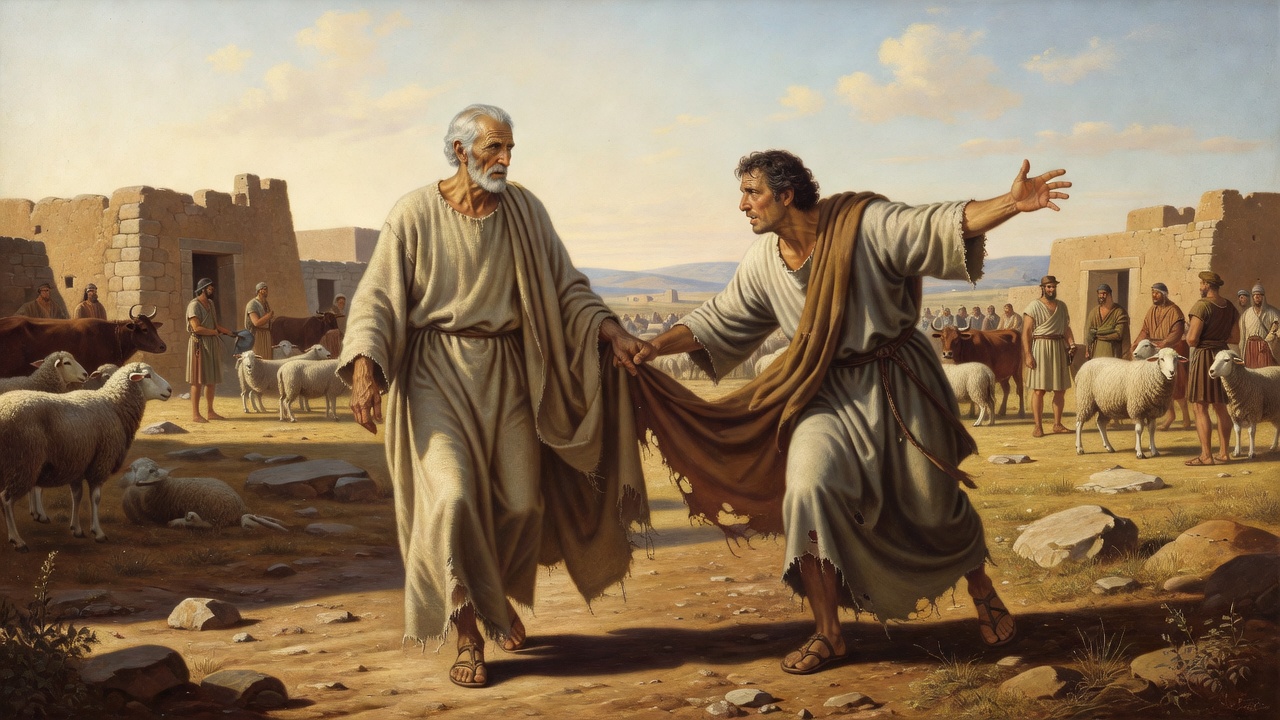
24And Saul said to Samuel, I have sinned, in that I have transgressed the word of the Lord and your direction; for I feared the people, and I listened to their voice. 25And now remove, I pray you, my sin, and turn back with me, and I will worship the Lord your God. 26And Samuel said to Saul, I will not turn back with you, for you have rejected the word of the Lord, and the Lord will reject you from being king over Israel. 27And Samuel turned his face to depart, and Saul caught hold of the skirt of his garment, and tore it. 28And Samuel said to him, The Lord has torn your kingdom from Israel out of your hand this day, and will give it to your neighbour who is better than you. 29And Israel shall be divided to two: and God will not turn nor repent, for he is not as a man to repent. 30And Saul said, I have sinned; yet honour me, I pray you, before the elders of Israel, and before my people; and turn back with me, and I will worship the Lord your God. 31So Samuel turned back after Saul, and he worshipped the Lord. 32And Samuel said, Bring me Agag the king of Amalec: and Agag came to him trembling; and Agag said Is death thus bitter? 33And Samuel said to Agag, As your sword has bereaved women of their children, so shall your mother be made childless amongst women: and Samuel killed Agag before the Lord in Galgal. 34And Samuel departed to Armathaim, and Saul went up to his house at Gabaa. 35And Samuel did not see Saul again till the day of his death, for Samuel mourned after Saul, and the Lord repented that he had made Saul king over Israel.
¿Sabías que…?
La desobediencia y el rechazo de Saúl
- Los amalecitas eran un pueblo pastoril y nómada que habitaba las tierras áridas entre Havila y Shur, en la frontera de Egipto. Su conflicto con Israel comenzó cuando emboscaron a los israelitas tras la salida de Egipto, lo cual constituye el trasfondo del juicio ordenado en este capítulo.Fuentes: el propio texto bíblico · Amalek · Shur
- Gilgal era un importante centro religioso y judicial donde Samuel administraba justicia periódicamente y ofrecía sacrificios. Saúl se congregó en Gilgal tras la batalla contra Amalec, convirtiendo este lugar en el escenario donde Samuel declaró que Dios había rechazado a Saúl como rey de Israel.Fuentes: el propio texto bíblico · Gilgal
- El nombre Agag era un título o nombre hereditario utilizado por los reyes de los amalecitas. Aunque Saúl perdonó la vida a Agag y lo mejor del ganado en contra de las instrucciones, Samuel ejecutó el juicio contra el rey cautivo en Gilgal.Fuentes: el propio texto bíblico · Agag · Amalek
Notas escritas con ayuda de IA a partir de fuentes abiertas (Theographic Bible Metadata, CC BY-SA 4.0; Easton’s Bible Dictionary, dominio público) y revisadas antes de publicarse.
Lugares de este capítulo
- Amalek · 30.648, 34.422 · versículos 2, 3, 5, 8, 20, 32
- Egypt · 30.129, 31.308 · versículos 2, 6, 7
- Havilah · Hoy: in the Arabian Peninsula · 23.000, 46.000 · versículo 7
Solo aparecen lugares identificados con alta confianza (90 % o más según las fuentes académicas reunidas por OpenBible). Mapa de la época: DARE (Digital Atlas of the Roman Empire), CC BY 4.0; mapa actual: © colaboradores de OpenStreetMap; lugares: OpenBible.info (CC BY 4.0).
Créditos y licencia de esta traducción
LXX2012: Septuagint in British/International English 2012
The Septuagint with Apocrypha, translated from Greek to English by Sir Lancelot C. L. Brenton and published in 1885, with some language updates (British/International English)
Public Domain
Language: English
Dialect (if applicable): British
Language in English: English
Translation by: Sir Lancelot Charles Lee Breton
LXX2012: Septuagint in English 2012, British/International English Edition
This is a translation of the Old Testament and Apocrypha/Deuterocanon from Hebrew to Greek to 19th Century British English, with some updates of spelling and word usage to contemporary British/International English. The original English translation was done by Sir Lancelot Charles Lee Brenton and published by Samuel Bagster & Sons, Ltd., in London in 1851. It has entered the Public Domain due to the passage of sufficient time. In the process of scanning and typing the text, the original poetry and prose formatting, as well as peripheral material like introductions and notes, have been omitted.
This edition of the Septuagint has some language updates. Brenton's word order and punctuation has been mostly retained, meaning that quotation marks are not used, and sentences within quotes may not start with capital letters, as was standard usage in 1851. Names transliterated from Greek to those transliterated from Hebrew in the common English Bibles often differ. These language updates are dedicated to the Public Domain by the author of those edits, Michael Paul Johnson. Therefore this edition may be freely copied, published, etc.
Before considering making changes to the text of this work, I recommend that you consult with God, because this is really His Book.
If you find errors in the text, please report them so that we can correct them.
Donations to help with the expenses of operating this web site and thus help others have free access to the Word of God may be made to us, but are not required. Please see http://MLJohnson.org/partner/ for more about that.
Títulos de sección adaptados de la Berean Standard Bible (dominio público); no forman parte del texto bíblico de esta traducción.
Fuente: http://ebible.org/eng-uk-lxx2012/ · eBible.org