1 Samuel 13
LXX2012: Septuagint in British/International English 2012 · Toca un versículo para ver sus referencias cruzadas.
War with the Philistines
1And Saul chooses for himself three thousand men of the men of Israel: and there were with Saul two thousand who were in Machmas, and in mount Baethel, and a thousand were with Jonathan in Gabaa of Benjamin: and he sent the rest of the people every man to his tent. 3And Jonathan struck Nasib the Philistine that lived in the hill; and the Philistines hear of it, and Saul sounds the trumpet through all the land, saying, The servants have despised us. 4And all Israel heard say, Saul has struck Nasib the Philistine; now Israel had been put to shame before the Philistines; and the children of Israel went up after Saul in Galgala. 5And the Philistines gather together to war with Israel; and then come up against Israel thirty thousand chariots, and six thousand horsemen, and people as the sand by the seashore for multitude: and they come up, and encamp in Machmas, opposite Baethoron southward. 6And the men of Israel saw that they were in a strait so that they could not draw near, and the people hid themselves in caves, and sheepfolds, and rocks, and ditches, and pits. 7And they that went over went over Jordan to the land of Gad and Galaad: and Saul was yet in Galgala, and all the people followed after him in amazement.
Saul’s Unlawful Sacrifice
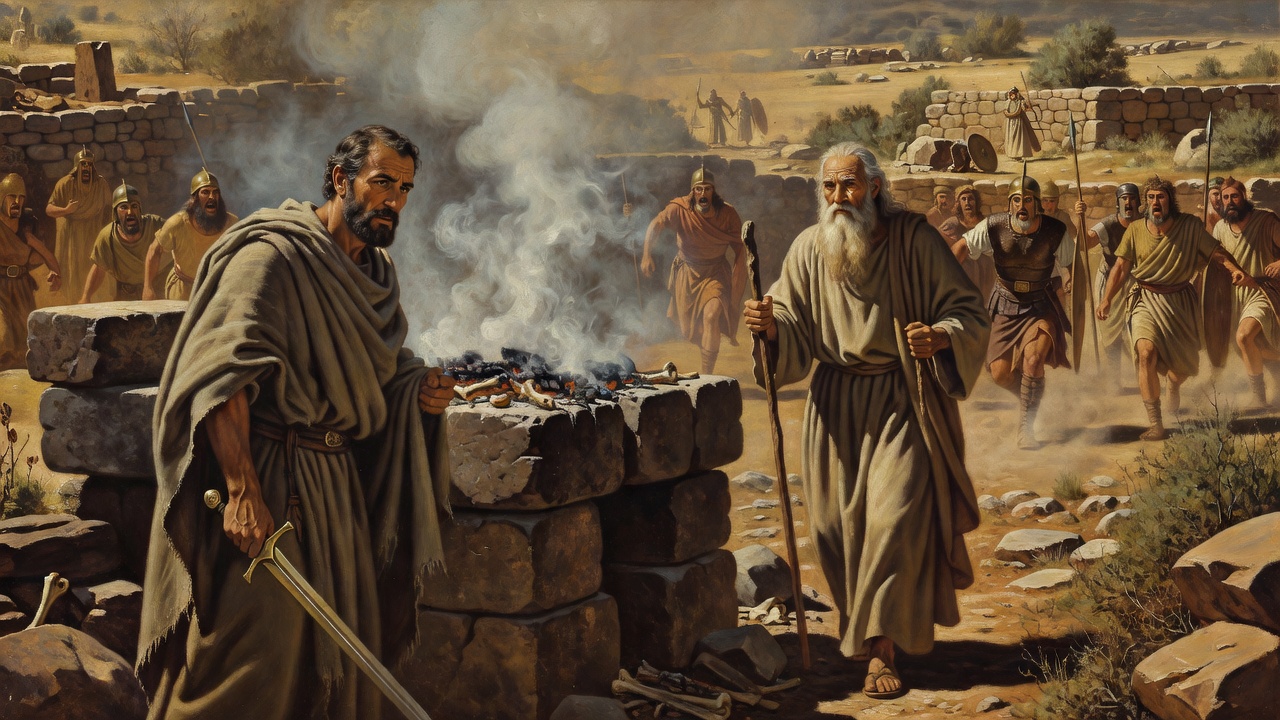
8And he continued seven days for the appointed testimony, as Samuel told him, and Samuel came not to Galgala, and his people were dispersed from him. 9And Saul said, Bring hither victims, that I may offer whole burnt offerings and peace-offerings: and he offered the whole burnt offering. 10And it came to pass when he had finished offering the whole burnt offering, that Samuel arrived, and Saul went out to meet him, and to bless him. 11And Samuel said, What have you done? and Saul said, Because I saw how the people were scattered from me, and you were not present as you purposed according to the set time of the days, and the Philistines were gathered to Machmas. 12Then I said, Now will the Philistines come down to me to Galgala, and I have not sought the face of the Lord: so I forced myself and offered the whole burnt offering. 13And Samuel said to Saul, You have done foolishly; for you have not kept my command, which the Lord commanded you, as now the Lord would have confirmed your kingdom over Israel for ever. 14But now your kingdom shall not stand to you, and the Lord shall seek for himself a man after his own heart; and the Lord shall appoint him to be a ruler over his people, because you have not kept all that the Lord commanded you. 15And Samuel arose, and departed from Galgala, and the remnant of the people went after Saul to meet him after the men of war, when they had come out of Galgala to Gabaa of Benjamin. And Saul numbered the people that were found with him, about six hundred men.
Israel without Weapons
16And Saul and Jonathan his son, and the people that were found with them, halted in Gabaa, of Benjamin; and they wept: and the Philistines had encamped in Machmas. 17And men came forth to destroy out of the land of the Philistines in three companies; one company turning by the way of Gophera towards the land of Sogal, 18and another company turning the way of Baethoron, and another company turning by the way of Gabae that turns aside to Gai of Sabim. 19And there was not found a smith in all the land of Israel, for the Philistines said, Lest the Hebrews make themselves sword or spear. 20And all Israel went down to the Land of the Philistines to forge every one his reaping-hook and his tool, and every one his axe and his sickle. 21And it was near the time of vintage: and their tools were valued at three shekels for a ploughshare, and there was the same rate for the axe and the sickle. 22And it came to pass in the days of the war of Machmas, that there was not a sword or spear found in the hand of all the people, that were with Saul and Jonathan; but with Saul and Jonathan his son was there found. 23And there went out some from the camp of the Philistines to the place beyond Machmas.
¿Sabías que…?
La impaciencia de Saúl y la amenaza filistea
- Los filisteos mantenían un monopolio sobre la metalurgia para evitar que los israelitas forjaran armas. Por ello, los israelitas debían acudir a los filisteos y pagar tarifas para afilar sus herramientas agrícolas de hierro, por lo que solo Saúl y su hijo Jonatán poseían espadas o lanzas.Fuentes: el propio texto bíblico
- Frente a una abrumadora fuerza filistea, Saúl esperó siete días en Gilgal a que Samuel ofreciera sacrificios. Al ver que sus atemorizados soldados comenzaban a dispersarse, Saúl ofreció el holocausto por sí mismo, lo que llevó a Samuel a declarar que su dinastía real no perduraría.Fuentes: el propio texto bíblico · Gilgal
- El enfrentamiento militar tuvo lugar en la accidentada región montañosa de Benjamín, con las fuerzas filisteas acampadas en Micmas y los hombres de Saúl apostados en Geba. Un escarpado desfiladero conocido como el paso de Micmas separaba a los dos ejércitos.Fuentes: el propio texto bíblico · Michmash · Geba
Notas escritas con ayuda de IA a partir de fuentes abiertas (Theographic Bible Metadata, CC BY-SA 4.0; Easton’s Bible Dictionary, dominio público) y revisadas antes de publicarse.
Lugares de este capítulo
- Gilead · Hoy: Gilead 1 · 32.187, 35.692 · versículo 7
- Jordan · Hoy: Jordan River · 31.761, 35.558 · versículo 7
- Beth-horon · Hoy: Beit Ur al Tahta · 31.895, 35.084 · versículo 18
Solo aparecen lugares identificados con alta confianza (90 % o más según las fuentes académicas reunidas por OpenBible). Mapa de la época: DARE (Digital Atlas of the Roman Empire), CC BY 4.0; mapa actual: © colaboradores de OpenStreetMap; lugares: OpenBible.info (CC BY 4.0).
Créditos y licencia de esta traducción
LXX2012: Septuagint in British/International English 2012
The Septuagint with Apocrypha, translated from Greek to English by Sir Lancelot C. L. Brenton and published in 1885, with some language updates (British/International English)
Public Domain
Language: English
Dialect (if applicable): British
Language in English: English
Translation by: Sir Lancelot Charles Lee Breton
LXX2012: Septuagint in English 2012, British/International English Edition
This is a translation of the Old Testament and Apocrypha/Deuterocanon from Hebrew to Greek to 19th Century British English, with some updates of spelling and word usage to contemporary British/International English. The original English translation was done by Sir Lancelot Charles Lee Brenton and published by Samuel Bagster & Sons, Ltd., in London in 1851. It has entered the Public Domain due to the passage of sufficient time. In the process of scanning and typing the text, the original poetry and prose formatting, as well as peripheral material like introductions and notes, have been omitted.
This edition of the Septuagint has some language updates. Brenton's word order and punctuation has been mostly retained, meaning that quotation marks are not used, and sentences within quotes may not start with capital letters, as was standard usage in 1851. Names transliterated from Greek to those transliterated from Hebrew in the common English Bibles often differ. These language updates are dedicated to the Public Domain by the author of those edits, Michael Paul Johnson. Therefore this edition may be freely copied, published, etc.
Before considering making changes to the text of this work, I recommend that you consult with God, because this is really His Book.
If you find errors in the text, please report them so that we can correct them.
Donations to help with the expenses of operating this web site and thus help others have free access to the Word of God may be made to us, but are not required. Please see http://MLJohnson.org/partner/ for more about that.
Títulos de sección adaptados de la Berean Standard Bible (dominio público); no forman parte del texto bíblico de esta traducción.
Fuente: http://ebible.org/eng-uk-lxx2012/ · eBible.org