1 Reyes 19
LXX2012: Septuagint in British/International English 2012 · Toca un versículo para ver sus referencias cruzadas.
Elijah Flees from Jezebel
1And Achaab told Jezabel his wife all that Eliu had done, and how he had slain the prophets with the sword. 2And Jezabel sent to Eliu, and said, If you are Eliu and I am Jezabel, God do so to me, and more also, if I do not make your life by this time to-morrow as the life of one of them. 3And Eliu feared, and rose, and departed for his life: and he comes to Bersabee to the land of Juda, and he left his servant there. 4And he himself went a day's journey in the wilderness, and came and sat under a juniper tree; and asked concerning his life that he might die, and said, Let it be enough now, O Lord, take, I pray you, my life from me; for I am no better than my fathers. 5And he lay down and slept there under a tree; and behold, some one touched him, and said to him, Arise and eat. 6And Eliu looked, and, behold, at his head there was a cake of meal and a cruse of water; and he arose, and ate and drank, and returned and lay down. 7And the angel of the Lord returned again, and touched him, and said to him, Arise, and eat, for the journey is far from you. 8And he arose, and ate and drank, and went in the strength of that meat forty days and forty nights to mount Choreb.
The LORD Speaks to Elijah at Horeb
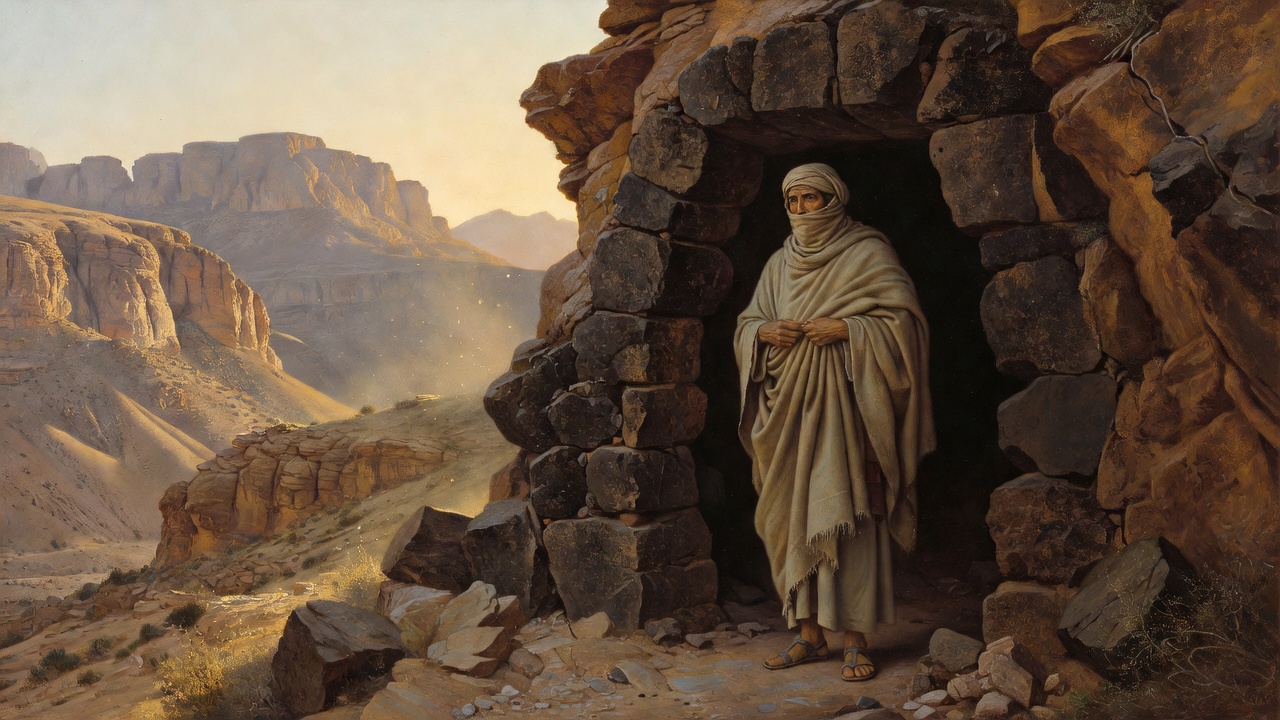
9And he entered there into a cave, and rested there; and, behold, the word of the Lord came to him, and he said, What do you here, Eliu? 10And Eliu said, I have been very jealous for the Lord Almighty, because the children of Israel have forsaken you: they have digged down your altars, and have slain your prophets with the sword; and I only am left alone, and they seek my life to take it. 11And he said, You shall go forth to-morrow, and shall stand before the Lord in the mount; behold, the Lord will pass by. And, behold, a great and strong wind rending the mountains, and crushing the rocks before the Lord; but the Lord was not in the wind; and after the wind an earthquake; but the Lord was not in the earthquake: 12and after the earthquake a fire; but the Lord was not in the fire: and after the fire the voice of a gentle breeze. 13And it came to pass when Eliu heard, that he wrapped his face in his mantle, and went forth and stood in the cave: and, behold, a voice came to him and said, What do you here, Eliu? 14And Eliu said, I have been very jealous for the Lord Almighty; for the children of Israel have forsaken your covenant, and they have overthrown your altars, and have slain your prophets with the sword! and I am left entirely alone, and they seek my life to take it. 15And the Lord said to him, Go, return, and you shall come into the way of the wilderness of Damascus: and you shall go and anoint Azael to be king over Syria. 16And Ju the son of Namessi shall you anoint to be king over Israel; and Elisaie the son of Saphat shall you anoint to be prophet in your room. 17And it shall come to pass, that him that escapes from the sword of Azael, Ju shall kill; and him that escapes from the sword of Ju, Elisaie shall kill. 18And you shall leave in Israel seven thousand men, all the knees which had not bowed themselves to Baal, and every mouth which had not worshipped him.
The Call of Elisha
19And he departed thence, and finds Elisaie the son of Saphat, and he was ploughing with oxen; there were twelve yoke before him, and he with the twelve, and he passed by to him, and cast his mantle upon him. 20And Elisaie left the cattle, and ran after Eliu and said, I will kiss my father, and follow after you. And Eliu said, Return, for I have done a work for you. 21And he returned from following him, and took a yoke of oxen, and killed them, and boiled them with the instruments of the oxen, and gave to the people, and they ate: and he arose, and went after Eliu, and ministered to him.
¿Sabías que…?
Elías en el monte Horeb y el llamamiento de Eliseo
- El monte Horeb, identificado también en la tradición bíblica con el monte Sinaí, fue la cordillera donde Israel recibió el pacto y la ley. El viaje de cuarenta días de Elías hacia el sur hasta Horeb sitúa su encuentro con Dios en el mismo escenario de las revelaciones concedidas a Moisés.Fuentes: el propio texto bíblico · Horeb
- Al ordenar a Elías que unja a Hazael como rey de Siria y a Jehú como rey de Israel, la narración vincula la autoridad profética con la sucesión geopolítica de ambas naciones, asegurando a Elías que aún quedaban siete mil israelitas fieles.Fuentes: el propio texto bíblico · Hazael · Jehu
- Echar el manto sobre los hombros de Eliseo mientras este araba con doce yuntas de bueyes en Abel-mehola fue un acto simbólico que lo designó como discípulo, heredero adoptivo y sucesor profético de Elías.Fuentes: el propio texto bíblico · Elisha · Abel-meholah
Notas escritas con ayuda de IA a partir de fuentes abiertas (Theographic Bible Metadata, CC BY-SA 4.0; Easton’s Bible Dictionary, dominio público) y revisadas antes de publicarse.
Lugares de este capítulo
- Mount Horeb · Hoy: Jebel Musa · 28.540, 33.973 · versículo 8
- Damascus · 33.511, 36.306 · versículo 15
- Syria · Hoy: Aram · 33.511, 36.306 · versículo 15
Solo aparecen lugares identificados con alta confianza (90 % o más según las fuentes académicas reunidas por OpenBible). Mapa de la época: DARE (Digital Atlas of the Roman Empire), CC BY 4.0; mapa actual: © colaboradores de OpenStreetMap; lugares: OpenBible.info (CC BY 4.0).
Créditos y licencia de esta traducción
LXX2012: Septuagint in British/International English 2012
The Septuagint with Apocrypha, translated from Greek to English by Sir Lancelot C. L. Brenton and published in 1885, with some language updates (British/International English)
Public Domain
Language: English
Dialect (if applicable): British
Language in English: English
Translation by: Sir Lancelot Charles Lee Breton
LXX2012: Septuagint in English 2012, British/International English Edition
This is a translation of the Old Testament and Apocrypha/Deuterocanon from Hebrew to Greek to 19th Century British English, with some updates of spelling and word usage to contemporary British/International English. The original English translation was done by Sir Lancelot Charles Lee Brenton and published by Samuel Bagster & Sons, Ltd., in London in 1851. It has entered the Public Domain due to the passage of sufficient time. In the process of scanning and typing the text, the original poetry and prose formatting, as well as peripheral material like introductions and notes, have been omitted.
This edition of the Septuagint has some language updates. Brenton's word order and punctuation has been mostly retained, meaning that quotation marks are not used, and sentences within quotes may not start with capital letters, as was standard usage in 1851. Names transliterated from Greek to those transliterated from Hebrew in the common English Bibles often differ. These language updates are dedicated to the Public Domain by the author of those edits, Michael Paul Johnson. Therefore this edition may be freely copied, published, etc.
Before considering making changes to the text of this work, I recommend that you consult with God, because this is really His Book.
If you find errors in the text, please report them so that we can correct them.
Donations to help with the expenses of operating this web site and thus help others have free access to the Word of God may be made to us, but are not required. Please see http://MLJohnson.org/partner/ for more about that.
Títulos de sección adaptados de la Berean Standard Bible (dominio público); no forman parte del texto bíblico de esta traducción.
Fuente: http://ebible.org/eng-uk-lxx2012/ · eBible.org