1 Crónicas 13
LXX2012: Septuagint in British/International English 2012 · Toca un versículo para ver sus referencias cruzadas.
David Fetches the Ark
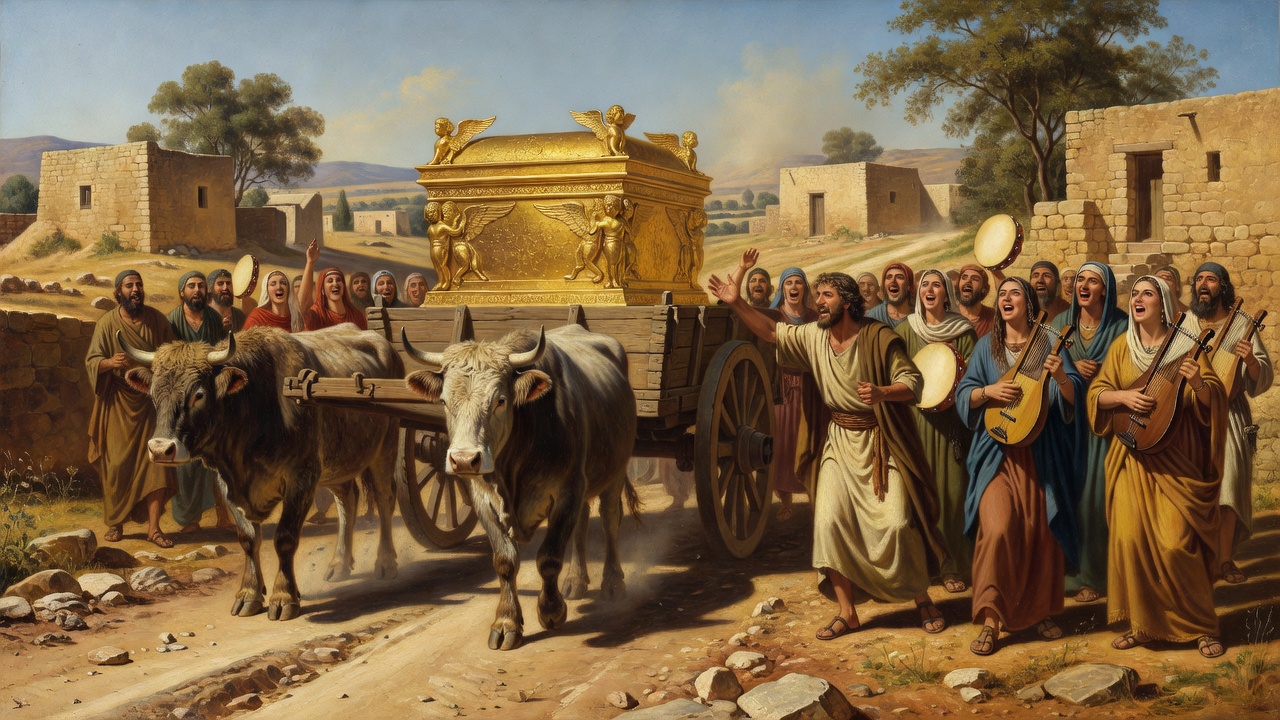
1And David took counsel with the captains of thousands and captains of hundreds, even with every commander. 2And David said to the whole congregation of Israel, If it seem good to you, and it should be prospered by the Lord our God, let us send to our brethren that are left in all the land of Israel, and let the priests the Levites who are with them in the cities of their possession come, and let them be gathered to us. 3And let us bring over to us the ark of our God; for men have not enquired at it since the days of Saul. 4And all the congregation said that they would do thus; for the saying was right in the eyes of all the people. 5So David assembled all Israel, from the borders of Egypt even to the entering in of Hemath, to bring in the ark of God from the city of Jarim. 6And David brought it up: and all Israel went up to the city of David, which belonged to Juda, to bring up thence the ark of the Lord God who sits between the cherubim, whose name is called on it. 7And they set the ark of God on a new wagon brought out of the house of Aminadab: and Oza and his brethren drove the wagon.
Uzzah Touches the Ark
8And David and all Israel were playing before the Lord with all their might, and that together with singers, and with harps, and with lutes, with timbrels, and with cymbals, and with trumpets. 9And they came as far as the threshing floor: and Oza put forth his hand to hold the ark, because the bullock moved it from its place. 10And the Lord was very angry with Oza, and struck him there, because of his stretching forth his hand upon the ark: and he died there before God. 11And David was dispirited, because the Lord had made a breach on Oza: and he called that place the Breach of Oza until this day. 12And David feared God that day, saying, How shall I bring the ark of God in to myself? 13So David brought not the ark home to himself into the city of David, but he turned it aside into the house of Abeddara the Gethite. 14And the ark of God abode in the house of Abeddara three months: and God blessed Abeddara and all that he had.
¿Sabías que…?
El intento de trasladar el arca
- El arca del pacto había permanecido en la casa de Abinadab en Quiriat-jearim (también llamada Baala) desde que fue recuperada de los filisteos. David consultó con los líderes y reunió a israelitas desde el Sijor de Egipto hasta Lebo-hamat en el norte para trasladar el arca a Jerusalén.Fuentes: el propio texto bíblico · Abinadab · Baalah
- Los hijos de Abinadab, Uza y Ahío, guiaban el carro nuevo tirado por bueyes que transportaba el arca, con Ahío caminando delante. Cuando los bueyes tropezaron en la era de Quirón, Uza extendió la mano para sostener el arca y murió allí, por lo que David llamó a ese lugar Pérez-uza.Fuentes: el propio texto bíblico · Uzzah · Ahio · Perez-uzza
- Tras la repentina muerte de Uza, David temió continuar hacia la Ciudad de David y desvió el arca hacia la casa de Obed-edom geteo. El arca permaneció allí durante tres meses, tiempo en el que su casa y todas sus posesiones fueron bendecidas.Fuentes: el propio texto bíblico · Uzzah
Notas escritas con ayuda de IA a partir de fuentes abiertas (Theographic Bible Metadata, CC BY-SA 4.0; Easton’s Bible Dictionary, dominio público) y revisadas antes de publicarse.
Lugares de este capítulo
- Egypt · 30.129, 31.308 · versículo 5
- Kiriath-jearim · Hoy: Deir el Azar · 31.809, 35.104 · versículos 5, 6
- Baalah · Hoy: Deir el Azar · 31.809, 35.104 · versículo 6
- Perez-uzzah · Hoy: within 1 km of Jerusalem · 31.777, 35.234 · versículo 11
- City of David · 31.774, 35.236 · versículo 13
Solo aparecen lugares identificados con alta confianza (90 % o más según las fuentes académicas reunidas por OpenBible). Mapa de la época: DARE (Digital Atlas of the Roman Empire), CC BY 4.0; mapa actual: © colaboradores de OpenStreetMap; lugares: OpenBible.info (CC BY 4.0).
Créditos y licencia de esta traducción
LXX2012: Septuagint in British/International English 2012
The Septuagint with Apocrypha, translated from Greek to English by Sir Lancelot C. L. Brenton and published in 1885, with some language updates (British/International English)
Public Domain
Language: English
Dialect (if applicable): British
Language in English: English
Translation by: Sir Lancelot Charles Lee Breton
LXX2012: Septuagint in English 2012, British/International English Edition
This is a translation of the Old Testament and Apocrypha/Deuterocanon from Hebrew to Greek to 19th Century British English, with some updates of spelling and word usage to contemporary British/International English. The original English translation was done by Sir Lancelot Charles Lee Brenton and published by Samuel Bagster & Sons, Ltd., in London in 1851. It has entered the Public Domain due to the passage of sufficient time. In the process of scanning and typing the text, the original poetry and prose formatting, as well as peripheral material like introductions and notes, have been omitted.
This edition of the Septuagint has some language updates. Brenton's word order and punctuation has been mostly retained, meaning that quotation marks are not used, and sentences within quotes may not start with capital letters, as was standard usage in 1851. Names transliterated from Greek to those transliterated from Hebrew in the common English Bibles often differ. These language updates are dedicated to the Public Domain by the author of those edits, Michael Paul Johnson. Therefore this edition may be freely copied, published, etc.
Before considering making changes to the text of this work, I recommend that you consult with God, because this is really His Book.
If you find errors in the text, please report them so that we can correct them.
Donations to help with the expenses of operating this web site and thus help others have free access to the Word of God may be made to us, but are not required. Please see http://MLJohnson.org/partner/ for more about that.
Títulos de sección adaptados de la Berean Standard Bible (dominio público); no forman parte del texto bíblico de esta traducción.
Fuente: http://ebible.org/eng-uk-lxx2012/ · eBible.org