Salmos 72
Translation for Translators · Toca un versículo para ver sus referencias cruzadas.
A psalm written by Solomon.
A prayer for God to bless the king
1O God, enable me, the king whom you appointed in Israel, to rule justly.
Show/Teach me how to judge matters fairly
2in order that I will judge your people fairly,
that I will govern your oppressed people justly.
3I desire that all over the country—even on the hills and mountains [DOU]—
people will live peacefully and righteously.
4Help me, your king, to defend the poor people
and to rescue needy people and to defeat those who oppress them.
5I desire that your people will revere you as long as the moon shines, forever.
6I desire that my rule will be enjoyed by the people [SIM]
like they enjoy rain on growing crops,
like they enjoy showers that fall on the land.
7I hope/desire that people will live righteously during the years that I rule,
and that my people will live peacefully and prosperously as long as the moon shines.
8I hope/desire that the kings of Israel will rule the people
in all the area from one sea in the east to another in the west,
and from the Euphrates River to the most remote/distant places on earth.
9I hope/desire that those who live in the desert will bow down before them,
and that their enemies will throw themselves on the ground in submission to them.
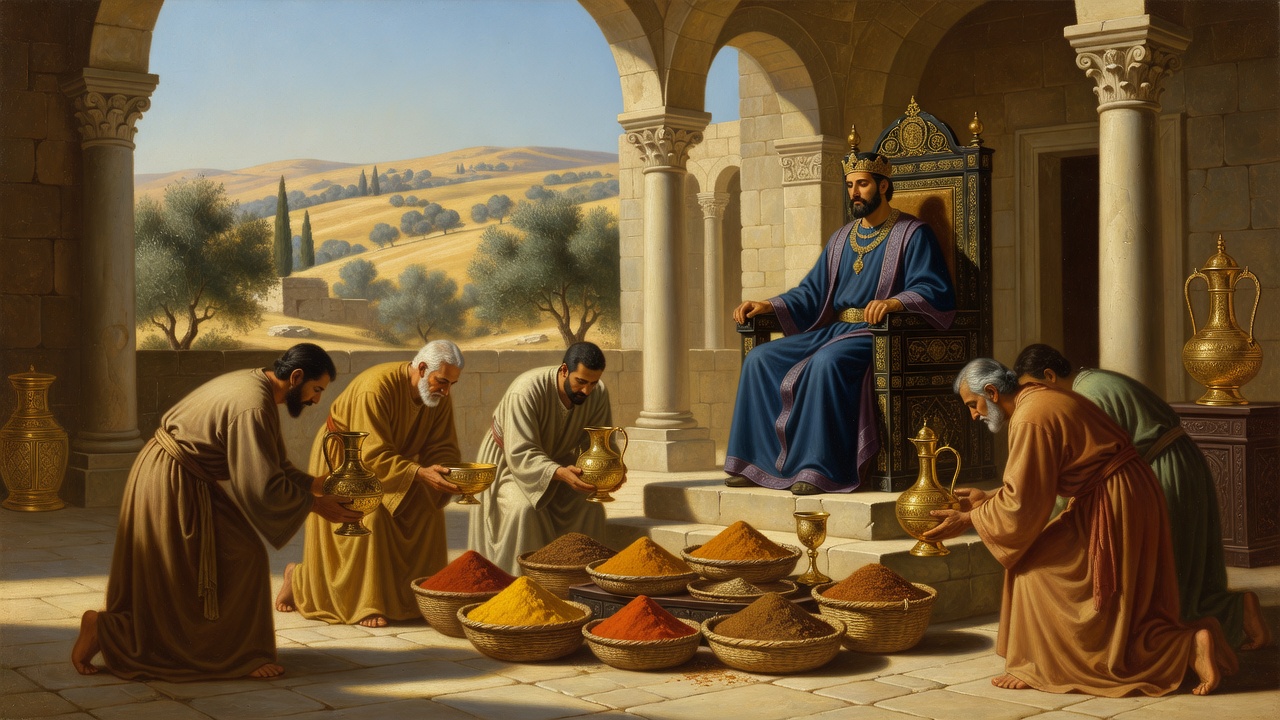
10I hope/desire that the kings of Spain and of the islands in the Mediterranean Sea will bring ◄tribute money/taxes► to the kings of Israel,
and that the kings of Sheba to the south and of Seba to the southwest will bring them gifts.
11I hope/desire that all the other kings in the world will bow before the kings of Israel,
and that people of all nations will serve them.
12They will rescue poor people when they ◄cry out/plead► for help,
and help those who are needy and those who have no one to help them.
13They will pity those who are weak and needy;
he saves the people’s lives.
14Our kings will rescue the people from being oppressed and from being treated cruelly,
because ◄their lives/they► [MTY] are precious to our kings.
15I hope/desire that our kings will live a long time!
I hope/desire that they will be given gold from Sheba.
I desire that people will always pray for our kings
and praise them all the time, every day.
16I hope/desire that the fields will produce plenty of grain everywhere, even on the tops of the hills in the land where they rule,
like the grain that grows on the hills in Lebanon.
I hope/desire that the cities in Israel will be full of people
like the fields are full of grass.
17I desire that the names of our kings will never be forgotten.
I hope/desire that people will remember them as long as the sun shines.
I hope/desire that people of all nations will ask ◄God to bless them/that they will be blessed by God►
just like he has blessed the kings of Israel.
18Praise Yahweh, the God whom we Israelis worship;
he is the only one who does wonderful things.
19Praise him forever!
I desire that ◄his glory will fill the whole world/people all over the world may see that he is very great► [MTY]!
Amen! May it be so!
20That is the end of this group of prayers/songs written by David, the son of Jesse.
¿Sabías que…?
Una oración real por la justicia y la paz universal
- El salmo nombra regiones distantes para ilustrar el tributo universal al rey justo: Tarsis (identificada como un lejano puerto occidental en España), Sabá (un reino del sur de Arabia famoso por su riqueza y comercio de oro y especias) y Seba (ubicada en el noreste de África).Fuentes: el propio texto bíblico · Tarshish · Sheba · Seba
- El texto finaliza con la indicación de que concluyen las oraciones de David, hijo de Isaí, marcando el cierre formal del segundo libro del Salterio. Isaí era un ciudadano de Belén y padre de ocho hijos, de los cuales David era el menor.Fuentes: el propio texto bíblico · David · Jesse
Notas escritas con ayuda de IA a partir de fuentes abiertas (Theographic Bible Metadata, CC BY-SA 4.0; Easton’s Bible Dictionary, dominio público) y revisadas antes de publicarse.
Lugares de este capítulo
- Euphrates · Hoy: Euphrates River · 31.004, 47.442 · versículo 8
- Sheba · 15.348, 44.206 · versículos 10, 15
- Lebanon · 33.540, 35.584 · versículo 16
Solo aparecen lugares identificados con alta confianza (90 % o más según las fuentes académicas reunidas por OpenBible). Mapa de la época: DARE (Digital Atlas of the Roman Empire), CC BY 4.0; mapa actual: © colaboradores de OpenStreetMap; lugares: OpenBible.info (CC BY 4.0).
Créditos y licencia de esta traducción
Translation for Translators
A Bible Translation for Bible Translators which makes implied information explicit in the text as an aid to the translator who may need that information to correctly translate into a particular language.
Copyright © 2008-2017 Ellis W. Deibler, Jr.
Language: English
Dialect: American
This translation is made available to you under the terms of the
Creative Commons Attribution Share-Alike license 4.0.
You have permission to share and redistribute this Bible translation in any format and to make reasonable revisions and adaptations of this translation, provided that:
You include the above copyright and source information.
If you make any changes to the text, you must indicate that you did so in a way that makes it clear that the original licensor is not necessarily endorsing your changes.
If you redistribute this text, you must distribute your contributions under the same license as the original.
Pictures included with Scriptures and other documents on this site are licensed just for use with those Scriptures and documents.
For other uses, please contact the respective copyright owners.
Note that in addition to the rules above, revising and adapting God's Word involves a great responsibility to be true to God's Word. See Revelation 22:18-19.
2026-10-02
Fuente: http://ebible.org/eng-t4t/ · eBible.org