Jeremías 24
Translation for Translators · Toca un versículo para ver sus referencias cruzadas.
Good figs and bad figs
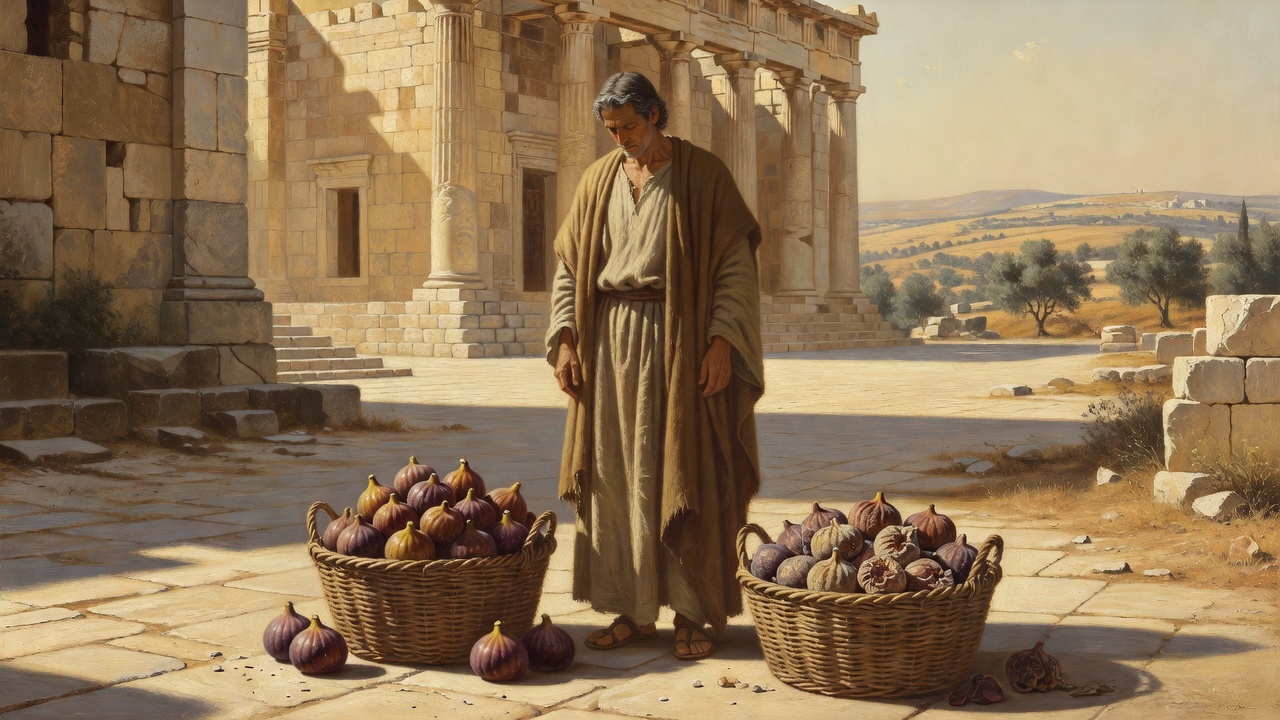
1The army of King Nebuchadnezzar of Babylon captured Jehoiachin, the king of Judah, and his officials, and all his skilled workers [DOU] and took them to Babylon. After that happened, Yahweh gave me a vision. In the vision I saw two baskets of figs that had been placed in front of the temple. 2One basket was full of good figs, like the kind that ripen first. The other basket was filled with figs that were bad/rotten, with the result that they could not be eaten.
3Then Yahweh said to me, “Jeremiah, what do you see?”
I replied, “ I see some figs. Some are very good ones, but some are very bad, with the result that no one would eat them.”
4Then Yahweh gave me this message: 5“This is what I, Yahweh, the God whom the Israeli people say that they worship, say: ‘The good figs represent [SIM] the people of Judah whom I exiled to Babylonia. 6I [SYN] will ◄watch over/take care of► them well, and some day I will bring them back here to Judah. I will establish them and cause them to be strong. I will cause them to be prosperous [MET], and I will not exile them again. 7I will enable them to desire to know [IDM] that I am Yahweh. They will be my people, and I will be their God, because they will return to me sincerely.’
8But I, Yahweh, also say, ‘The bad figs represent [SIM] Zedekiah, the king of Judah, and his officials, and all the other people who remain in Jerusalem, and those who have gone to Egypt. I will do to them like people do to rotten figs. 9I will get rid of them, with the result that people in every nation on the earth will be horrified, and will hate them because they are evil people. Wherever I scatter them, people will make fun of them, and say that they are disgraced, and ridicule them, and curse them. 10And I will cause them to experience wars and famines and diseases, until they have disappeared from this land which I gave to them and to their ancestors.’”
¿Sabías que…?
Las Dos Cestas de Higos
- Jeremías recibió esta visión después de que el rey Nabucodonosor de Babilonia deportara al rey Jeconías (también llamado Joaquín), junto con los magistrados, artesanos y herreros de Jerusalén. Posteriormente, Nabucodonosor colocó a Sedequías como rey sobre la población restante en Judá.Fuentes: el propio texto bíblico · Jehoiachin · Zedekiah · Nebuchadnezzar
- En la visión presentada ante el templo, la cesta de higos excelentes y madurados tempranamente simboliza a los exiliados llevados a Babilonia. El Señor promete preservarlos, darles un corazón para conocerlo y devolverlos a su tierra.Fuentes: el propio texto bíblico
- En contraste, la cesta de higos podridos e incomestibles simboliza al rey Sedequías, a sus dignatarios y al remanente que permaneció en Judá o se refugió en Egipto. En lugar de hallar seguridad, son advertidos de calamidad, hambre, peste y escarnio entre las naciones.Fuentes: el propio texto bíblico · Zedekiah · Egypt
Notas escritas con ayuda de IA a partir de fuentes abiertas (Theographic Bible Metadata, CC BY-SA 4.0; Easton’s Bible Dictionary, dominio público) y revisadas antes de publicarse.
Lugares de este capítulo
- Babylon · 32.543, 44.422 · versículo 1
- Jerusalem · 31.777, 35.234 · versículos 1, 8
- Chaldea · 30.962, 46.104 · versículo 5
- Egypt · 30.129, 31.308 · versículo 8
Solo aparecen lugares identificados con alta confianza (90 % o más según las fuentes académicas reunidas por OpenBible). Mapa de la época: DARE (Digital Atlas of the Roman Empire), CC BY 4.0; mapa actual: © colaboradores de OpenStreetMap; lugares: OpenBible.info (CC BY 4.0).
Créditos y licencia de esta traducción
Translation for Translators
A Bible Translation for Bible Translators which makes implied information explicit in the text as an aid to the translator who may need that information to correctly translate into a particular language.
Copyright © 2008-2017 Ellis W. Deibler, Jr.
Language: English
Dialect: American
This translation is made available to you under the terms of the
Creative Commons Attribution Share-Alike license 4.0.
You have permission to share and redistribute this Bible translation in any format and to make reasonable revisions and adaptations of this translation, provided that:
You include the above copyright and source information.
If you make any changes to the text, you must indicate that you did so in a way that makes it clear that the original licensor is not necessarily endorsing your changes.
If you redistribute this text, you must distribute your contributions under the same license as the original.
Pictures included with Scriptures and other documents on this site are licensed just for use with those Scriptures and documents.
For other uses, please contact the respective copyright owners.
Note that in addition to the rules above, revising and adapting God's Word involves a great responsibility to be true to God's Word. See Revelation 22:18-19.
2026-10-02
Fuente: http://ebible.org/eng-t4t/ · eBible.org