Hechos 17
Translation for Translators · Toca un versículo para ver sus referencias cruzadas.
In Thessalonica, Paul convinced many people that Jesus is the Messiah.
1Paul and Silas traveled through Amphipolis and Apollonia towns and arrived at Thessalonica city. There was a Jewish meeting place there. 2◄On the Sabbath/On the Jewish rest day► Paul went into the meeting house, as he usually did. For three weeks he went there on each Jewish day of rest. Referring to the Scriptures about the Messiah, he spoke to the people who were there. 3He explained and showed that the prophets wrote that the Messiah needed to die and ◄to become alive again/to be raised from the dead afterwards►. He told them: “This man Jesus, whom I am telling you about, is our Messiah. He died and became alive again, just like the prophets predicted.” 4Some of the Jews there were persuaded by {believed} what Paul had said and began to associate with Paul and Silas. There were also many non-Jewish people there who worshipped God and many important women who also believed the message about Jesus, and they began to associate with Paul and Silas.
Some Jews there incited people to oppose Paul and Silas.
5But some leaders of the Jews there in Thessalonica became jealous because many people believed what Paul taught. So they went to the public square and persuaded some lazy men who were loitering there to follow them. In this way, the leaders of the Jews gathered a crowd and incited them to become noisy and start a riot against Paul and Silas. Those Jews and others ran to the house of a man named Jason. He was the man who had invited Paul and Silas to stay at his house. They wanted to bring Paul and Silas outside to where the crowd of people was waiting. 6They discovered that Paul and Silas were not there, but they found Jason and grabbed him. They dragged him and some of the other believers to where the city officials/authorities and many other people were gathered. The men who had brought Jason shouted, “Those two men have caused trouble [IDM] everywhere [HYP] they have gone. Now they have come to our city, 7and this fellow Jason invited them to stay at his house. All the people of this sect oppose what our Emperor has decreed. They say that another person, whose name is Jesus, is the real king!” 8When the crowd of people that had gathered and the city authorities heard that, they became very angry and excited. 9They wanted to put the believers in jail. But instead, the officials made Jason and the other believers pay a fine and told them that they would give the money back to them if Paul and Silas did not cause any more trouble. Then the authorities let Jason and those other believers go.
In Berea, Paul helped many Jews and non-Jews to believe in Jesus.
10So that same night, the believers sent Paul and Silas out of Thessalonica to Berea town. When Paul and Silas arrived there, they went to the Jewish meeting place, on a day when people had gathered there. 11The Jews in Thessalonica had not been very willing to listen to God’s message, but the Jews who lived in Berea were very willing to listen, so they listened very eagerly to the message about Jesus. Every day they read the Scriptures for themselves to find out if what Paul said about the Messiah was true. 12As a result, many of the Jewish people believed in Jesus, and also some of the important non-Jewish women and many non-Jewish men believed in him.
Jews from Thessalonica incited people to oppose Paul.
13But then the Jews in Thessalonica heard people tell them that Paul was in Berea and that he was preaching the message from God about Jesus. So they went to Berea and told people there that what Paul was teaching was not true. Thus, they caused many of those people to get angry at Paul. 14So several of the believers in Berea took Paul to the coast to go to another province. But Silas and Timothy stayed in Berea. 15When Paul and the other men from Berea arrived at the coast, they got on a ship and went to Athens city. Then Paul said to the men who had come with him, “Tell Silas and Timothy to come to me here in Athens as soon as they can.” Then those men left Athens and returned to Berea.
In Athens, idols distressed Paul, so he talked to many people about Jesus.
16In Athens, Paul waited for Silas and Timothy to arrive. In the meantime, he walked around in the city. He became very distressed/disturbed because he saw that throughout [HYP] the city there were many idols. 17So he went to the Jewish meeting place and talked about Jesus with the Jews, and also with the Greeks who had accepted what the Jews believe. He also went to the public square/center every day and talked to the people whom he met there.
When Paul talked about Jesus, he perplexed some teachers.
18Paul met some teachers who liked to talk about what people should believe. People called some of them Epicureans and they called others Stoics. They told Paul what they believed, and they asked him what he believed. Then some of them said to one another, “This ignorant person is just talking nonsense [RHQ]!” Others said, “ We(exc) think that he is teaching people about ◄foreign gods/ new gods that we (exc) have not heard about►.” They said that because Paul was telling them that Jesus had died and had become alive again afterwards. They had not heard that message before.
Athens Council members asked Paul to explain what he had been teaching.
19So they took Paul to the place where the city council met. When they arrived there, they said to Paul, “ Please tell us, what is this new message that you (sg) are teaching people? 20You are teaching some things that startle us (exc), so we want to know what they mean.” 21They said that, because the people of Athens and also the people from other regions who lived there continually talked about what was new to them, or they listened to others tell what was new.
Paul told them about the God whom they did not know.
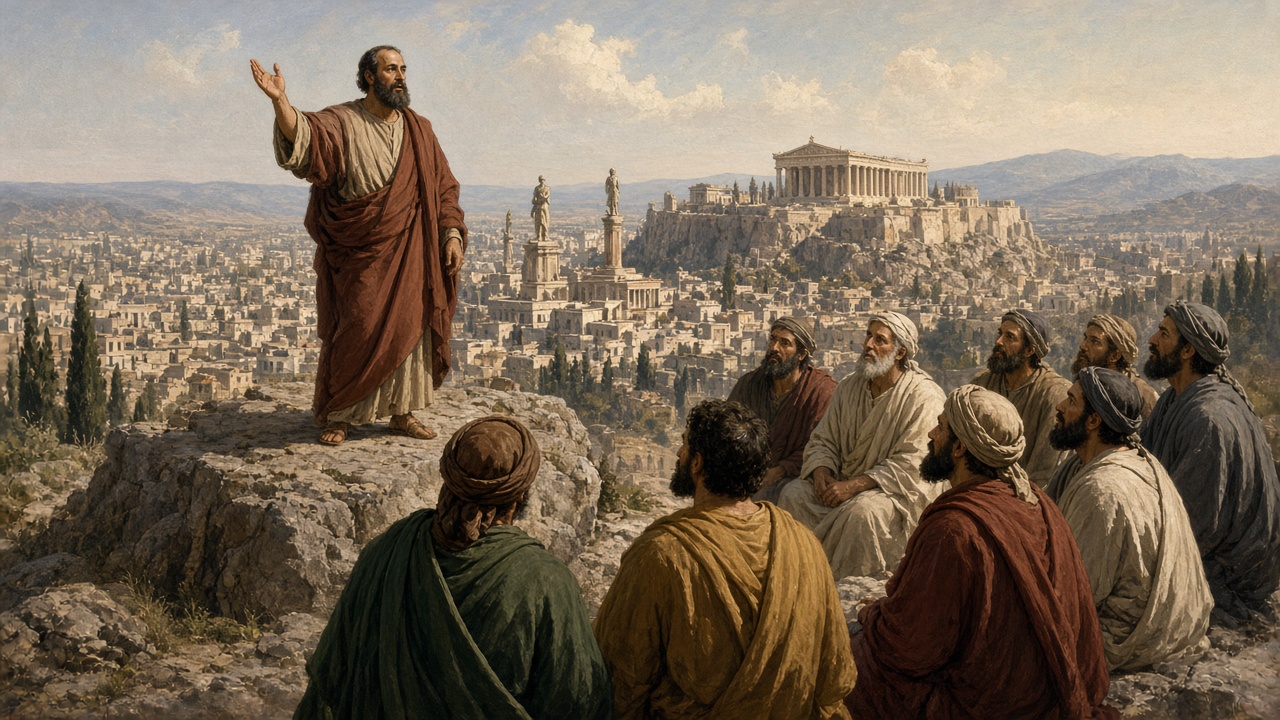
22Then Paul stood up before the men of the city council and said, “Citizens of Athens, I see that you ◄are very religious/think that it is very important to worship many gods►. 23I say that because, while I was walking along and observing the objects that represent different gods that you worship, I even saw an altar that had these words that someone had carved on it: THIS HONORS THE GOD THAT WE(exc) DO NOT KNOW. So now I will tell you about that God whom you worship but you do not know.
24He is the God who made the world and everything in it. Because he rules over all beings in heaven and on earth, he does not dwell in shrines that people have made. 25He does not need to have anything made for him by people [MTY] {to have people [MTY] make [MTY] anything for him}, because everything that exists belongs to him. He is the one who causes ◄us (inc)/all people► to live and breathe, and he gives us all the things that we(inc) need.
26In the beginning, God created one couple, and from them God produced all ◄the ethnic groups/the nations► that now live everywhere on the earth. He also decided where each ethnic group of people should live and how long they should live there. 27He wanted people to realize that they need him. Then maybe they would seek him and find him. God wants us to seek him, although he is really close [LIT] to each one of us. 28As someone has said, ‘ It is only because he enables us that we (inc) live and move and do what we do.’ And, as some of your own poets have said, ‘We (inc) are God’s children.’
29Therefore, because we are God’s children and can communicate like God does, we (inc) should not think that he is anything like an image that people have made of gold or silver or stone which cannot communicate. Those images are designed and skillfully made {People design and make those images}, but they are not alive. 30During the times when people did not know what God wanted them to do, he did not immediately punish them for what they did. But now God commands all people everywhere to turn away from their evil behavior. 31He tells us that on a certain day that he has chosen he is going to judge all of us(inc) people in [MTY] the world. He has appointed a certain man to judge us, and that man will judge each of us fairly/justly. God has shown to all people that he has appointed that man to judge everyone, because God ◄caused him to become alive again after he had died/raised him from the dead►.”
Some Council members believed in Jesus.
32When the men of the council heard Paul say that ◄ a man had become alive again after he had died/ someone had been raised from the dead►, some of them laughed scornfully. But others said, “We (exc) would like you (sg) to tell us more about this, some other time.” 33After they said that, Paul left the council meeting. 34However, some of the people there went along with Paul and became believers. Among those who believed in Jesus was a member of the council whose name was Dionysius. Also, an important woman whose name was Damaris and some other people who had heard Paul’s message also believed in Jesus.
¿Sabías que…?
De la sinagoga al Areópago
- Tesalónica era una ciudad grande y populosa a orillas del golfo Termaico, capital de uno de los cuatro distritos romanos de Macedonia, gobernada por un pretor. Jasón hospedó allí a Pablo y a Silas; una multitud allanó su casa y, al no hallar a los dos, arrastraron a Jasón y a otros hermanos ante las autoridades de la ciudad. Los acusaron de acoger a hombres que desafiaban los decretos del César y hablaban de otro rey, Jesús, y las autoridades solo los soltaron después de tomar fianza.Fuentes: Thessalonica · Jason · el propio texto bíblico
- Atenas, capital del Ática, era celebrada como sede de la literatura y el arte griegos, y sus habitantes eran aficionados a la novedad y notables por su celo en el culto a los dioses. Un satírico romano decía que era más fácil encontrar un dios en Atenas que un hombre. El Areópago, una colina rocosa al noroeste de la Acrópolis, era el lugar donde funcionaban el tribunal supremo ateniense y el tribunal de las costumbres, y Pablo pronunció el discurso de este capítulo desde algún punto de esa colina.Fuentes: Athens · Areopagus · el propio texto bíblico
- Pablo y Silas llegaron a Tesalónica solo después de pasar por Anfípolis, ciudad macedonia y gran estación militar romana, a treinta y tres millas romanas de Filipos, y por Apolonia, a unas treinta y seis millas de Tesalónica. Cuando los disturbios los siguieron hasta Berea, otra ciudad de Macedonia, los hermanos enviaron a Pablo a la costa, y quienes lo escoltaron lo llevaron hasta Atenas. Silas y Timoteo se quedaron en Berea, con la instrucción de reunirse con Pablo tan pronto como pudieran.Fuentes: Amphipolis · Apollonia · Berea · el propio texto bíblico
Notas escritas con ayuda de IA a partir de fuentes abiertas (Theographic Bible Metadata, CC BY-SA 4.0; Easton’s Bible Dictionary, dominio público) y revisadas antes de publicarse.
Lugares de este capítulo
- Amphipolis · 40.820, 23.847 · versículo 1
- Apollonia · 40.624, 23.470 · versículo 1
- Thessalonica · Hoy: Thessaloniki · 40.638, 22.946 · versículos 1, 11, 13
- Berea · Hoy: Veria · 40.518, 22.200 · versículos 10, 11, 13, 14, 15
- Athens · 37.972, 23.727 · versículos 15, 16, 21, 22
- Areopagus · 37.972, 23.724 · versículos 19, 22, 33
Solo aparecen lugares identificados con alta confianza (90 % o más según las fuentes académicas reunidas por OpenBible). Mapa de la época: DARE (Digital Atlas of the Roman Empire), CC BY 4.0; mapa actual: © colaboradores de OpenStreetMap; lugares: OpenBible.info (CC BY 4.0).
Créditos y licencia de esta traducción
Translation for Translators
A Bible Translation for Bible Translators which makes implied information explicit in the text as an aid to the translator who may need that information to correctly translate into a particular language.
Copyright © 2008-2017 Ellis W. Deibler, Jr.
Language: English
Dialect: American
This translation is made available to you under the terms of the
Creative Commons Attribution Share-Alike license 4.0.
You have permission to share and redistribute this Bible translation in any format and to make reasonable revisions and adaptations of this translation, provided that:
You include the above copyright and source information.
If you make any changes to the text, you must indicate that you did so in a way that makes it clear that the original licensor is not necessarily endorsing your changes.
If you redistribute this text, you must distribute your contributions under the same license as the original.
Pictures included with Scriptures and other documents on this site are licensed just for use with those Scriptures and documents.
For other uses, please contact the respective copyright owners.
Note that in addition to the rules above, revising and adapting God's Word involves a great responsibility to be true to God's Word. See Revelation 22:18-19.
2026-10-02
Fuente: http://ebible.org/eng-t4t/ · eBible.org