1 Reyes 4
Translation for Translators · Toca un versículo para ver sus referencias cruzadas.
Solomon’s governors and officials
1Solomon was the king who ruled all of Israel, 2and these were his most important officials:
Zadok’s son Azariah was the priest.
3Shisha’s sons Elihoreph and Ahijah were the official secretaries.
Ahilud’s son Jehoshaphat was the one who announced to the people the king’s decisions.
4Benaiah was the commander of the army.
Zadok and Abiathar were also priests.
5Nathan’s son Azariah was the administrator of the governors.
Another of Nathan’s sons, Zabud, was a priest and the king’s chief advisor.
6Ahishar supervised the servants who worked in the palace.
Abda’s son Adoniram supervised the men who were forced to do work for the government.
7Solomon appointed twelve men, one to govern each of the regions in Israel. They also were required to provide food for the king and all the others who lived and worked in the palace. Each man was required to provide from his own region the food for one month each year. 8Their names were:
Ben-Hur, for the hilly area of the tribe of Ephraim.
9Ben-Deker, for Makaz, Shaalbim, Beth-Shemesh, and Elon-Bethhanan cities;
10Ben-Hesed, for Arubboth and Socoh towns and the area near Hepher town;
11Ben-Abinadab, who was married to Solomon’s daughter Taphath, for all the Dor district;
12Ahilud’s son Baana, for Taanach and Megiddo towns, and all the region near Zarethan city, and from Beth-Shan city south of Jezreel as far as Abel-Meholah town and Jokmeam city;
13Ben-Geber, for Ramoth city in the Gilead region, and for the villages in Gilead that belonged to Jair, who was a descendant of Manasseh, and the Argob area in the Bashan region. There were 60 large towns in that region altogether, each town with a wall around it and bronze bars across the gates.
14Iddo’s son Ahinadab, for Mahanaim city east of the Jordan River;
15Ahimaaz, who had married Solomon’s daughter Basemath, for the territory of the tribe of Naphtali;
16Hushai’s son Baana, for the territory of the tribe of Asher and for Aloth town;
17Paruah’s son Jehoshaphat, for the territory of the tribe of Issachar;
18Ela’s son Shimei, for the territory of the tribe of Benjamin;
19Uri’s son Geber, for the Gilead region, the land that Sihon the king of the Amor people-group formerly ruled, and the Bashan area, which was the area that Og formerly ruled.
In addition to all those, Solomon appointed one governor for the territory of the tribe of Judah.
Solomon’s kingdom
20There were as many people in Judah and Israel as there are grains of sand [HYP] on the seashore. They had plenty to eat and drink and they were happy. 21Solomon’s kingdom extended from the Euphrates River in the northeast to the Philistia area in the west and to the border of Egypt in the south. The conquered people in those areas paid taxes and were under Solomon’s control for the rest of his life.
22To feed the people in his palace and his guests Solomon needed people to bring to him every day 150 bushels of fine flour and 300 bushels of wheat, 23ten cattle that were kept in stalls/barns, 20 cattle that were kept in pastures, 100 sheep, and ◄deer and gazelles and roebucks/three kinds of deer►, and poultry. 24Solomon ruled over all the area west of the Euphrates River, from Tiphsah city in the northeast to Gaza city in the southwest. He ruled over all the kings in that area. And there was peace between his government and the governments of nearby countries. 25All during the years that Solomon ruled, the people of Judah and Israel lived safely. Each family had its own grapevines and fig trees.
26Solomon had 4,000 stalls for the horses that pulled his chariots and 12,000 men who rode on horses (OR, in the chariots).
27His twelve governors supplied the food that King Solomon needed for himself and for all those who ate in the palace. Each governor supplied food for one month each year. They provided everything [LIT] that Solomon required. 28They also brought stalks of barley and wheat for the fast horses that pulled the chariots and for the other work horses. They brought it to the places where the horses were kept.
Solomon’s wisdom
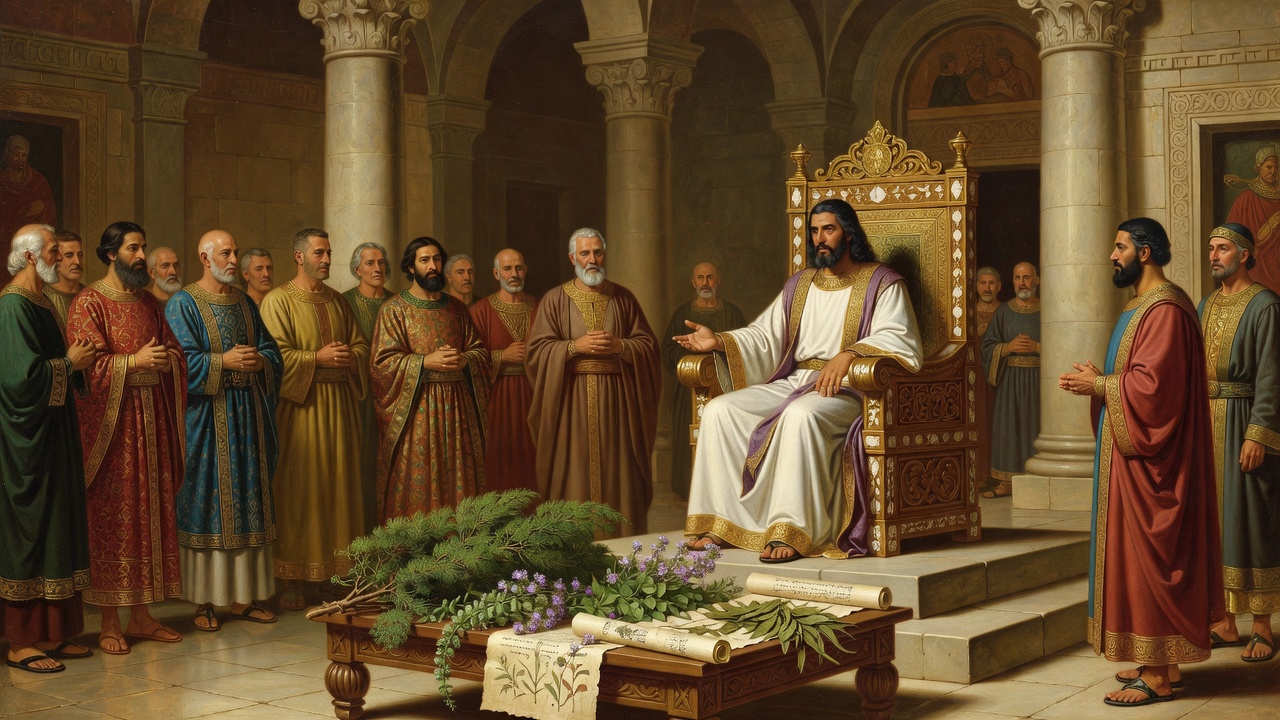
29God enabled Solomon to be extremely wise and to have great insight/understanding. He understood about more things than the number of grains of sand on the seashore [HYP]. 30He was wiser than all the wise men in Arabia and Mesopotamia and all the wise men in Egypt. 31Ethan from Ezrah and Heman and Calcol and Darda and the sons of Mahol were considered to be very wise, but Solomon was wiser than all of them. People in all the nearby countries heard about Solomon. 32He composed/wrote 3,000 ◄proverbs/wise sayings► and more than 1,000 songs. 33He talked about various kinds of plants, from the huge cedar trees in Lebanon to the tiny hyssop plants that grow in cracks in walls. He also talked about wild animals and birds and reptiles and fish. 34People came from all over the world to hear the wise things that Solomon said. Many kings sent men to listen to him and then return and tell them what Solomon said.
¿Sabías que…?
La corte y la administración de Salomón
- Salomón organizó su reino bajo altos funcionarios y doce gobernadores regionales, cada uno encargado de abastecer a la corte real durante un mes del año. Esta red sostenía la casa de Salomón con abundantes suministros diarios de harina, ganado y caza, además de proporcionar forraje para miles de caballos en un territorio que se extendía hasta el río Éufrates.Fuentes: el propio texto bíblico · Euphrates
- La administración de Salomón mantuvo continuidad con la corte de David, conservando al sumo sacerdote Sadoc, al jefe del ejército Benaía hijo de Joiada y al cronista real Josafat hijo de Ahilud. Sus secretarios, Elihoref y Ahías, eran hijos de Sisa (también registrado como Savsa), quien antes había servido como escriba de David.Fuentes: el propio texto bíblico · Zadok · Benaiah · Jehoshaphat
- El relato bíblico destaca la profunda sabiduría de Salomón, señalando que compuso tres mil proverbios y más de mil cánticos. Su conocimiento registrado abarcaba el mundo natural, desde los grandes cedros del Líbano hasta el hisopo que brota en los muros, así como animales, aves, reptiles y peces.Fuentes: el propio texto bíblico
Notas escritas con ayuda de IA a partir de fuentes abiertas (Theographic Bible Metadata, CC BY-SA 4.0; Easton’s Bible Dictionary, dominio público) y revisadas antes de publicarse.
Lugares de este capítulo
- Megiddo · Hoy: Tel Megiddo · 32.585, 35.184 · versículo 12
- Taanach · Hoy: Tell Ta’anakh · 32.522, 35.219 · versículo 12
- Argob · 32.969, 36.455 · versículo 13
- Bashan · 32.781, 35.935 · versículos 13, 19
- Gilead · Hoy: Gilead 1 · 32.187, 35.692 · versículos 13, 19
- Havvoth-jair · 32.588, 35.726 · versículo 13
- Egypt · 30.129, 31.308 · versículos 21, 30
- Euphrates · Hoy: Euphrates River · 31.004, 47.442 · versículos 21, 24
- Gaza · Hoy: Tell Harube · 31.504, 34.464 · versículo 24
- Dan · Hoy: Tel Dan · 33.249, 35.652 · versículo 25
- East · Hoy: region around Amman · 31.955, 35.934 · versículo 30
- Lebanon · 33.540, 35.584 · versículo 33
Solo aparecen lugares identificados con alta confianza (90 % o más según las fuentes académicas reunidas por OpenBible). Mapa de la época: DARE (Digital Atlas of the Roman Empire), CC BY 4.0; mapa actual: © colaboradores de OpenStreetMap; lugares: OpenBible.info (CC BY 4.0).
Créditos y licencia de esta traducción
Translation for Translators
A Bible Translation for Bible Translators which makes implied information explicit in the text as an aid to the translator who may need that information to correctly translate into a particular language.
Copyright © 2008-2017 Ellis W. Deibler, Jr.
Language: English
Dialect: American
This translation is made available to you under the terms of the
Creative Commons Attribution Share-Alike license 4.0.
You have permission to share and redistribute this Bible translation in any format and to make reasonable revisions and adaptations of this translation, provided that:
You include the above copyright and source information.
If you make any changes to the text, you must indicate that you did so in a way that makes it clear that the original licensor is not necessarily endorsing your changes.
If you redistribute this text, you must distribute your contributions under the same license as the original.
Pictures included with Scriptures and other documents on this site are licensed just for use with those Scriptures and documents.
For other uses, please contact the respective copyright owners.
Note that in addition to the rules above, revising and adapting God's Word involves a great responsibility to be true to God's Word. See Revelation 22:18-19.
2026-10-02
Fuente: http://ebible.org/eng-t4t/ · eBible.org