1 Reyes 1
Translation for Translators · Toca un versículo para ver sus referencias cruzadas.
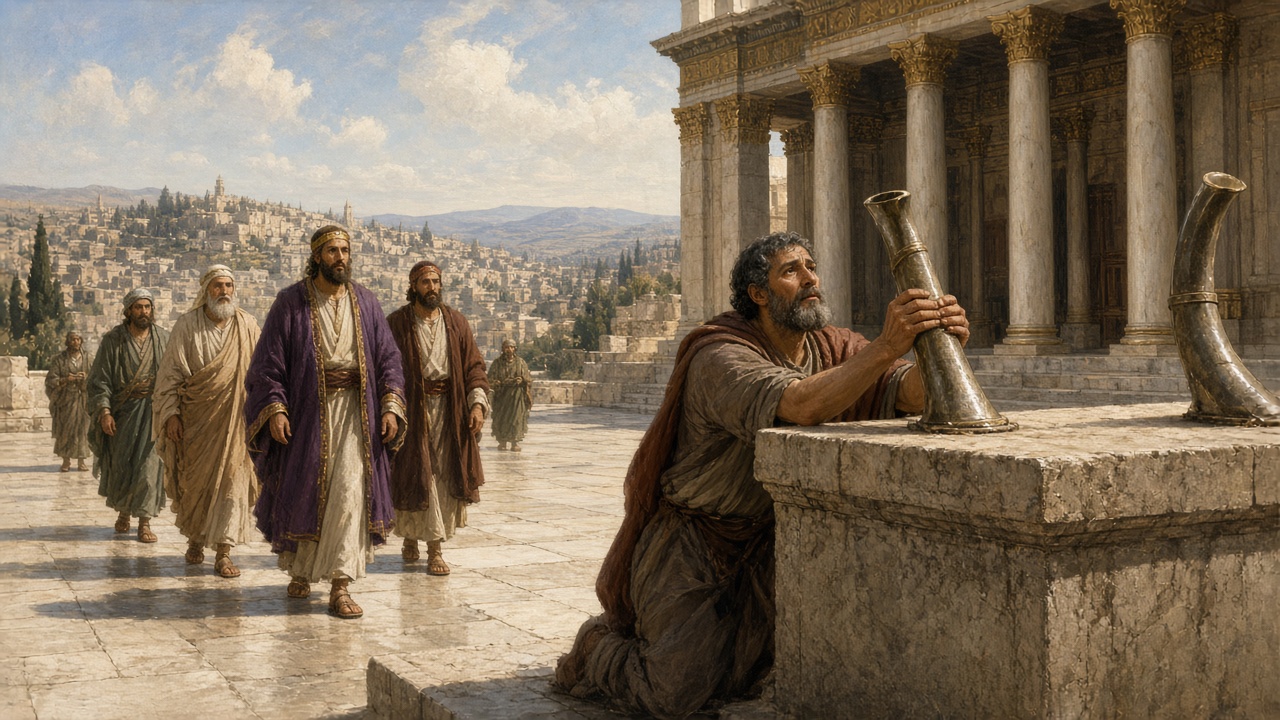
Acerca de este libro
Sobre 1 Reyes
- El Easton's Bible Dictionary (1897) considera incierta la autoría de los libros de Reyes. Una tradición según la cual Jeremías los escribió queda, a juicio de Easton, respaldada por pasajes casi idénticos a partes de Jeremías y por sucesos que Jeremías conocía personalmente; sin embargo, Easton estima más probable que Esdras, después del cautiverio, compilara los libros a partir de documentos anteriores, quizá escritos por David, Salomón, Natán, Gad e Iddo. Easton sitúa la composición entre el 561 a. C., cuando Evil-merodac liberó a Joaquín del cautiverio, y el 538 a. C., el decreto de Ciro.Fuentes: Easton: Kings, The Books of
- Easton afirma que estos libros contienen los anales del reino desde la subida de Salomón al trono hasta que Nabucodonosor y los babilonios lo sometieron, un período que estima en unos 453 años. 1 Reyes comienza mientras David está muriendo: Adonías, su cuarto hijo, que había pasado a ser el heredero presunto del trono tras la muerte de Amnón y Absalón, se hace proclamar rey, pero Natán y Betsabé persuaden a David de que entronice a Salomón de inmediato. Salomón, hijo de David y Betsabé, cuya historia se registra en 1 Reyes 1-11, llegó al trono, sugiere Easton, hacia los dieciséis o dieciocho años.Fuentes: Easton: Kings, The Books of · Adonijah · Solomon
- En las Escrituras hebreas, los dos libros de Reyes formaban originalmente un solo libro; la Septuaginta fue la primera en dividirlos y, con la Vulgata, los numera como el tercer y el cuarto libros de Reyes, siendo los libros de Samuel el primero y el segundo. Easton observa que Crónicas da mayor relieve al oficio sacerdotal o levítico, mientras que Reyes da mayor relieve al oficio real, y que en la división de las Escrituras en tres partes hecha por los judíos estos libros se cuentan entre los Profetas. La narración remite a fuentes anteriores: el libro de los hechos de Salomón y las crónicas de los reyes de Judá y de Israel.Fuentes: Easton: Kings, The Books of
- Tras la muerte de Salomón, las diez tribus se rebelaron e invitaron a Jeroboam, hijo de Nebat, a ser su rey; Easton lo llama el primer rey de esas tribus y sitúa su reinado entre 976 y 945 a. C. Había huido a Egipto bajo la protección de Sisac I y luego trasladó su residencia de Siquem, su primera capital, a Tirsa, que siguió siendo la residencia principal de los reyes de Israel hasta que Omri compró a Semer el monte de Shomeron por dos talentos de plata y edificó Samaria. La narración posterior incluye a Acab, hijo de Omri y séptimo rey de Israel, cuya esposa era Jezabel: al culto del becerro introducido por Jeroboam añadió el culto de Baal, y fue severamente amonestado por el profeta Elías.Fuentes: Jeroboam · Tirzah · Samaria · Ahab
Notas escritas con ayuda de IA a partir de fuentes abiertas (Theographic Bible Metadata, CC BY-SA 4.0; Easton’s Bible Dictionary, dominio público) y revisadas antes de publicarse.
When King David was an old man
1When King David was very old [IDM, DOU], even though his servants put many blankets on top of him, he was unable to become warm. 2So they said to him, “Your Majesty, allow us to search for a young virgin who can stay with you and take care of you. She can sleep close to you and enable you to become warm.”
3The king gave them permission, so they searched throughout Israel for a beautiful young woman. They found a woman named Abishag, from Shunem town, and brought her to the king. 4She was truly very beautiful. She took care of [DOU] the king, but the king did not have sexual relations with her.
Adonijah tried to become the king
5After Absalom died, David’s oldest surviving son was Adonijah, whose mother was Haggith. He was a very handsome/good-looking man. But David had never rebuked him about anything he did. After Absalom died, Adonijah thought that he would become king. So he started to boast, saying “I will become king now.” Then he provided for himself some chariots, and men to drive them, and horses to pull them, and 50 men to run as his bodyguards in front of those chariots wherever he went.
7One day he conferred with Joab, David’s army commander, and Abiathar the priest, and they promised/agreed to help/support Adonijah. 8But Zadok, who was also a priest, Benaiah who had supervised David’s bodyguards, Nathan the prophet, Shimei and Rei, and David’s most capable soldiers refused to help/support Adonijah.
9One day Adonijah went to Snake Rock near En-Rogel Spring, which is near Jerusalem, to sacrifice some sheep and oxen and fattened cattle. He invited most of his brothers, King David’s other sons, to come. He also invited all of the king’s officials from Judah to come to the celebration. 10But he did not invite Nathan or Benaiah or the king’s most capable soldiers or his younger/half-brother Solomon.
11Nathan found out what they were doing, so he went to Solomon’s mother Bathsheba and asked her, “Have you not heard that Haggith’s son Adonijah is declared himself to be the king? And King David does not know about it! 12So if you want to save yourself and your son Solomon from being killed, allow me to tell you what you should do. 13Go immediately to King David. Say to him, ‘Your Majesty, you solemnly promised me [RHQ] that my son Solomon would become the king after you die, and that he would sit on your throne and rule. So why is it that Adonijah has said that he is now the king?’ 14Then, while you are still talking to the king, I will come in and tell him that what you are saying to him about Adonijah is true.”
15So Bathsheba went to see the king in his bedroom. He was very old, and Abishag was taking care of him. 16Bathsheba bowed very low in front of the king, and the king asked her, “What do you want?”
17She replied, “Your Majesty, you solemnly promised me, knowing that Yahweh our God was listening [IDM], that my son Solomon would become king after you die, and that he would sit on your throne and rule. 18But now, believe it or not, Adonijah has become king, and you do not know anything about it. 19He has sacrificed a lot of oxen and fattened cattle and sheep, and he has invited all of your other sons to the celebration. He has also invited Abiathar the priest and Joab the commander of your army, but he did not invite your son Solomon. 20Your Majesty, all the people [SYN] of Israel are expecting you to tell them who is the one who will become king after you are no longer the king. 21If you do not do that, what will happen is that after you die [EUP] people will consider that my son Solomon and I are rebelling, and they will execute us because we did not help Adonijah to become king.”
22While she was still talking to the king, Nathan came to the palace. 23The king’s servants/advisors told David, “Nathan the prophet has come.” So Bathsheba left, and Nathan went into where the king was and knelt down, with his face on the ground.
24Then Nathan said, “Your Majesty, have you declared that Adonijah will become king after you are no longer the king? 25I say that because today he has gone down to En-Rogel Spring and has sacrificed a lot of oxen, fattened cattle, and sheep. And he has invited all of your other sons, Joab the army commander, and Abiathar the priest. They are all eating and drinking with him and saying ‘We hope/desire that King Adonijah will live a long time!’ 26But he did not invite me or Zadok the priest or Benaiah or Solomon. 27Did you, as the king, say that they should do this without telling your other officials who you want to become king [MTY] after you are no longer the king?”
David arranged for Solomon to be declared king
28Then after Nathan left the room, King David said to one of his servants, “Tell Bathsheba to come in here again.” So he went and told her, and she came in and stood in front of the king.
29Then the king said, “Yahweh has rescued me from all my troubles. I promised you, with Yahweh the God whom we Israelis worship listening, that your son Solomon would be king after I am no longer the king. Today, as surely as Yahweh lives, I solemnly declare that I will do what I promised.” 31Bathsheba knelt down with her face on the ground and said, “Your Majesty, I hope/desire that you will live for many more years [HYP]!”
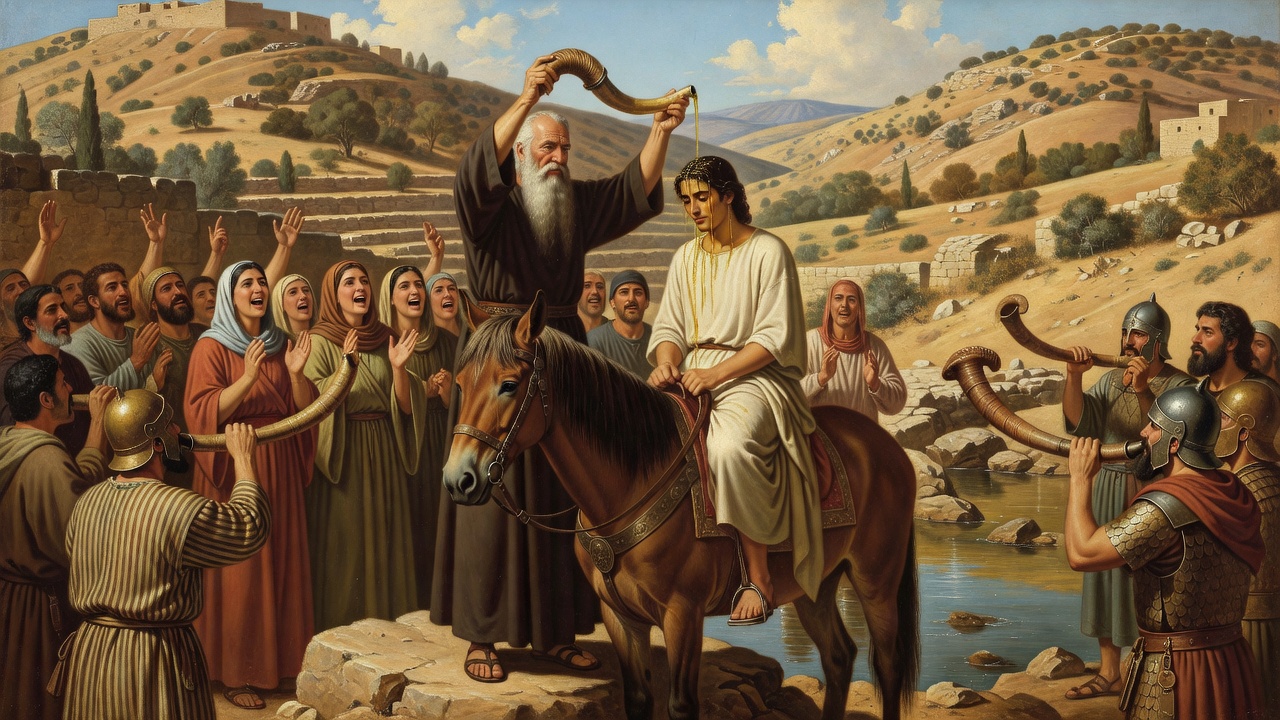
32Then King David said, “Summon Zadok the priest, Nathan the prophet, and Benaiah.” So someone went and summoned them. When they came in, 33he said to them, “Put my son Solomon on my mule. Take him with my officials down to Gihon Spring. 34There, you two, Zadok and Nathan, should anoint him, with olive oil to appoint him to be the king of Israel. Then you must blow trumpets, and all the people there must shout, ‘We hope/desire that King Solomon will live for many years!’ 35Then follow him back here, and he will come and sit on my throne. He will then become king instead of me. I have appointed him to be the ruler of all the people of Israel and of Judah.”
36Benaiah replied, “We will do that! We hope/wish that Yahweh, who is your God and our God, will cause it to happen! 37King David, Yahweh has helped you; we hope/wish that he will also help Solomon and enable him to become a greater king than you have been.”
38So Zadok, Nathan, Benaiah, and the two groups of men who were the king’s bodyguards went and put Solomon on King David’s mule and escorted him down to Gihon Spring. 39There Zadok took the container of olive oil from the Sacred Tent and ◄anointed/poured some oil on► Solomon. Then the trumpets were blown, and all the people shouted, “We hope/wish that King Solomon will live for many years!” 40Then all the people followed him back up to the city, shouting joyfully and playing flutes. They shouted very loudly, with the result that the ground shook.
Adonijah’s reaction
41When Adonijah and all ◄his guests/the people whom he had invited► were finishing eating at their celebration, they heard the noise. When Joab heard the sound of the trumpets, he asked, “What is causing all that noise in the city?”
42While he was still speaking, Jonathan, the son of Abiathar the priest, arrived. Adonijah said, “Come in! You are a man whom we can trust, so you must be bringing us good news!”
43Jonathan replied, “No, I do not have good news! His Majesty, King David, has caused Solomon to be the king! 44He sent Zadok, Nathan, Benaiah, and his own group of bodyguards to go with Solomon. They put Solomon on King David’s mule. 45They went down to Gihon Spring, and there Zadok and Nathan anointed him to become the king. Now they have returned from there to the city, shouting joyfully. That is why there is that great/loud noise that you are hearing. 46So Solomon is now our king [MTY]. 47Furthermore, the palace officials came to His Majesty, King David, to tell him that they approved of what he had done. They said, ‘We wish/hope that our God will enable Solomon [MTY] to become more famous than you have been and enable him to be a better king than you have been.’ When they said that, the king, lying on his bed, bowed his head to worship Yahweh. 48Then he said, ‘I praise Yahweh, the God whom we Israelis worship, because he has allowed one of my sons to become the king today, and has permitted me to see it happen.’”
49Then all of Adonijah’s guests ◄trembled/were afraid►, so they all immediately got up and left and scattered. 50Adonijah was afraid of what Solomon would do, so he went to the Sacred Tent and grabbed the projections at the corners of the altar, because he knew that no one would kill him there. 51But someone told Solomon, “Hey/Listen, Adonijah is afraid of you, so he has gone to the Sacred Tent and is holding on to the corners of the altar. He is saying, ‘ Before I leave, I want King Solomon to solemnly promise that he will not command that I be executed.’”
52Solomon replied, “If he proves that he is loyal to me, I will not harm him at all [IDM]. But if he does anything that is wrong, he will be executed.” 53So King Solomon sent some men to Adonijah, and they brought him back from the altar. He came to Solomon and bowed down in front of him. Then Solomon said to him, “Go home.”
¿Sabías que…?
La sucesión al trono de David
- Siendo el hijo mayor sobreviviente de David tras la muerte de Amnón y Absalón, Adonías reclamó la sucesión real respaldado por el comandante militar Joab y el sacerdote Abiatar. Sin embargo, David eligió a su hijo menor Salomón, quien contaba con el apoyo del profeta Natán, el sacerdote Sadoc y Benaía.Fuentes: Adonijah · Solomon · el propio texto bíblico
- Montar en la propia mula del rey constituía una proclamación pública decisiva de autoridad real. Por orden expresa de David, Salomón fue llevado al manantial de Gijón, donde Sadoc lo ungió como rey con aceite sagrado del tabernáculo en medio del sonido de cuernos y la aclamación popular.Fuentes: Gihon · Zadok · el propio texto bíblico
- Al enterarse de la coronación pública de Salomón, Adonías huyó aterrorizado y buscó asilo sujetándose a los cuernos del altar de los sacrificios. Salomón le otorgó clemencia condicional, perdonándole la vida siempre que demostrara ser un hombre digno.Fuentes: Adonijah · el propio texto bíblico
Notas escritas con ayuda de IA a partir de fuentes abiertas (Theographic Bible Metadata, CC BY-SA 4.0; Easton’s Bible Dictionary, dominio público) y revisadas antes de publicarse.
Lugares de este capítulo
- Shunem · Hoy: Sulam · 32.606, 35.334 · versículo 3
- Serpent’s Stone · Hoy: within 100 m of Bir Ayub · 31.767, 35.236 · versículo 9
- Gihon · Hoy: Gihon Spring · 31.773, 35.236 · versículos 33, 38, 44, 45
- Jerusalem · 31.777, 35.234 · versículo 40
Solo aparecen lugares identificados con alta confianza (90 % o más según las fuentes académicas reunidas por OpenBible). Mapa de la época: DARE (Digital Atlas of the Roman Empire), CC BY 4.0; mapa actual: © colaboradores de OpenStreetMap; lugares: OpenBible.info (CC BY 4.0).
Créditos y licencia de esta traducción
Translation for Translators
A Bible Translation for Bible Translators which makes implied information explicit in the text as an aid to the translator who may need that information to correctly translate into a particular language.
Copyright © 2008-2017 Ellis W. Deibler, Jr.
Language: English
Dialect: American
This translation is made available to you under the terms of the
Creative Commons Attribution Share-Alike license 4.0.
You have permission to share and redistribute this Bible translation in any format and to make reasonable revisions and adaptations of this translation, provided that:
You include the above copyright and source information.
If you make any changes to the text, you must indicate that you did so in a way that makes it clear that the original licensor is not necessarily endorsing your changes.
If you redistribute this text, you must distribute your contributions under the same license as the original.
Pictures included with Scriptures and other documents on this site are licensed just for use with those Scriptures and documents.
For other uses, please contact the respective copyright owners.
Note that in addition to the rules above, revising and adapting God's Word involves a great responsibility to be true to God's Word. See Revelation 22:18-19.
2026-10-02
Fuente: http://ebible.org/eng-t4t/ · eBible.org