Números 19
Revised Version with Apocrypha (1895) · Toca un versículo para ver sus referencias cruzadas.
The Red Heifer
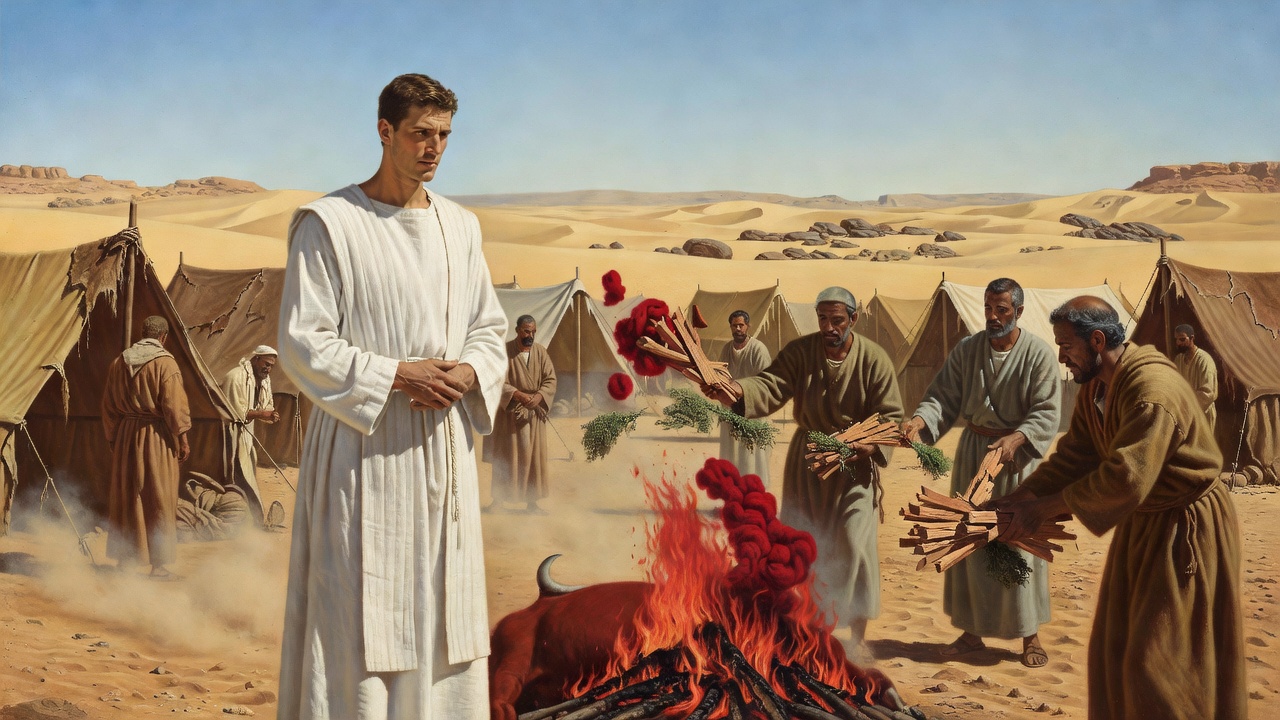
1And the LORD spake unto Moses and unto Aaron, saying, 2This is the statute of the law which the LORD hath commanded, saying, Speak unto the children of Israel, that they bring thee a red heifer without spot, wherein is no blemish, and upon which never came yoke: 3and ye shall give her unto Eleazar the priest, and he shall bring her forth without the camp, and one shall slay her before his face: 4and Eleazar the priest shall take of her blood with his finger, and sprinkle of her blood toward the front of the tent of meeting seven times: 5and one shall burn the heifer in his sight; her skin, and her flesh, and her blood, with her dung, shall he burn: 6and the priest shall take cedar wood, and hyssop, and scarlet, and cast it into the midst of the burning of the heifer. 7Then the priest shall wash his clothes, and he shall bathe his flesh in water, and afterward he shall come into the camp, and the priest shall be unclean until the even. 8And he that burneth her shall wash his clothes in water, and bathe his flesh in water, and shall be unclean until the even. 9And a man that is clean shall gather up the ashes of the heifer, and lay them up without the camp in a clean place, and it shall be kept for the congregation of the children of Israel for a water of separation: it is a sin offering. 10And he that gathereth the ashes of the heifer shall wash his clothes, and be unclean until the even: and it shall be unto the children of Israel, and unto the stranger that sojourneth among them, for a statute for ever.
Purification of the Unclean
11He that toucheth the dead body of any man shall be unclean seven days: 12the same shall purify himself therewith on the third day, and on the seventh day he shall be clean: but if he purify not himself the third day, then the seventh day he shall not be clean. 13Whosoever toucheth the dead body of any man that is dead, and purifieth not himself, defileth the tabernacle of the LORD; and that soul shall be cut off from Israel: because the water of separation was not sprinkled upon him, he shall be unclean; his uncleanness is yet upon him. 14This is the law when a man dieth in a tent: every one that cometh into the tent, and every one that is in the tent, shall be unclean seven days. 15And every open vessel, which hath no covering bound upon it, is unclean. 16And whosoever in the open field toucheth one that is slain with a sword, or a dead body, or a bone of a man, or a grave, shall be unclean seven days. 17And for the unclean they shall take of the ashes of the burning of the sin offering, and running water shall be put thereto in a vessel: 18and a clean person shall take hyssop, and dip it in the water, and sprinkle it upon the tent, and upon all the vessels, and upon the persons that were there, and upon him that touched the bone, or the slain, or the dead, or the grave: 19and the clean person shall sprinkle upon the unclean on the third day, and on the seventh day: and on the seventh day he shall purify him; and he shall wash his clothes, and bathe himself in water, and shall be clean at even. 20But the man that shall be unclean, and shall not purify himself, that soul shall be cut off from the midst of the assembly, because he hath defiled the sanctuary of the LORD: the water of separation hath not been sprinkled upon him; he is unclean. 21And it shall be a perpetual statute unto them: and he that sprinkleth the water of separation shall wash his clothes; and he that toucheth the water of separation shall be unclean until even. 22And whatsoever the unclean person toucheth shall be unclean; and the soul that toucheth it shall be unclean until even.
¿Sabías que…?
La novilla roja y la purificación de la impureza
- A diferencia de los sacrificios habituales presentados en el altar del tabernáculo, la novilla roja sin defecto y que nunca había llevado yugo era llevada fuera del campamento. Allí era sacrificada ante el sacerdote Eleazar y quemada por completo junto con madera de cedro, hisopo y lana escarlata.Fuentes: el propio texto bíblico · Eleazar
- Las cenizas de la novilla se guardaban fuera del campamento para preparar el agua de purificación. Paradójicamente, aunque esta mezcla purificaba a quienes contraían impureza por la muerte, todos los que manipulaban la novilla, recogían las cenizas o rociaban el agua quedaban ceremonialmente impuros hasta el anochecer.Fuentes: el propio texto bíblico
- Tocar un cadáver, un hueso humano, una tumba o permanecer en una tienda donde alguien había muerto causaba siete días de impureza ceremonial. Para purificarse, la persona debía ser rociada con el agua de purificación al tercer y al séptimo día, además de lavar sus vestiduras y bañarse.Fuentes: el propio texto bíblico
Notas escritas con ayuda de IA a partir de fuentes abiertas (Theographic Bible Metadata, CC BY-SA 4.0; Easton’s Bible Dictionary, dominio público) y revisadas antes de publicarse.
Créditos y licencia de esta traducción
Revised Version with Apocrypha (1895)
The Revised Version of the Holy Bible (1895) with Apocrypha
Public Domain
Language: English
Dialect: archaic British
This work is in the Public Domain. You may copy and use it freely.
2026-10-02
Títulos de sección adaptados de la Berean Standard Bible (dominio público); no forman parte del texto bíblico de esta traducción.
Fuente: http://ebible.org/eng-rv/ · eBible.org