Números 12
LXX2012: Septuagint in American English 2012 · Toca un versículo para ver sus referencias cruzadas.
The Complaint of Miriam and Aaron
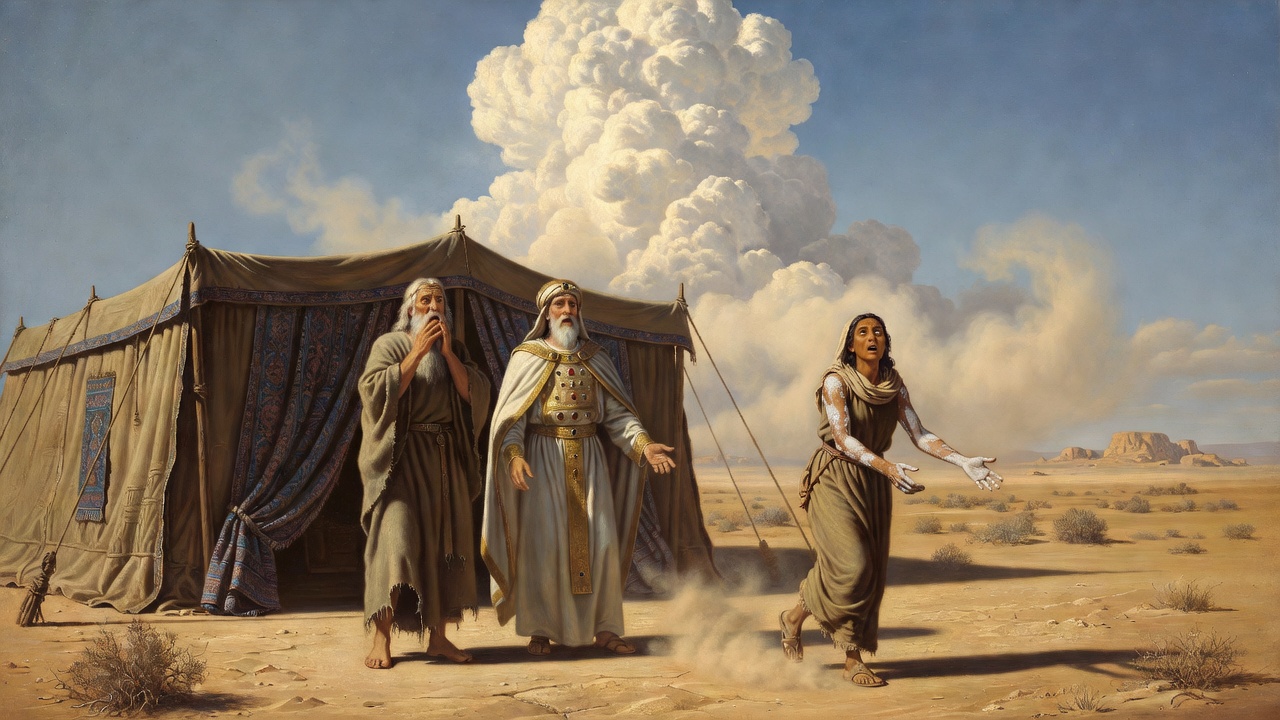
1And Mariam and Aaron spoke against Moses, because of the Ethiopian woman whom Moses took; for he had taken an Ethiopian woman. 2And they said, Has the Lord spoken to Moses only? has he not also spoken to us? and the Lord heard it. 3And the man Moses was very meek beyond all the men that were upon the earth. 4And the Lord said immediately to Moses and Aaron and Mariam, Come forth all three of you to the tabernacle of witness. 5And the three came forth to the tabernacle of witness; and the Lord descended in a pillar of a cloud, and stood at the door of the tabernacle of witness; and Aaron and Mariam were called; and both came forth. 6And he said to them, Hear my words: If there should be of you a prophet to the Lord, I will be made known to him in a vision, and in sleep will I speak to him. 7My servant Moses is not so; he is faithful in all my house. 8I will speak to him mouth to mouth apparently, and not in dark speeches; and he has seen the glory of the Lord; and why were you⌃ not afraid to speak against my servant Moses? 9And the great anger of the Lord was upon them, and he departed. 10And the cloud departed from the tabernacle; and, behold, Mariam was leprous, white as snow; and Aaron looked upon Mariam, and, behold, she was leprous. 11And Aaron said to Moses, I beseech you, my lord, do not lay sin upon us, for we were ignorant wherein we sinned. 12Let her not be as it were like death, as an abortion coming out of his mother's womb, when the disease devours the half of the flesh. 13And Moses cried to the Lord, saying, O God, I beseech you, heal her. 14And the Lord said to Moses, If her father had only spit in her face, would she not be ashamed seven days? let her be set apart seven days without the camp, and afterwards she shall come in. 15And Mariam was separated without the camp seven days; and the people moved not forward till Mariam was cleansed.
¿Sabías que…?
María y Aarón se oponen a Moisés
- El nombre Hazerot alude a recintos cercados, tradicionalmente muros bajos de piedra coronados con ramas espinosas de acacia para resguardar tiendas y ganado. En este campamento tuvo lugar el conflicto respecto a Moisés antes de que Israel avanzara hacia el desierto de Parán.Fuentes: Hazeroth · Paran · el propio texto bíblico
- María y Aarón eran los hermanos mayores de Moisés y ocupaban importantes funciones de liderazgo: María era reconocida como profetisa y encabezó el canto triunfal tras el cruce del mar Rojo, mientras que Aarón colaboró con Moisés desde el Éxodo.Fuentes: Miriam · Aaron · el propio texto bíblico
- El capítulo resalta una diferencia entre la revelación profética habitual, que Dios otorgaba mediante visiones y sueños, y la relación única de Moisés, con quien Dios hablaba cara a cara y con claridad, no por medio de enigmas.Fuentes: el propio texto bíblico
Notas escritas con ayuda de IA a partir de fuentes abiertas (Theographic Bible Metadata, CC BY-SA 4.0; Easton’s Bible Dictionary, dominio público) y revisadas antes de publicarse.
Lugares de este capítulo
- Paran · 30.303, 34.777 · versículo 16
Solo aparecen lugares identificados con alta confianza (90 % o más según las fuentes académicas reunidas por OpenBible). Mapa de la época: DARE (Digital Atlas of the Roman Empire), CC BY 4.0; mapa actual: © colaboradores de OpenStreetMap; lugares: OpenBible.info (CC BY 4.0).
Créditos y licencia de esta traducción
LXX2012: Septuagint in American English 2012
The Septuagint with Apocrypha, translated from Greek to English by Sir Lancelot C. L. Brenton and published in 1885, with some language updates (American English)
Public Domain
Language: English
Dialect (if applicable): American
Language in English: English
Translation by:
Sir Lancelot Charles Lee Brenton
Michael Paul Johnson
LXX2012: Septuagint in English 2012
This is a translation of the Old Testament and Apocrypha/Deuterocanon from Hebrew to Greek to 19th Century British English, with some updates of spelling and word usage to contemporary American English. The original English translation was done by Sir Lancelot Charles Lee Brenton and published by Samuel Bagster & Sons, Ltd., in London in 1851. It has entered the Public Domain due to the passage of sufficient time. In the process of scanning and typing the text, the original poetry and prose formatting, as well as peripheral material like introductions and notes, have been omitted.
This edition of the Septuagint has some language updates. Brenton's word order and punctuation has been mostly retained, meaning that quotation marks are not used, and sentences within quotes may not start with capital letters, as was standard usage in 1851. Names transliterated from Greek to those transliterated from Hebrew in the common English Bibles often differ. These language updates are dedicated to the Public Domain by the author of those edits, Michael Paul Johnson. Therefore this edition may be freely copied, published, etc.
Before considering making changes to the text of this work, I recommend that you consult with God, because this is really His Book.
If you find errors in the text, please report them so that we can correct them.
Donations to help with the expenses of operating this web site and thus help others have free access to the Word of God may be made to us, but are not required. Please see http://MLJohnson.org/partner/ for more about that.
Títulos de sección adaptados de la Berean Standard Bible (dominio público); no forman parte del texto bíblico de esta traducción.
Fuente: http://ebible.org/eng-lxx2012/ · eBible.org