Nehemías 8
LXX2012: Septuagint in American English 2012 · Toca un versículo para ver sus referencias cruzadas.
Ezra Reads the Law
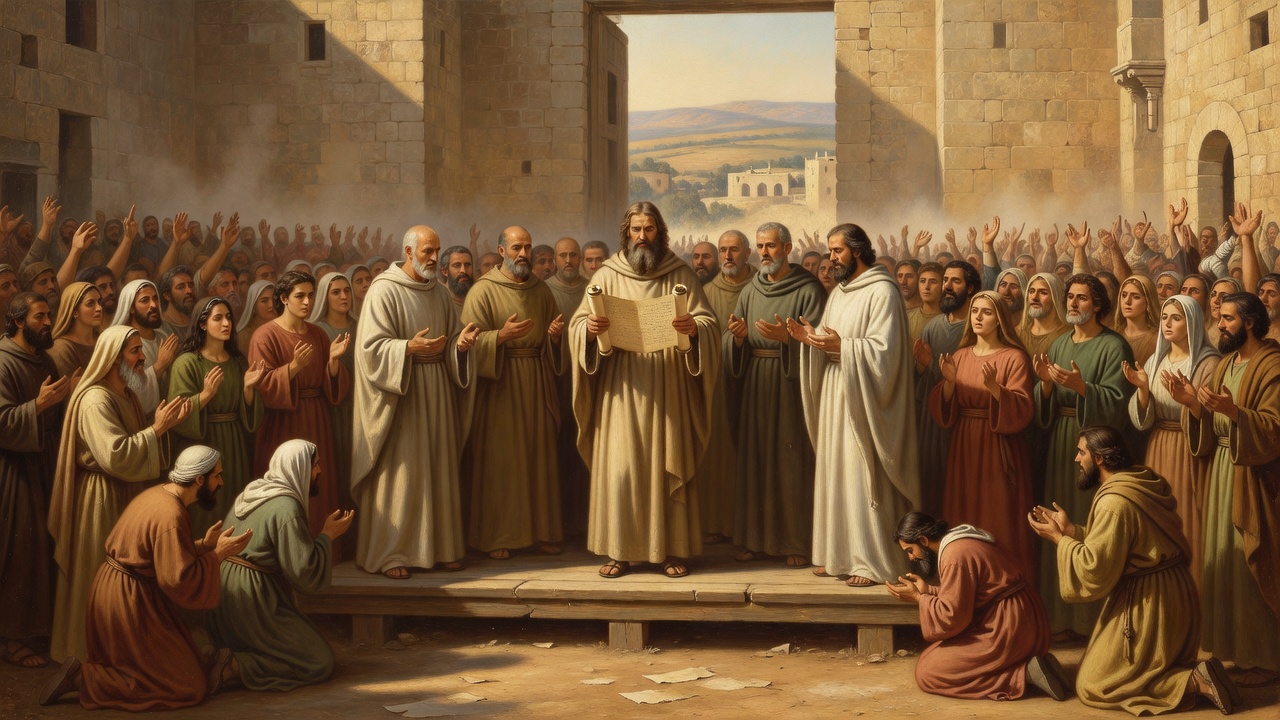
1And the seventh month arrived, and the children of Israel were settled in their cities; and all the people were gathered as one man to the broad place before the water-gate, and they told Esdras the scribe to bring the book of the law of Moses, which the Lord commanded Israel. 2So Esdras the priest brought the law before the congregation both of men and women, and every one who had understanding was present to listen, on the first day of the seventh month. 3And he read in it from the time of sunrise to the middle of the day, before the men and the women; and they understood it, and the ears of all the people were attentive to the book of the law. 4And Esdras the scribe stood on a wooden stage, and there stood next to him Mattathias, and Samaeas, and Ananias, and Urias, and Chelcia, and Massia, on his right hand; and on his left Phadaeas, and Misael, and Melchias, and Asom, and Asabadma, and Zacharias, and Mesollam. 5And Esdras opened the book before all the people, for he was above the people; and it came to pass when he had opened it, that all the people stood. 6And Esdras blessed the Lord, the great God: and all the people answered, and said, Amen, lifting up their hands: and they bowed down and worshipped the Lord with their face to the ground. 7And Jesus and Banaias and Sarabias instructed the people in the law, and the people stood in their place. 8And they read in the book of the law of God, and Esdras taught, and instructed them distinctly in the knowledge of the Lord, and the people understood the law in the reading. 9And Neemias, and Esdras the priest and scribe, and the Levites, and they that instructed the people, spoke and said to all the people, It is a holy day to the Lord our God; do not mourn, nor weep. For all the people wept when they heard the words of the law. 10And the governor said to them, Go, eat the fat, and drink the sweet, and send portions to them that have nothing; for the day is holy to our Lord: and faint not, for the Lord is our strength. 11And the Levites caused all the people to be silent, saying, Be silent, for it is a holy day, and despond not. 12So all the people departed to eat, and to drink, and to send portions, and to make great mirth, for they understood the words which he made known to them.
The Feast of Tabernacles
13And on the second day the heads of families assembled with all the people, also the priests and Levites, to Esdras the scribe, to attend to all the words of the law. 14And they found written in the law which the Lord commanded Moses, that the children of Israel should dwell in booths, in the feast in the seventh month: 15and that they should sound with trumpets in all their cities, and in Jerusalem. And Esdras said, Go forth to the mountain, and bring branches of olive, and branches of cypress trees, and branches of myrtle, and branches of palm trees, and branches of every thick tree, to make booths, according to that which was written. 16And the people went forth, and brought them, and made booths for themselves, each one upon his roof, and in their courts, and in the courts of the house of God, and in the streets of the city, and as far as the gate of Ephraim. 17And all the congregation who had returned from the captivity, made booths, and lived in booths: for the children of Israel had not done so from the days of Jesus the son of Naue until that day: and there was great joy. 18And Esdras read in the book of the law of God daily, from the first day even to the last day: and they kept the feast seven days; and on the eighth day a solemn assembly, according to the ordinance.
¿Sabías que…?
La lectura de la Ley y la Fiesta de las Enramadas
- Esdras el escriba, un sacerdote descendiente de Aarón que había guiado a exiliados de regreso de Babilonia, leyó el Libro de la Ley de Moisés desde el amanecer hasta el mediodía ante la asamblea en Jerusalén. De pie sobre una plataforma alta de madera en la plaza frente a la Puerta del Agua, leyó mientras los levitas explicaban el texto para que todos pudieran comprenderlo.Fuentes: el propio texto bíblico · Ezra · Water Gate · Jerusalem
- Al escuchar la lectura de la Ley, la gente comenzó a llorar, pero Nehemías el gobernador, Esdras y los levitas les indicaron que no se entristecieran en un día consagrado. Se les mandó comer alimentos ricos, beber bebidas dulces, compartir porciones con quienes no tenían nada preparado y regocijarse en el gozo del Señor.Fuentes: el propio texto bíblico
- Al descubrir el mandato de la Ley de habitar en enramadas durante la fiesta del séptimo mes, la asamblea de retornados recolectó ramas de palmera, olivo y mirto para construir refugios en azoteas, patios y plazas cerca de la Puerta del Agua y la Puerta de Efraín. El relato señala que los israelitas no habían celebrado de esa manera desde los días de Josué hijo de Nun.Fuentes: el propio texto bíblico · Water Gate · Gate of Ephraim
Notas escritas con ayuda de IA a partir de fuentes abiertas (Theographic Bible Metadata, CC BY-SA 4.0; Easton’s Bible Dictionary, dominio público) y revisadas antes de publicarse.
Lugares de este capítulo
- Water Gate · Hoy: in Jerusalem · 31.777, 35.234 · versículos 1, 3, 16
- Jerusalem · 31.777, 35.234 · versículo 15
- Ephraim Gate · Hoy: in Jerusalem · 31.777, 35.234 · versículo 16
Solo aparecen lugares identificados con alta confianza (90 % o más según las fuentes académicas reunidas por OpenBible). Mapa de la época: DARE (Digital Atlas of the Roman Empire), CC BY 4.0; mapa actual: © colaboradores de OpenStreetMap; lugares: OpenBible.info (CC BY 4.0).
Créditos y licencia de esta traducción
LXX2012: Septuagint in American English 2012
The Septuagint with Apocrypha, translated from Greek to English by Sir Lancelot C. L. Brenton and published in 1885, with some language updates (American English)
Public Domain
Language: English
Dialect (if applicable): American
Language in English: English
Translation by:
Sir Lancelot Charles Lee Brenton
Michael Paul Johnson
LXX2012: Septuagint in English 2012
This is a translation of the Old Testament and Apocrypha/Deuterocanon from Hebrew to Greek to 19th Century British English, with some updates of spelling and word usage to contemporary American English. The original English translation was done by Sir Lancelot Charles Lee Brenton and published by Samuel Bagster & Sons, Ltd., in London in 1851. It has entered the Public Domain due to the passage of sufficient time. In the process of scanning and typing the text, the original poetry and prose formatting, as well as peripheral material like introductions and notes, have been omitted.
This edition of the Septuagint has some language updates. Brenton's word order and punctuation has been mostly retained, meaning that quotation marks are not used, and sentences within quotes may not start with capital letters, as was standard usage in 1851. Names transliterated from Greek to those transliterated from Hebrew in the common English Bibles often differ. These language updates are dedicated to the Public Domain by the author of those edits, Michael Paul Johnson. Therefore this edition may be freely copied, published, etc.
Before considering making changes to the text of this work, I recommend that you consult with God, because this is really His Book.
If you find errors in the text, please report them so that we can correct them.
Donations to help with the expenses of operating this web site and thus help others have free access to the Word of God may be made to us, but are not required. Please see http://MLJohnson.org/partner/ for more about that.
Títulos de sección adaptados de la Berean Standard Bible (dominio público); no forman parte del texto bíblico de esta traducción.
Fuente: http://ebible.org/eng-lxx2012/ · eBible.org