Levítico 27
LXX2012: Septuagint in American English 2012 · Toca un versículo para ver sus referencias cruzadas.
Rules about Valuations
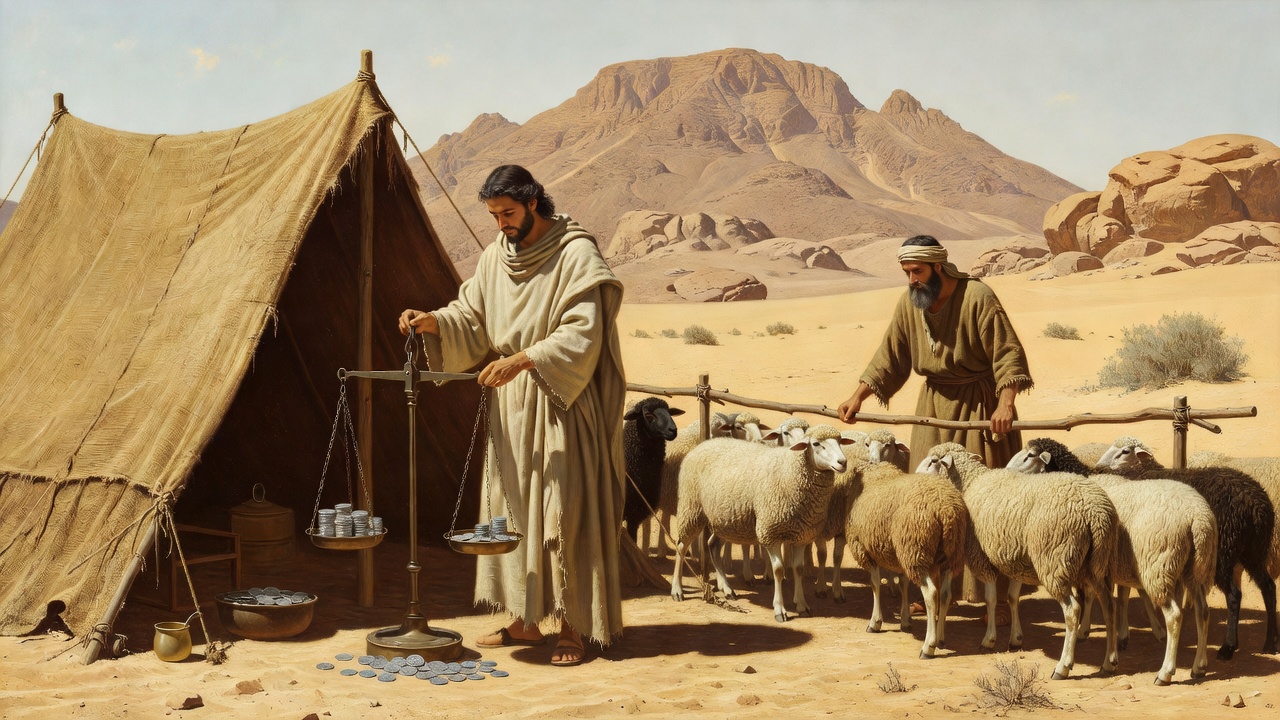
1And the Lord spoke to Moses, saying, 2Speak to the children of Israel, and you shall say to them, Whosoever shall vow a vow as the valuation of his soul for the Lord, 3the valuation of a male from twenty years old to sixty years old shall be his valuation shall be fifty didrachmas of silver by the standard of the sanctuary. 4And the valuation of a female shall be thirty didrachmas. 5And if it be from five years old to twenty, the valuation of a male shall be twenty didrachmas, and of a female ten didrachmas. 6And from a month old to five years old, the valuation of a male shall be five didrachmas, and of a female, three didrachmas of silver. 7And if from sixty year old and upward, if it be a male, his valuation shall be fifteen didrachmas of silver, and if a female, ten didrachmas. 8And if the man be too poor for the valuation, he shall stand before the priest; and the priest shall value him: according to what the man who has vowed can afford, the priest shall value him. 9And if it be from the cattle that are offered as a gift to the Lord, whoever shall offer one of these to the Lord, it shall be holy. 10He shall not change it, a good for a bad, or a bad for a good; and if he do at all change it, a beast for a beast, it and the substitute shall be holy. 11And if it be any unclean beast, of which none are offered as a gift to the Lord, he shall set the beast before the priest. 12And the priest shall make a valuation between the good and the bad, and accordingly as the priest shall value it, so shall it stand. 13And if the worshipper will at all redeem it, he shall add the fifth part to its value. 14And whatever man shall consecrate his house as holy to the Lord, the priest shall make a valuation of it between the good and the bad: as the priest shall value it, so shall it stand. 15And if he that has sanctified it should redeem his house, he shall add to it the fifth part of the money of the valuation, and it shall be his. 16And if a man should hallow to the Lord a part of the field of his possession, then the valuation shall be according to its seed, fifty didrachmas of silver for a homer of barley. 17And if he should sanctify his field from the year of release, it shall stand according to his valuation. 18And if he should sanctify his field in the latter time after the release, the priest shall reckon to him the money for the remaining years, until the next year of release, and it shall be deducted as an equivalent from his full valuation. 19And if he that sanctified the field would redeem it, he shall add to its value the fifth part of the money, and it shall be his. 20And if he do not redeem the field, but should sell the field to another man, he shall not after redeem it. 21But the field shall be holy to the Lord after the release, as separated land; the priest shall have possession of it. 22And if he should consecrate to the Lord of a field which he has bought, which is not of the field of his possession, 23the priest shall reckon to him the full valuation from the year of release, and he shall pay the valuation in that day as holy to the Lord. 24And in the year of release the land shall be restored to the man of whom the other bought it, whose the possession of the land was. 25And every valuation shall be by holy weights: the didrachm shall be twenty oboli. 26And every firstborn which shall be produced among your cattle shall be the Lord's, and no man shall sanctify it: whether calf or sheep, it is the Lord's. 27But if he should redeem an unclean beast, according to its valuation, then he shall add the fifth part to it, and it shall be his; and if he redeem it not, it shall be sold according to its valuation. 28And every dedicated thing which a man shall dedicate to the Lord of all that he has, whether man or beast, or of the field of his possession, he shall not sell it, nor redeem it: every devoted thing shall be most holy to the Lord. 29And whatever shall be dedicated of men, shall not be ransomed, but shall be surely put to death.
Instruction on Tithes
30Every tithe of the land, both of the seed of the land, and of the fruit of trees, is the Lord's, holy to the Lord. 31And if a man should at all redeem his tithe, he shall add the fifth part to it, and it shall be his. 32And every tithe of oxen, and of sheep, and whatever may come in numbering under the rod, the tenth shall be holy to the Lord. 33You shall not change a good for a bad, or a bad for a good; and if you should at all change it, its equivalent also shall be holy, it shall not be redeemed. 34These are the commandments which the Lord commanded Moses for the sons of Israel in mount Sina.
¿Sabías que…?
Votos, Tasaciones y las Leyes del Sinaí
- Cuando los israelitas consagraban casas, tierras, animales impuros o diezmos agrícolas a Dios, a menudo podían rescatarlos pagando el valor tasado más un recargo de una quinta parte de ese precio.Fuentes: el propio texto bíblico
- Las personas consagradas por voto tenían valores monetarios fijados según su edad y sexo, calculados conforme al siclo del santuario, equivalente a veinte geras. Si quien hacía el voto era demasiado pobre para pagar la tasa fija, el sacerdote fijaba una suma acorde a sus posibilidades.Fuentes: el propio texto bíblico
- El libro de Levítico concluye señalando que estos mandamientos fueron dados a Moisés en el monte Sinaí, donde los israelitas permanecieron acampados alrededor de un año tras el Éxodo.Fuentes: el propio texto bíblico · Mount Sinai
Notas escritas con ayuda de IA a partir de fuentes abiertas (Theographic Bible Metadata, CC BY-SA 4.0; Easton’s Bible Dictionary, dominio público) y revisadas antes de publicarse.
Créditos y licencia de esta traducción
LXX2012: Septuagint in American English 2012
The Septuagint with Apocrypha, translated from Greek to English by Sir Lancelot C. L. Brenton and published in 1885, with some language updates (American English)
Public Domain
Language: English
Dialect (if applicable): American
Language in English: English
Translation by:
Sir Lancelot Charles Lee Brenton
Michael Paul Johnson
LXX2012: Septuagint in English 2012
This is a translation of the Old Testament and Apocrypha/Deuterocanon from Hebrew to Greek to 19th Century British English, with some updates of spelling and word usage to contemporary American English. The original English translation was done by Sir Lancelot Charles Lee Brenton and published by Samuel Bagster & Sons, Ltd., in London in 1851. It has entered the Public Domain due to the passage of sufficient time. In the process of scanning and typing the text, the original poetry and prose formatting, as well as peripheral material like introductions and notes, have been omitted.
This edition of the Septuagint has some language updates. Brenton's word order and punctuation has been mostly retained, meaning that quotation marks are not used, and sentences within quotes may not start with capital letters, as was standard usage in 1851. Names transliterated from Greek to those transliterated from Hebrew in the common English Bibles often differ. These language updates are dedicated to the Public Domain by the author of those edits, Michael Paul Johnson. Therefore this edition may be freely copied, published, etc.
Before considering making changes to the text of this work, I recommend that you consult with God, because this is really His Book.
If you find errors in the text, please report them so that we can correct them.
Donations to help with the expenses of operating this web site and thus help others have free access to the Word of God may be made to us, but are not required. Please see http://MLJohnson.org/partner/ for more about that.
Títulos de sección adaptados de la Berean Standard Bible (dominio público); no forman parte del texto bíblico de esta traducción.
Fuente: http://ebible.org/eng-lxx2012/ · eBible.org