Jueces 17
LXX2012: Septuagint in American English 2012 · Toca un versículo para ver sus referencias cruzadas.
Micah’s Idolatry
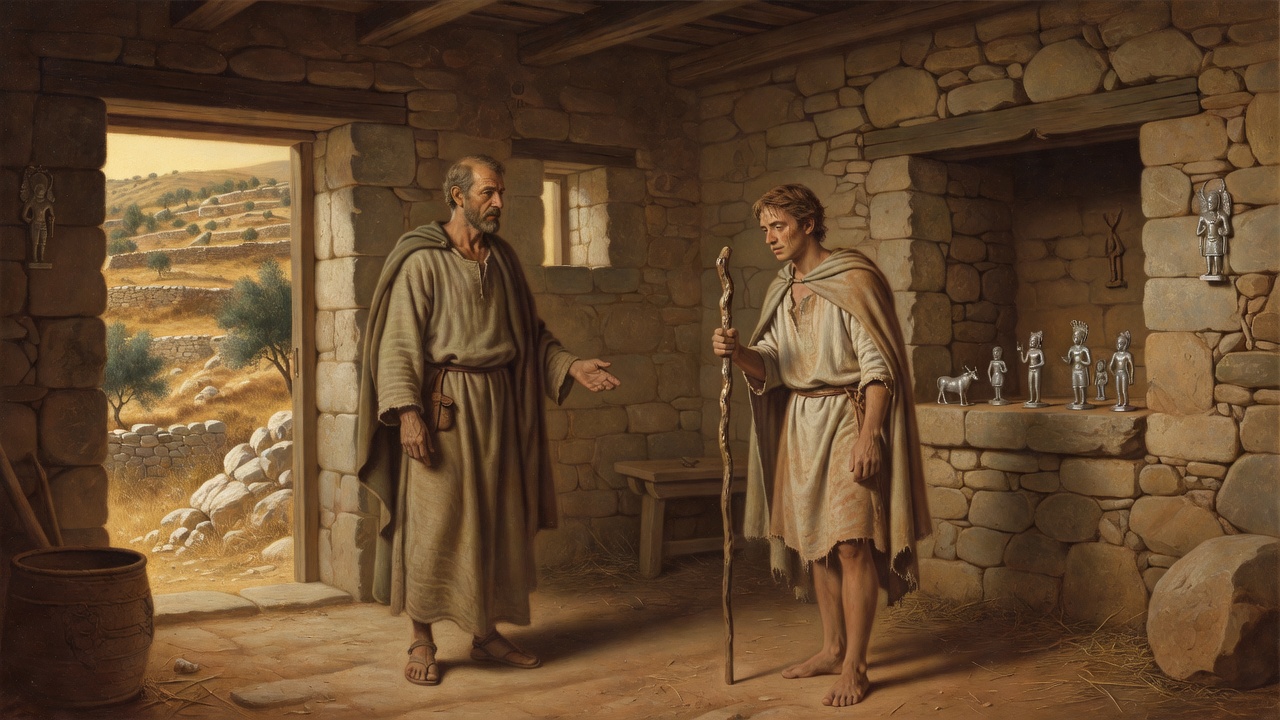
1And there was a man of mount Ephraim, and his name was Michaias. 2And he said to his mother, The eleven hundred pieces of silver which you took of yourself, and about which you cursed me, and spoke in my ears, behold, the silver is with me; I took it: and his mother said, Blessed be my son of the Lord. 3And he restored the eleven hundred pieces of silver to his mother; and his mother said, I had wholly consecrated the money to the Lord out of my hand for my son, to make a graven and a molten image, and now I will restore it to you. 4But he returned the silver to his mother, and his mother took two hundred pieces of silver, and gave them to a silversmith, and he made it a graven and a molten image; and it was in the house of Michaias. 5And the house of Michaias was to him the house of God, and he made an ephod and theraphin, and he consecrated one of his sons, and he became to him a priest. 6And in those days there was no king in Israel; every man did that which was right in his own eyes. 7And there was a young man in Bethleem of the tribe of Juda, and he was a Levite, and he was sojourning there. 8And the man departed from Bethleem the city of Juda to sojourn in whatever place he might find; and he came as far as mount Ephraim, and to the house of Michaias to accomplish his journey. 9And Michaias said to him, Whence come you? and he said to him, I am a Levite of Bethleem Juda, and I go to sojourn in any place I may find. 10And Michaias said to him, Dwell with me, and be to me a father and a priest; and I will give you ten pieces of silver by the year, and a change of raiment, and your living. 11And the Levite went and began to dwell with the man; and the young man was to him as one of his sons. 12And Michaias consecrated the Levite, and he became to him a priest, and he was in the house of Michaias. 13And Michaias said, Now I know that the Lord will do me good, because a Levite has become my priest.
¿Sabías que…?
El santuario doméstico de Micaías
- Micaías, un hombre de la región montañosa de Efraín, estableció un santuario privado con imágenes de plata talladas y fundidas, un efod e ídolos domésticos. Al principio consagró a uno de sus propios hijos como sacerdote antes de contratar a un levita viajero para atender su santuario.Fuentes: el propio texto bíblico · Micah
- La narración señala que en aquellos días no había rey en Israel y cada cual hacía lo que le parecía bien ante sus propios ojos. Este relato ilustra la anarquía y la confusión religiosa del período previo a la monarquía.Fuentes: el propio texto bíblico · Micah
- Un levita errante procedente de Belén de Judá aceptó servir como sacerdote de Micaías a cambio de sustento, ropa y un salario anual de diez siclos de plata.Fuentes: el propio texto bíblico
Notas escritas con ayuda de IA a partir de fuentes abiertas (Theographic Bible Metadata, CC BY-SA 4.0; Easton’s Bible Dictionary, dominio público) y revisadas antes de publicarse.
Lugares de este capítulo
Solo aparecen lugares identificados con alta confianza (90 % o más según las fuentes académicas reunidas por OpenBible). Mapa de la época: DARE (Digital Atlas of the Roman Empire), CC BY 4.0; mapa actual: © colaboradores de OpenStreetMap; lugares: OpenBible.info (CC BY 4.0).
Créditos y licencia de esta traducción
LXX2012: Septuagint in American English 2012
The Septuagint with Apocrypha, translated from Greek to English by Sir Lancelot C. L. Brenton and published in 1885, with some language updates (American English)
Public Domain
Language: English
Dialect (if applicable): American
Language in English: English
Translation by:
Sir Lancelot Charles Lee Brenton
Michael Paul Johnson
LXX2012: Septuagint in English 2012
This is a translation of the Old Testament and Apocrypha/Deuterocanon from Hebrew to Greek to 19th Century British English, with some updates of spelling and word usage to contemporary American English. The original English translation was done by Sir Lancelot Charles Lee Brenton and published by Samuel Bagster & Sons, Ltd., in London in 1851. It has entered the Public Domain due to the passage of sufficient time. In the process of scanning and typing the text, the original poetry and prose formatting, as well as peripheral material like introductions and notes, have been omitted.
This edition of the Septuagint has some language updates. Brenton's word order and punctuation has been mostly retained, meaning that quotation marks are not used, and sentences within quotes may not start with capital letters, as was standard usage in 1851. Names transliterated from Greek to those transliterated from Hebrew in the common English Bibles often differ. These language updates are dedicated to the Public Domain by the author of those edits, Michael Paul Johnson. Therefore this edition may be freely copied, published, etc.
Before considering making changes to the text of this work, I recommend that you consult with God, because this is really His Book.
If you find errors in the text, please report them so that we can correct them.
Donations to help with the expenses of operating this web site and thus help others have free access to the Word of God may be made to us, but are not required. Please see http://MLJohnson.org/partner/ for more about that.
Títulos de sección adaptados de la Berean Standard Bible (dominio público); no forman parte del texto bíblico de esta traducción.
Fuente: http://ebible.org/eng-lxx2012/ · eBible.org