Isaías 64
LXX2012: Septuagint in American English 2012 · Toca un versículo para ver sus referencias cruzadas.
A Prayer for God’s Power
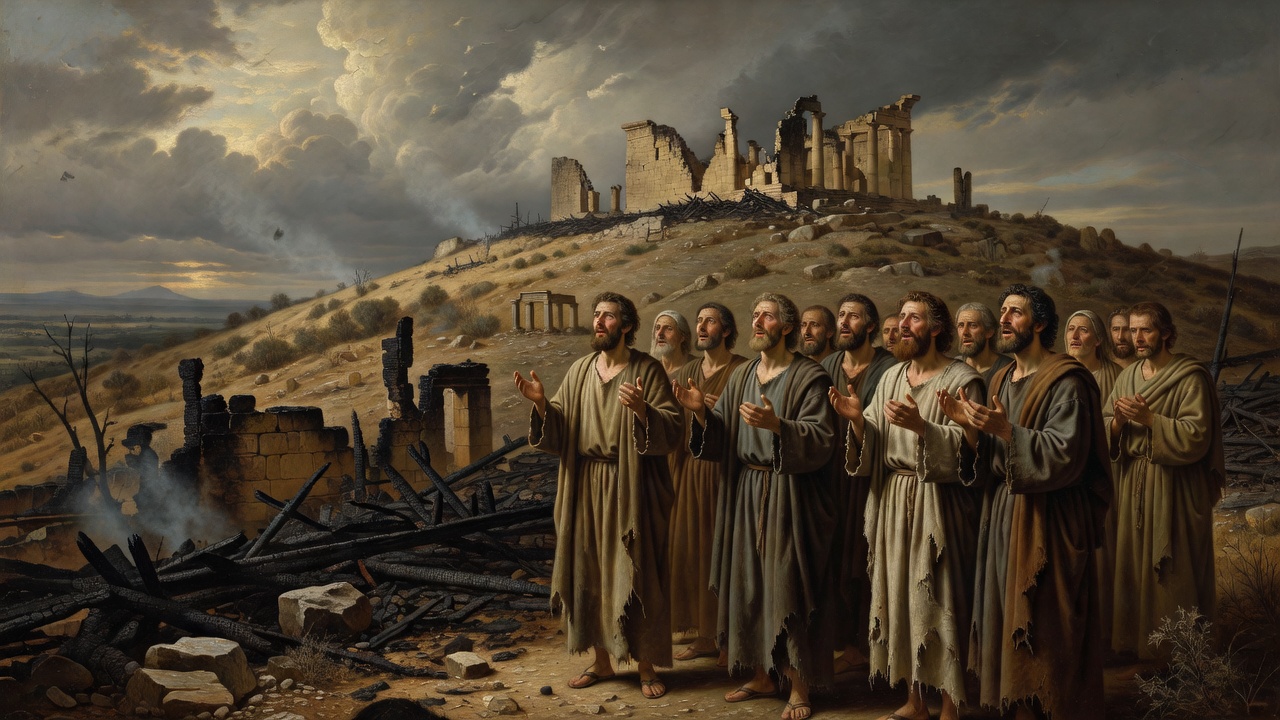
1If you would open the heaven, trembling will take hold upon the mountains from you, and they shall melt, 2as wax melts before the fire; and fire shall burn up the enemies, and your name shall be manifest among the adversaries: at your presence the nations shall be troubled, 3whenever you shall work gloriously; trembling from you shall take hold upon the mountains. 4From of old we have not heard, neither have our eyes seen a God beside you, and your works which you will perform to them that wait for mercy. 5For these blessings shall happen to them that work righteousness, and they shall remember your ways: behold, you were angry and we have sinned; therefore we have erred, 6and we are all become as unclean, and all our righteousness as a filthy rag: and we have fallen as leaves because of our iniquities; thus the wind shall carry us away. 7And there is none that calls upon your name, or that remembers to take hold on you: for you have turned your face away from us, and have delivered us up because of our sins. 8And now, O Lord, you are our Father, and we are clay, all of us the work of your hands. 9Be not very angry with us, and remember not our sins for ever; but now look on us, for we are all your people. 10The city of your holiness has become desolate, Sion has become as a wilderness, Jerusalem a curse. 11The house, our sanctuary, and the glory which our fathers blessed, has been burnt with fire: and all our glorious things have gone to ruin. 12And for all these things you, O Lord, has withholden, yourself, and been silent, and have brought us very low.
¿Sabías que…?
Una Oración por Misericordia en Medio de la Ruina
- El pasaje comienza con una súplica para que Dios rasgue los cielos y descienda con poder sobrecogedor, como fuego que enciende la leña. Sin embargo, contrasta este deseo de la presencia divina con una confesión de la indignidad humana, comparando a las personas con hojas secas arrastradas por sus propias iniquidades.Fuentes: el propio texto bíblico
- En Isaías 64, la comunidad apela a Dios como Padre y artesano, declarando: "nosotros somos el barro, y tú nuestro alfarero". Esta metáfora subraya la fragilidad humana y la total dependencia de Dios, suplicando misericordia divina a pesar del reconocimiento de sus culpas.Fuentes: el propio texto bíblico
- El capítulo lamenta la destrucción de los lugares sagrados, describiendo a Sion y Jerusalén como desolaciones y desiertos. El texto lamenta específicamente el incendio y la ruina del templo sagrado donde las generaciones pasadas habían ofrecido alabanzas.Fuentes: el propio texto bíblico · Zion · Jerusalem
Notas escritas con ayuda de IA a partir de fuentes abiertas (Theographic Bible Metadata, CC BY-SA 4.0; Easton’s Bible Dictionary, dominio público) y revisadas antes de publicarse.
Lugares de este capítulo
Solo aparecen lugares identificados con alta confianza (90 % o más según las fuentes académicas reunidas por OpenBible). Mapa de la época: DARE (Digital Atlas of the Roman Empire), CC BY 4.0; mapa actual: © colaboradores de OpenStreetMap; lugares: OpenBible.info (CC BY 4.0).
Créditos y licencia de esta traducción
LXX2012: Septuagint in American English 2012
The Septuagint with Apocrypha, translated from Greek to English by Sir Lancelot C. L. Brenton and published in 1885, with some language updates (American English)
Public Domain
Language: English
Dialect (if applicable): American
Language in English: English
Translation by:
Sir Lancelot Charles Lee Brenton
Michael Paul Johnson
LXX2012: Septuagint in English 2012
This is a translation of the Old Testament and Apocrypha/Deuterocanon from Hebrew to Greek to 19th Century British English, with some updates of spelling and word usage to contemporary American English. The original English translation was done by Sir Lancelot Charles Lee Brenton and published by Samuel Bagster & Sons, Ltd., in London in 1851. It has entered the Public Domain due to the passage of sufficient time. In the process of scanning and typing the text, the original poetry and prose formatting, as well as peripheral material like introductions and notes, have been omitted.
This edition of the Septuagint has some language updates. Brenton's word order and punctuation has been mostly retained, meaning that quotation marks are not used, and sentences within quotes may not start with capital letters, as was standard usage in 1851. Names transliterated from Greek to those transliterated from Hebrew in the common English Bibles often differ. These language updates are dedicated to the Public Domain by the author of those edits, Michael Paul Johnson. Therefore this edition may be freely copied, published, etc.
Before considering making changes to the text of this work, I recommend that you consult with God, because this is really His Book.
If you find errors in the text, please report them so that we can correct them.
Donations to help with the expenses of operating this web site and thus help others have free access to the Word of God may be made to us, but are not required. Please see http://MLJohnson.org/partner/ for more about that.
Títulos de sección adaptados de la Berean Standard Bible (dominio público); no forman parte del texto bíblico de esta traducción.
Fuente: http://ebible.org/eng-lxx2012/ · eBible.org