Génesis 4
LXX2012: Septuagint in American English 2012 · Toca un versículo para ver sus referencias cruzadas.
Cain and Abel
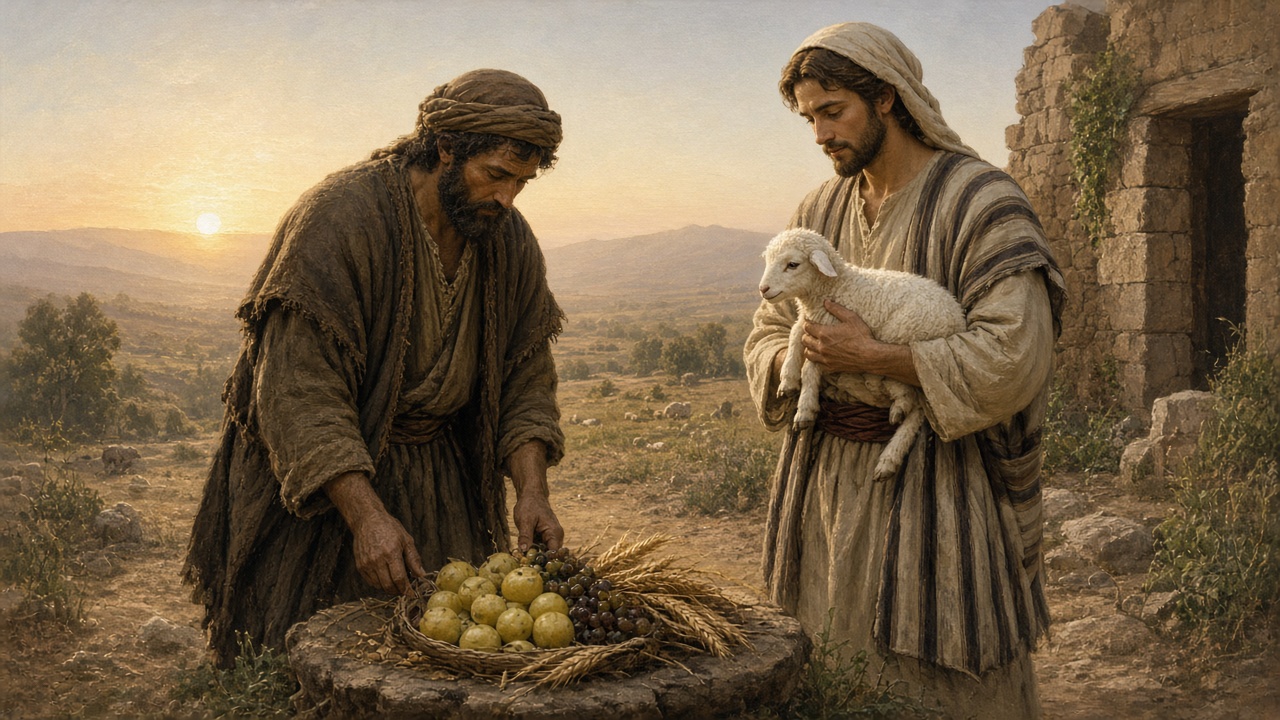
1And Adam knew Eve his wife, and she conceived and brought forth Cain and said, I have gained a man through God. 2And she again bore his brother Abel. And Abel was a keeper of sheep, but Cain was a tiller of the ground. 3And it was so after some time that Cain brought of the fruits of the earth a sacrifice to the Lord. 4And Abel also brought of the first born of his sheep and of his fatlings, and God looked upon Abel and his gifts, 5but Cain and his sacrifices he regarded not, and Cain was exceedingly sorrowful and his countenance fell. 6And the Lord God said to Cain, Why are you become very sorrowful and why is your countenance fallen? 7Have you not sinned if you have brought it rightly, but not rightly divided it? be still, to you shall be his submission, and you shall rule over him. 8And Cain said to Abel his brother, Let us go out into the plain; and it came to pass that when they were in the plain Cain rose up against Abel his brother, and killed him. 9And the Lord God said to Cain, Where is Abel your brother? and he said, I know not, am I my brother's keeper? 10And the Lord said, What have you done? the voice of your brother's blood cries to me out of the ground. 11And now you are cursed from the earth which has opened her mouth to receive your brother's blood from your hand. 12When you till the earth, then it shall not continue to give its strength to you: you shall be groaning and trembling on the earth. 13And Cain said to the Lord God, My crime is too great for me to be forgiven. 14If you cast me out this day from the face of the earth, and I shall be hidden from your presence, and I shall be groaning and trembling upon the earth, then it will be that any one that finds me shall kill me. 15And the Lord God said to him, Not so, any one that slays Cain shall suffer sevenfold vengeance; and the Lord God set a mark upon Cain that no one that found him might kill him. 16So Cain went forth from the presence of God and lived in the land of Nod over against Edem.
The Descendants of Cain
17And Cain knew his wife, and having conceived she bore Enoch; and he built a city; and he named the city after the name of his son, Enoch. 18And to Enoch was born Gaidad; and Gaidad begot Maleleel; and Maleleel begot Mathusala; and Mathusala begot Lamech. 19And Lamech took to himself two wives; the name of the one was Ada, and the name of the second Sella. 20And Ada bore Jobel; he was the father of those that dwell in tents, feeding cattle. 21And the name of his brother was Jubal; he it was who invented the lute and harp. 22And Sella also bore Thobel; he was a smith, a manufacturer both of brass and iron; and the sister of Thobel was Noema. 23And Lamech said to his wives, Ada and Sella, Hear my voice, you⌃ wives of Lamech, consider my words, because I have slain a man to my sorrow and a youth to my grief. 24Because vengeance has been exacted seven times on Cain's behalf, on Lamech's it shall be seventy times seven.
Seth and Enosh
25And Adam knew Eve his wife, and she conceived and bore a son, and called his name Seth, saying, For God has raised up to me another seed instead of Abel, whom Cain killed. 26And Seth had a son, and he called his name Enos: he hoped to call on the name of the Lord God.
¿Sabías que…?
Caín, Abel y la vida al este del Edén
- El nombre hebreo de Abel significa “soplo” o “vanidad”. Él cuidaba ovejas, mientras su hermano Caín labraba el suelo: Abel llevó las mejores porciones de los primogénitos de su rebaño, y Caín llevó fruto del suelo. El Diccionario Bíblico de Easton (1897) lee la frase “en el transcurso del tiempo” (al margen, “al fin de los días”) como probable referencia al sábado.Fuentes: Abel · Cain · el propio texto bíblico
- Tras la muerte de Abel, Caín se estableció en la tierra de Nod, al este del Edén, nombre que significa exilio, vagabundeo o inquietud. Allí construyó una ciudad y la llamó como su hijo Enoc. El Diccionario Bíblico de Easton señala que esta es la primera ciudad mencionada en las Escrituras.Fuentes: Nod · Enoch (son of Cain) · el propio texto bíblico
- Lamec, quinto en la descendencia de Caín, se casó con dos mujeres, Ada y Zila. El Diccionario Bíblico de Easton llama a las palabras que les dirigió el único ejemplo conservado de poesía antediluviana, a veces conocido como “canto de la espada de Lamec”. Sus hijos se vinculan con modos de vida antiguos: Jabal, con las tiendas y el ganado; Jubal, con el arpa y la flauta; y Tubal-caín, con la forja del bronce y del hierro.Fuentes: Lamech (descendant of Cain) · Adah (wife of Lamech) · Zillah · el propio texto bíblico
Notas escritas con ayuda de IA a partir de fuentes abiertas (Theographic Bible Metadata, CC BY-SA 4.0; Easton’s Bible Dictionary, dominio público) y revisadas antes de publicarse.
Créditos y licencia de esta traducción
LXX2012: Septuagint in American English 2012
The Septuagint with Apocrypha, translated from Greek to English by Sir Lancelot C. L. Brenton and published in 1885, with some language updates (American English)
Public Domain
Language: English
Dialect (if applicable): American
Language in English: English
Translation by:
Sir Lancelot Charles Lee Brenton
Michael Paul Johnson
LXX2012: Septuagint in English 2012
This is a translation of the Old Testament and Apocrypha/Deuterocanon from Hebrew to Greek to 19th Century British English, with some updates of spelling and word usage to contemporary American English. The original English translation was done by Sir Lancelot Charles Lee Brenton and published by Samuel Bagster & Sons, Ltd., in London in 1851. It has entered the Public Domain due to the passage of sufficient time. In the process of scanning and typing the text, the original poetry and prose formatting, as well as peripheral material like introductions and notes, have been omitted.
This edition of the Septuagint has some language updates. Brenton's word order and punctuation has been mostly retained, meaning that quotation marks are not used, and sentences within quotes may not start with capital letters, as was standard usage in 1851. Names transliterated from Greek to those transliterated from Hebrew in the common English Bibles often differ. These language updates are dedicated to the Public Domain by the author of those edits, Michael Paul Johnson. Therefore this edition may be freely copied, published, etc.
Before considering making changes to the text of this work, I recommend that you consult with God, because this is really His Book.
If you find errors in the text, please report them so that we can correct them.
Donations to help with the expenses of operating this web site and thus help others have free access to the Word of God may be made to us, but are not required. Please see http://MLJohnson.org/partner/ for more about that.
Títulos de sección adaptados de la Berean Standard Bible (dominio público); no forman parte del texto bíblico de esta traducción.
Fuente: http://ebible.org/eng-lxx2012/ · eBible.org