Génesis 26
LXX2012: Septuagint in American English 2012 · Toca un versículo para ver sus referencias cruzadas.
God’s Promise to Isaac
1And there was a famine in the land, besides the former famine, which was in the time of Abraam; and Isaac went to Abimelech the king of the Phylistines to Gerara. 2And the Lord appeared to him and said, Go not down to Egypt, but dwell in the land, which I shall tell you of. 3And sojourn in this land; and I will be with you, and bless you, for I will give to you and to your seed all this land; and I will establish my oath which I swore to your father Abraam. 4And I will multiply your seed as the stars of heaven; and I will give to your seed all this land, and all the nations of the earth shall be blest in your seed. 5Because Abraam your father listened to my voice, and kept my injunctions, and my commandments, and my ordinances, and my statutes.
Isaac Deceives Abimelech
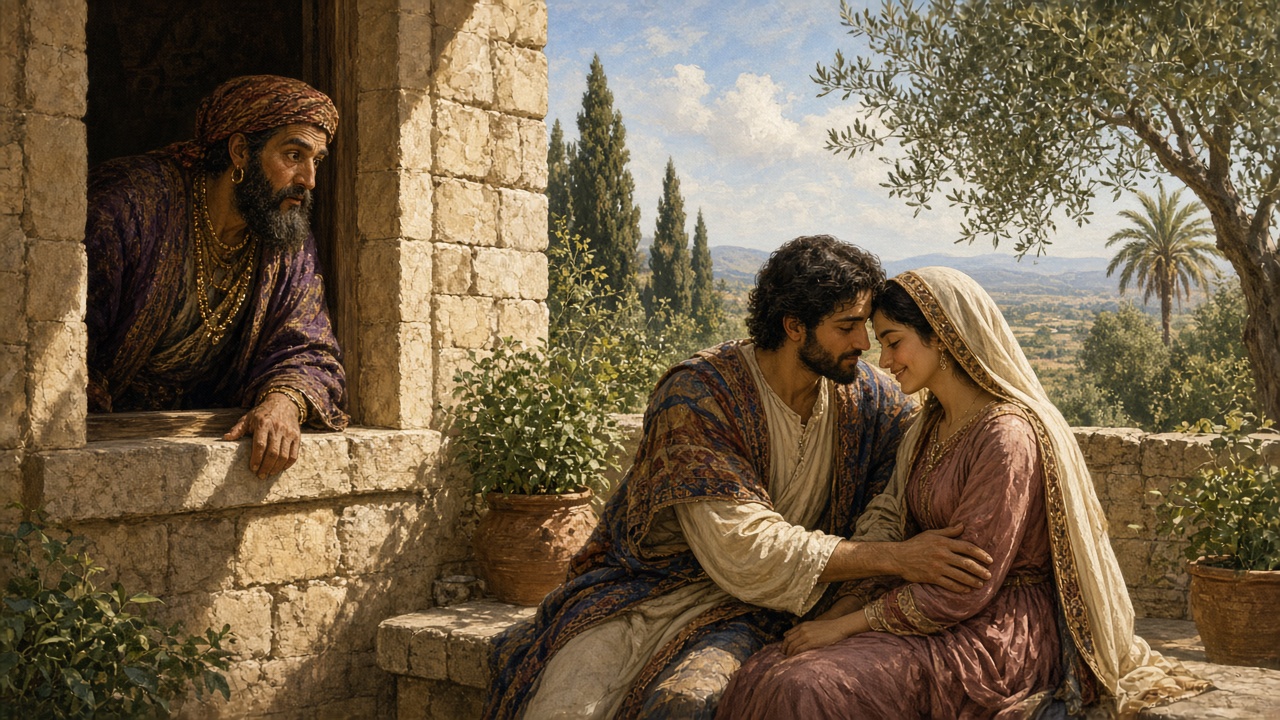
6And Isaac lived in Gerara. 7And the men of the place questioned him concerning Rebecca his wife, and he said, She is my sister, for he feared to say, She is my wife, lest at any time the men of the place should kill him because of Rebecca, because she was fair. 8And he remained there a long time, and Abimelech the king of Gerara leaned to look through the window, and saw Isaac sporting with Rebecca his wife. 9And Abimelech called Isaac, and said to him, Is she then your wife? why have you said, She is my sister? And Isaac said to him, I did so, for I said, Lest at any time I die on her account. 10And Abimelech said to him, Why have you done this to us? one of my kindred within a little had lain with your wife, and you would have brought a sin of ignorance upon us. 11And Abimelech charged all his people, saying Every man that touches this man and his wife shall be liable to death.
Isaac’s Prosperity
12And Isaac sowed in that land, and he found in that year barley one hundred-fold, and the Lord blessed him. 13And the man was exalted, and advancing he increased, till he became very great. 14And he had cattle of sheep, and cattle of oxen, and many tilled lands, and the Phylistines envied him. 15And all the wells which the servants of his father had dug in the time of his father, the Phylistines stopped them, and filled them with earth. 16And Abimelech said to Isaac, Depart from us, for you are become much mightier than we. 17And Isaac departed thence, and rested in the valley of Gerara, and lived there. 18And Isaac dug again the wells of water, which the servants of his father Abraam had dug, and the Phylistines had stopped them, after the death of his father Abraam; and he gave them names, according to the names by which his father named them. 19And the servants of Isaac dug in the valley of Gerara, and they found there a well of living water. 20And the shepherds of Gerara strove with the shepherds of Isaac, saying that the water was theirs; and they called the name of the well, Injury, for they injured him. 21And having departed thence he dug another well, and they strove also for that; and he named the name of it, Enmity. 22And he departed thence and dug another well; and they did not strive about that; and he named the name of it, Room, saying, Because now the Lord has made room for us, and has increased us upon the earth. 23And he went up thence to the well of the oath. 24And the Lord appeared to him in that night, and said, I am the God of Abraam your father; fear not, for I am with you, and I will bless you, and multiply your seed for the sake of Abraam your father. 25And he built there an altar, and called on the name of the Lord, and there he pitched his tent, and there the servants of Isaac dug a well in the valley of Gerara.
Isaac’s Covenant with Abimelech
26And Abimelech came to him from Gerara, and so did Ochozath his friend, and Phichol the commander-in-chief of his army. 27And Isaac said to them, Therefore have you⌃ come to me? whereas you⌃ hated me, and sent me away from you. 28And they said, We have surely seen that the Lord was with you, and we said, Let there be an oath between us and you, and we will make a covenant with you, 29that you shall do no wrong by us, as we have not abhorred you, and according as we have treated you well, and have sent you forth peaceably; and now you are blessed of the Lord. 30And he made a feast for them, and they ate and drank. 31And they arose in the morning, and swore each to his neighbor; and Isaac sent them forth, and they departed from him in safety. 32And it came to pass in that day, that the servants of Isaac came and told him of the well which they had dug; and they said, We have not found water. 33And he called it, Oath: therefore he called the name of that city, the Well of Oath, until this day.
Esau’s Wives
34And Esau was forty years old; and he took as wife Judith the daughter of Beoch the Chettite, and Basemath, daughter of Helon the Chettite. 35And they were provoking to Isaac and Rebecca.
¿Sabías que…?
Isaac en Gerar
- Durante una hambruna, Isaac buscó refugio junto a Abimelec, rey de Gerar, una antigua ciudad y distrito en la frontera sur de Palestina. El Easton's Bible Dictionary (1897) señala que Isaac actuó con su esposa Rebeca de manera muy parecida a como su padre Abraham había actuado con Sara allí: dijo que ella era su hermana. Abimelec después lo reprendió, cuando se descubrió el engaño.Fuentes: Abimelech (King of Gerar) · Gerar · el propio texto bíblico
- Los nombres de los pozos en el valle de Gerar recuerdan las disputas por ellos. Esek significa “contienda”, porque los pastores de Gerar reclamaron el agua, y Sitna significa “conflicto”. Isaac también reabrió pozos que los siervos de su padre Abraham habían cavado y que los filisteos habían tapado, y les dio los mismos nombres que su padre les había dado.Fuentes: Esek · Sitnah · el propio texto bíblico
- Beerseba significa “pozo del juramento” o “pozo de los siete”. Según el Easton's Bible Dictionary (1897), Abraham cavó allí un pozo y le puso ese nombre tras un pacto con Abimelec, e Isaac le dio el mismo nombre al reabrirlo. El diccionario también identifica a Ficol —“grande”— como capitán jefe del ejército de Abimelec y dice que participó en la alianza de Abraham acerca de ese pozo.Fuentes: Beersheba · Phichol · el propio texto bíblico
Notas escritas con ayuda de IA a partir de fuentes abiertas (Theographic Bible Metadata, CC BY-SA 4.0; Easton’s Bible Dictionary, dominio público) y revisadas antes de publicarse.
Lugares de este capítulo
- Egypt · 30.129, 31.308 · versículo 2
- Valley of Gerar · Hoy: about 3 km around Tel Haror · 31.382, 34.606 · versículos 17, 19
Solo aparecen lugares identificados con alta confianza (90 % o más según las fuentes académicas reunidas por OpenBible). Mapa de la época: DARE (Digital Atlas of the Roman Empire), CC BY 4.0; mapa actual: © colaboradores de OpenStreetMap; lugares: OpenBible.info (CC BY 4.0).
Créditos y licencia de esta traducción
LXX2012: Septuagint in American English 2012
The Septuagint with Apocrypha, translated from Greek to English by Sir Lancelot C. L. Brenton and published in 1885, with some language updates (American English)
Public Domain
Language: English
Dialect (if applicable): American
Language in English: English
Translation by:
Sir Lancelot Charles Lee Brenton
Michael Paul Johnson
LXX2012: Septuagint in English 2012
This is a translation of the Old Testament and Apocrypha/Deuterocanon from Hebrew to Greek to 19th Century British English, with some updates of spelling and word usage to contemporary American English. The original English translation was done by Sir Lancelot Charles Lee Brenton and published by Samuel Bagster & Sons, Ltd., in London in 1851. It has entered the Public Domain due to the passage of sufficient time. In the process of scanning and typing the text, the original poetry and prose formatting, as well as peripheral material like introductions and notes, have been omitted.
This edition of the Septuagint has some language updates. Brenton's word order and punctuation has been mostly retained, meaning that quotation marks are not used, and sentences within quotes may not start with capital letters, as was standard usage in 1851. Names transliterated from Greek to those transliterated from Hebrew in the common English Bibles often differ. These language updates are dedicated to the Public Domain by the author of those edits, Michael Paul Johnson. Therefore this edition may be freely copied, published, etc.
Before considering making changes to the text of this work, I recommend that you consult with God, because this is really His Book.
If you find errors in the text, please report them so that we can correct them.
Donations to help with the expenses of operating this web site and thus help others have free access to the Word of God may be made to us, but are not required. Please see http://MLJohnson.org/partner/ for more about that.
Títulos de sección adaptados de la Berean Standard Bible (dominio público); no forman parte del texto bíblico de esta traducción.
Fuente: http://ebible.org/eng-lxx2012/ · eBible.org