Génesis 13
LXX2012: Septuagint in American English 2012 · Toca un versículo para ver sus referencias cruzadas.
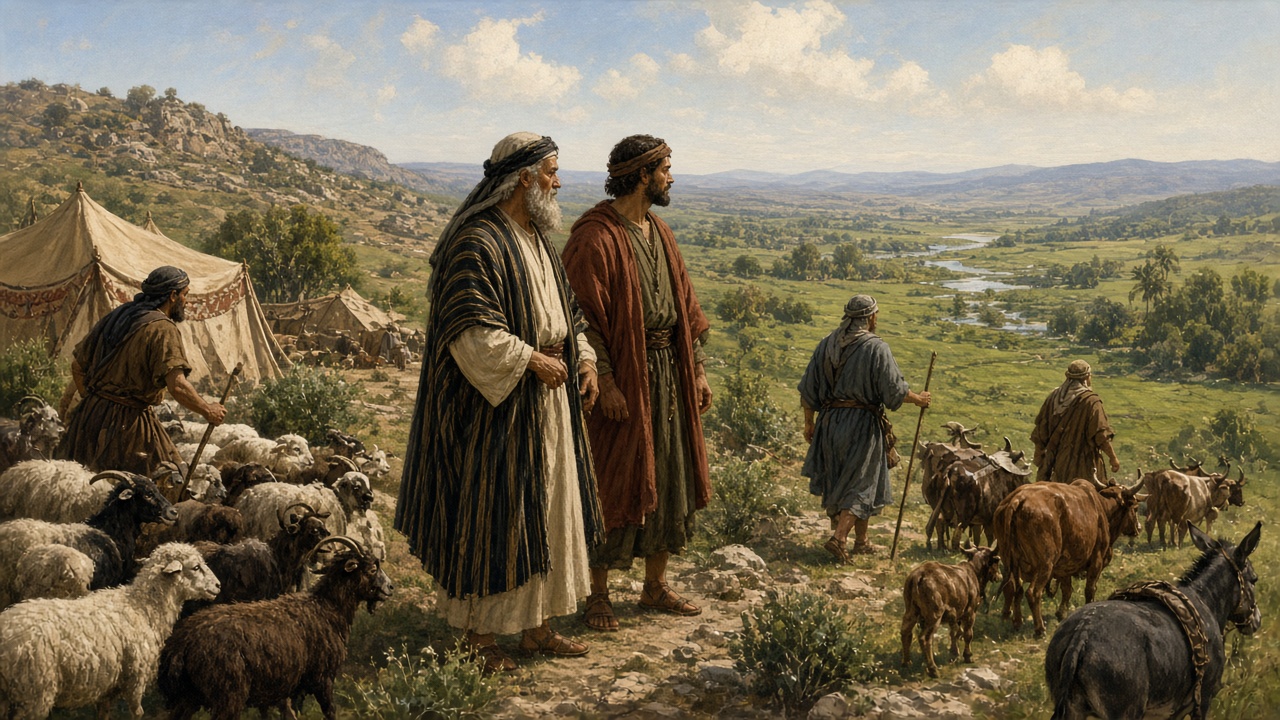
Abram and Lot Part Ways
1And Abram went up out of Egypt, he and his wife, and all that he had, and Lot with him, into the wilderness. 2And Abram was very rich in cattle, and silver, and gold. 3And he went to the place whence he came, into the wilderness as far as Baethel, as far as the place where his tent was before, between Baethel and Aggai, 4to the place of the altar, which he built there at first, and Abram there called on the name of the Lord. 5And Lot who went out with Abram had sheep, and oxen, and tents. 6And the land was not large enough for them to live together, because their possessions were great; and the land was not large enough for them to live together. 7And there was a strife between the herdmen of Abram's cattle, and the herdmen of Lot's cattle, and the Chananites and the Pherezites then inhabited the land. 8And Abram said to Lot, Let there not be a strife between me and you, and between my herdmen and your herdmen, for we are brethren. 9Behold! is not the whole land before you? Separate yourself from me; if you go to the left, I will go to the right, and if you go to the right, I will go to the left.
Lot Proceeds toward Sodom
10And Lot having lifted up his eyes, observed all the country round about Jordan, that it was all watered, before God overthrew Sodom and Gomorrha, as the garden of the Lord, and as the land of Egypt, until you come to Zogora. 11And Lot chose for himself all the country round Jordan, and Lot went from the east, and they were separated each from his brother. And Abram lived in the land of Chanaan. 12And Lot lived in a city of the neighbouring people, and pitched his tent in Sodom. 13But the men of Sodom were evil, and exceedingly sinful before God.
God Renews the Promise to Abram
14And God said to Abram after Lot was separated from him, Look up with your eyes, and behold from the place where you now are northward and southward, and eastward and seaward; 15for all the land which you see, I will give it to you and to your seed for ever. 16And I will make your seed like the dust of the earth; if any one is able to number the dust of the earth, then shall your seed be numbered. 17Arise and traverse the land, both in the length of it and in the breadth; for to you will I give it, and to your seed for ever. 18And Abram having removed his tent, came and lived by the oak of Mambre, which was in Chebrom, and he there built an altar to the Lord.
¿Sabías que…?
Abram y Lot se separan
- Abram subió de Egipto al Néguev, la región árida al sur de Palestina por donde corría la ruta de las caravanas entre la Palestina central y Egipto, y avanzó de lugar en lugar hacia Betel.Fuentes: Negeb · el propio texto bíblico
- Volvió al lugar entre Betel y Ai donde había estado su tienda y donde había construido un altar, y allí invocó el nombre del Señor. El Diccionario Bíblico de Easton (1897) describe Betel, a unas diez millas al norte de Jerusalén, como la antigua ciudad real cananea de Luz, y sostiene que el nombre Betel se dio primero a un santuario cercano y no a la ciudad misma hasta que la tribu de Efraín la conquistó. Ai era una de las ciudades reales cananeas y quedaba al este de Betel.Fuentes: Bethel (of Palestine) · Ai · el propio texto bíblico
- Lot miró y vio la llanura del Jordán, bien regada hasta Zoar, como el jardín del Señor y como la tierra de Egipto. El Diccionario Bíblico de Easton (1897) llama a esto la primera mención histórica del Jordán, en el relato de la separación de Abraham y Lot, y sitúa Sodoma, hacia donde Lot plantó su tienda, en el valle de Sidim. El capítulo señala que el Señor aún no había destruido Sodoma y Gomorra, destrucción que el diccionario atribuye a fuego del cielo por la maldad de la ciudad.Fuentes: Plain of Jordan · Sodom · el propio texto bíblico
Notas escritas con ayuda de IA a partir de fuentes abiertas (Theographic Bible Metadata, CC BY-SA 4.0; Easton’s Bible Dictionary, dominio público) y revisadas antes de publicarse.
Lugares de este capítulo
- Egypt · 30.129, 31.308 · versículos 1, 10
- Negeb · 31.245, 34.841 · versículos 1, 3
- Jordan Valley · 32.317, 35.570 · versículos 10, 11, 12
- Canaan · 32.767, 35.333 · versículo 12
- Hebron · Hoy: Tel Rumeida · 31.525, 35.102 · versículo 18
Solo aparecen lugares identificados con alta confianza (90 % o más según las fuentes académicas reunidas por OpenBible). Mapa de la época: DARE (Digital Atlas of the Roman Empire), CC BY 4.0; mapa actual: © colaboradores de OpenStreetMap; lugares: OpenBible.info (CC BY 4.0).
Créditos y licencia de esta traducción
LXX2012: Septuagint in American English 2012
The Septuagint with Apocrypha, translated from Greek to English by Sir Lancelot C. L. Brenton and published in 1885, with some language updates (American English)
Public Domain
Language: English
Dialect (if applicable): American
Language in English: English
Translation by:
Sir Lancelot Charles Lee Brenton
Michael Paul Johnson
LXX2012: Septuagint in English 2012
This is a translation of the Old Testament and Apocrypha/Deuterocanon from Hebrew to Greek to 19th Century British English, with some updates of spelling and word usage to contemporary American English. The original English translation was done by Sir Lancelot Charles Lee Brenton and published by Samuel Bagster & Sons, Ltd., in London in 1851. It has entered the Public Domain due to the passage of sufficient time. In the process of scanning and typing the text, the original poetry and prose formatting, as well as peripheral material like introductions and notes, have been omitted.
This edition of the Septuagint has some language updates. Brenton's word order and punctuation has been mostly retained, meaning that quotation marks are not used, and sentences within quotes may not start with capital letters, as was standard usage in 1851. Names transliterated from Greek to those transliterated from Hebrew in the common English Bibles often differ. These language updates are dedicated to the Public Domain by the author of those edits, Michael Paul Johnson. Therefore this edition may be freely copied, published, etc.
Before considering making changes to the text of this work, I recommend that you consult with God, because this is really His Book.
If you find errors in the text, please report them so that we can correct them.
Donations to help with the expenses of operating this web site and thus help others have free access to the Word of God may be made to us, but are not required. Please see http://MLJohnson.org/partner/ for more about that.
Títulos de sección adaptados de la Berean Standard Bible (dominio público); no forman parte del texto bíblico de esta traducción.
Fuente: http://ebible.org/eng-lxx2012/ · eBible.org