Ezequiel 6
LXX2012: Septuagint in American English 2012 · Toca un versículo para ver sus referencias cruzadas.
Judgment against Idolatry
1And the word of the Lord came to me, saying, 2Son of man, set your face against the mountains of Israel, and prophesy against them; 3and you shall say, You⌃ mountains of Israel, hear the word of the Lord; thus says the Lord to the mountains, and to the hills, and to the valleys, and to the forests; Behold, I bring a sword upon you, and your high places shall be utterly destroyed. 4And your altars shall be broken to pieces, and your consecrated plats; and I will cast down your slain men before your idols. 5And I will scatter your bones round about your altars, 6and in all your habitations: the cities shall be made desolate, and the high places utterly laid waste; that your altars may be destroyed, and your idols be broken to pieces, and your consecrated plats be abolished. 7And slain men shall fall in the midst of you, and you⌃ shall know that I am the Lord.
A Remnant to Be Blessed
8When there are some of you escaping from the sword among the Gentiles, and when you⌃ are scattered in the countries; 9then they of you that escape among the nations whither they were carried captive shall remember me; (I have sworn an oath against their heart that goes a-whoring from me, and their eyes that go a-whoring after their practices;) and they shall mourn over themselves for all their abominations. 10And they shall know that I the Lord have spoken. 11Thus says the Lord; Clap with your hand, and stamp with your foot and say, Aha, aha! for all the abominations of the house of Israel: they shall fall by the sword, and by pestilence, and by famine. 12He that is near shall fall by the sword; and he that is far off shall die by the pestilence; and he that is in the siege shall be consumed with famine: and I will accomplish my anger upon them. 13Then you⌃ shall know that I am the Lord, when your slain are in the midst of your idols round about your altars, on every high hill, and under every shady tree, where they offered a sweet savor to all their idols. 14And I will stretch out my hand against them, and I will make the land desolate and ruined from the wilderness of Deblatha, in all their habitations: and you⌃ shall know that I am the Lord.
¿Sabías que…?
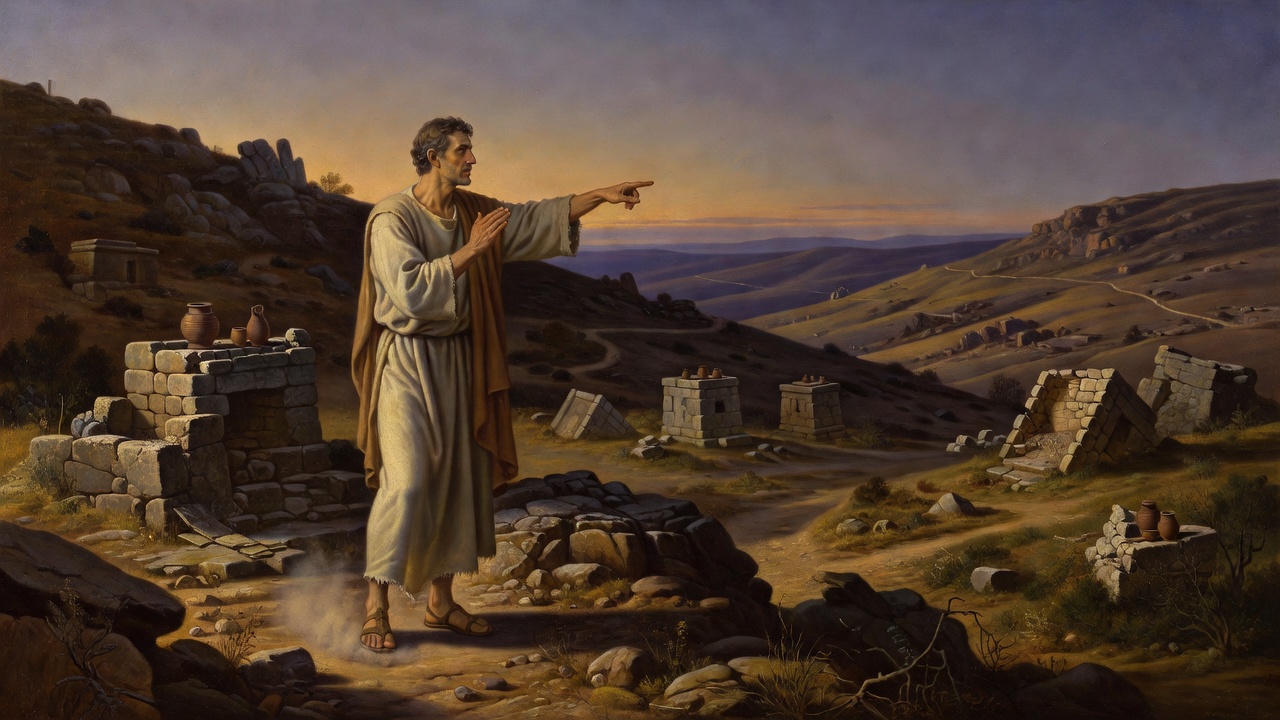
Juicio contra la Idolatría en los Montes de Israel
- Ezequiel dirige su profecía específicamente contra los montes, colinas, barrancos y valles de Israel porque estos lugares naturales elevados y aislados eran los principales sitios donde florecían altares paganos e incensarios bajo robles frondosos y árboles verdes.Fuentes: el propio texto bíblico
- Se le ordena al profeta acompañar su mensaje con gestos físicos expresivos, como aplaudir y golpear con el pie, para dramatizar el impacto, el dolor y la solemnidad del juicio inminente por espada, hambre y peste.Fuentes: el propio texto bíblico
- A pesar de anunciar una desolación generalizada en toda la tierra, el texto promete que un remanente sobrevivirá a la espada y reflexionará sobre sus acciones mientras se encuentre disperso en cautiverio entre las naciones.Fuentes: el propio texto bíblico
Notas escritas con ayuda de IA a partir de fuentes abiertas (Theographic Bible Metadata, CC BY-SA 4.0; Easton’s Bible Dictionary, dominio público) y revisadas antes de publicarse.
Lugares de este capítulo
- Riblah · Hoy: Rableh · 34.460, 36.573 · versículo 14
Solo aparecen lugares identificados con alta confianza (90 % o más según las fuentes académicas reunidas por OpenBible). Mapa de la época: DARE (Digital Atlas of the Roman Empire), CC BY 4.0; mapa actual: © colaboradores de OpenStreetMap; lugares: OpenBible.info (CC BY 4.0).
Créditos y licencia de esta traducción
LXX2012: Septuagint in American English 2012
The Septuagint with Apocrypha, translated from Greek to English by Sir Lancelot C. L. Brenton and published in 1885, with some language updates (American English)
Public Domain
Language: English
Dialect (if applicable): American
Language in English: English
Translation by:
Sir Lancelot Charles Lee Brenton
Michael Paul Johnson
LXX2012: Septuagint in English 2012
This is a translation of the Old Testament and Apocrypha/Deuterocanon from Hebrew to Greek to 19th Century British English, with some updates of spelling and word usage to contemporary American English. The original English translation was done by Sir Lancelot Charles Lee Brenton and published by Samuel Bagster & Sons, Ltd., in London in 1851. It has entered the Public Domain due to the passage of sufficient time. In the process of scanning and typing the text, the original poetry and prose formatting, as well as peripheral material like introductions and notes, have been omitted.
This edition of the Septuagint has some language updates. Brenton's word order and punctuation has been mostly retained, meaning that quotation marks are not used, and sentences within quotes may not start with capital letters, as was standard usage in 1851. Names transliterated from Greek to those transliterated from Hebrew in the common English Bibles often differ. These language updates are dedicated to the Public Domain by the author of those edits, Michael Paul Johnson. Therefore this edition may be freely copied, published, etc.
Before considering making changes to the text of this work, I recommend that you consult with God, because this is really His Book.
If you find errors in the text, please report them so that we can correct them.
Donations to help with the expenses of operating this web site and thus help others have free access to the Word of God may be made to us, but are not required. Please see http://MLJohnson.org/partner/ for more about that.
Títulos de sección adaptados de la Berean Standard Bible (dominio público); no forman parte del texto bíblico de esta traducción.
Fuente: http://ebible.org/eng-lxx2012/ · eBible.org