Ezequiel 31
LXX2012: Septuagint in American English 2012 · Toca un versículo para ver sus referencias cruzadas.
Egypt Will Fall like Assyria
1And it came to pass in the eleventh year, in the third month, on the first day of the month, the word of the Lord came to me, saying, 2Son of man, say to Pharao king of Egypt, and to his multitude; To whom have you compared yourself in your haughtiness? 3Behold, the Assyrian was a cypress in Libanus, and was fair in shoots, and high in stature: his top reached to the midst of the clouds. 4The water nourished him, the depth made him grow tall; she led her rivers round about his plants, and she sent forth her streams to all the trees of the field. 5Therefore was his stature exalted above all the trees of the field, and his branches spread far by the help of much water. 6All the birds of the sky made their nests in his boughs, and under his branches all the wild beasts of the field bred; the whole multitude of nations lived under his shadow. 7And he was fair in his height by reason of the multitude of his branches: for his roots were amidst much water. 8And such cypresses as this were in the paradise of God; and there were no pines like his shoots, and there were no firs like his branches: no tree in the paradise of God was like him in his beauty, 9because of the multitude of his branches: and the trees of God's paradise of delight envied him. 10Therefore thus says the Lord; Because you are grown great, and have set your top in the midst of the clouds, and I saw when he was exalted; 11therefore I delivered him into the hands of the prince of the nations, and he wrought his destruction. 12And ravaging strangers from the nations have destroyed him, and have cast him down upon the mountains: his branches fell in all the valleys, and his boughs were broken in every field of the land; and all the people of the nations are gone down from their shelter, and have laid him low. 13All the birds of the sky have settled on his fallen trunk, and all the wild beasts of the field came upon his boughs: 14in order that none of the trees by the water should exalt themselves by reason of their size: whereas they set their top in the midst of the clouds, yet they continued not in their high state in their place, all that drank water, all were consigned to death, to the depth of the earth, in the midst of the children of men, with them that go down to the pit. 15Thus says the Lord God; In the day wherein he went down to Hades, the deep mourned for him: and I stayed her floods, and restrained her abundance of water: and Libanus saddened for him, all the trees of the field fainted for him. 16At the sound of his fall the nations quaked, when I brought him down to Hades with them that go down to the pit: and all the trees of Delight comforted him in the heart, and the choice of plants of Libanus, all that drink water. 17For they went down to hell with him among the slain with the sword; and his seed, even they that lived under his shadow, perished in the midst of their life. 18To whom are you compared? descend, and be you debased with the trees of paradise to the depth of the earth: you shall lie in the midst of the uncircumcised with them that are slain by the sword. Thus shall Pharao be, and the multitude of his host, says the Lord God.
¿Sabías que…?
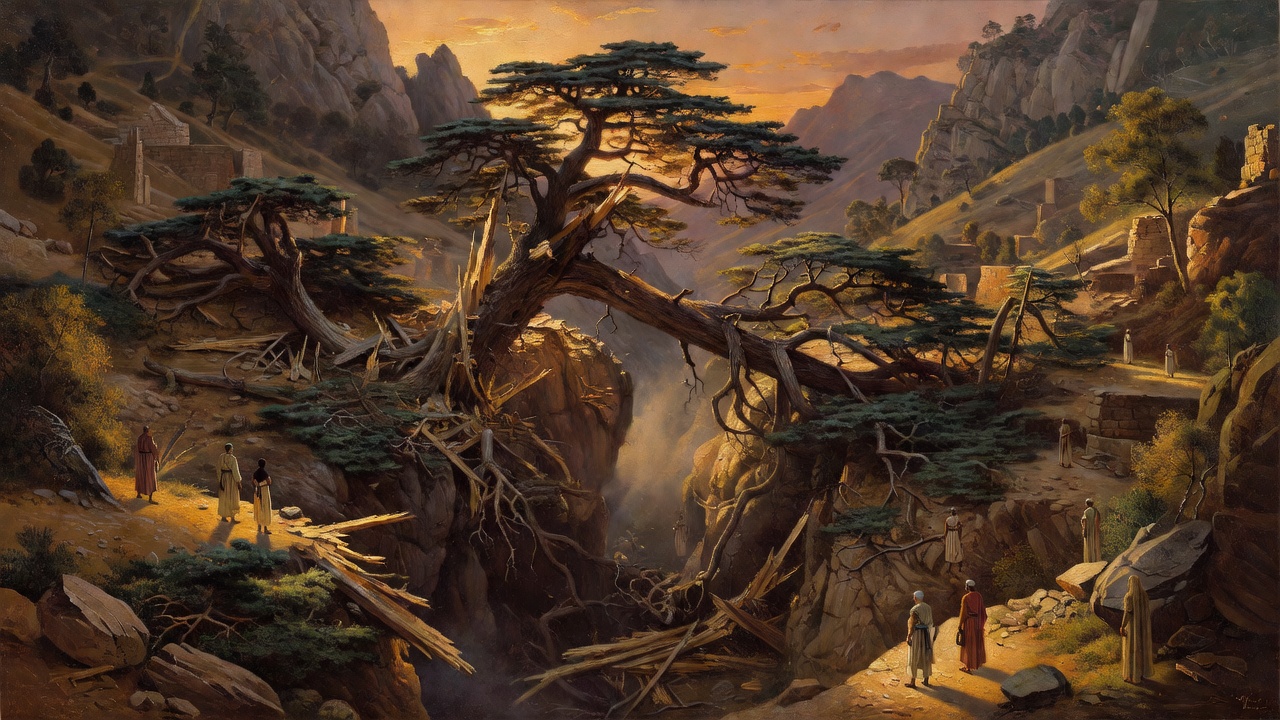
El cedro caído del Líbano
- Ezequiel emplea la metáfora de un imponente cedro del Líbano —una célebre cordillera en Siria— para ilustrar la grandeza y el repentino colapso del imperio asirio como advertencia directa al faraón y a Egipto.Fuentes: el propio texto bíblico · Lebanon · Assyria · Pharaoh
- La alegoría describe el majestuoso árbol como superior en altura y esplendor a todos los árboles del jardín de Dios, o Edén, una antigua región fértil situada a lo largo de los grandes ríos de Asia occidental.Fuentes: el propio texto bíblico · Eden
- A causa de su orgullo, el gran árbol es talado por despiadados conquistadores extranjeros y arrojado al Seol, demostrando que ningún imperio o gobernante terrenal está exento de la mortalidad y del juicio.Fuentes: el propio texto bíblico · Pharaoh
Notas escritas con ayuda de IA a partir de fuentes abiertas (Theographic Bible Metadata, CC BY-SA 4.0; Easton’s Bible Dictionary, dominio público) y revisadas antes de publicarse.
Lugares de este capítulo
- Egypt · 30.129, 31.308 · versículos 2, 10, 18
- Assyria · 36.359, 43.153 · versículos 3, 15
- Lebanon · 33.540, 35.584 · versículos 3, 15, 16
Solo aparecen lugares identificados con alta confianza (90 % o más según las fuentes académicas reunidas por OpenBible). Mapa de la época: DARE (Digital Atlas of the Roman Empire), CC BY 4.0; mapa actual: © colaboradores de OpenStreetMap; lugares: OpenBible.info (CC BY 4.0).
Créditos y licencia de esta traducción
LXX2012: Septuagint in American English 2012
The Septuagint with Apocrypha, translated from Greek to English by Sir Lancelot C. L. Brenton and published in 1885, with some language updates (American English)
Public Domain
Language: English
Dialect (if applicable): American
Language in English: English
Translation by:
Sir Lancelot Charles Lee Brenton
Michael Paul Johnson
LXX2012: Septuagint in English 2012
This is a translation of the Old Testament and Apocrypha/Deuterocanon from Hebrew to Greek to 19th Century British English, with some updates of spelling and word usage to contemporary American English. The original English translation was done by Sir Lancelot Charles Lee Brenton and published by Samuel Bagster & Sons, Ltd., in London in 1851. It has entered the Public Domain due to the passage of sufficient time. In the process of scanning and typing the text, the original poetry and prose formatting, as well as peripheral material like introductions and notes, have been omitted.
This edition of the Septuagint has some language updates. Brenton's word order and punctuation has been mostly retained, meaning that quotation marks are not used, and sentences within quotes may not start with capital letters, as was standard usage in 1851. Names transliterated from Greek to those transliterated from Hebrew in the common English Bibles often differ. These language updates are dedicated to the Public Domain by the author of those edits, Michael Paul Johnson. Therefore this edition may be freely copied, published, etc.
Before considering making changes to the text of this work, I recommend that you consult with God, because this is really His Book.
If you find errors in the text, please report them so that we can correct them.
Donations to help with the expenses of operating this web site and thus help others have free access to the Word of God may be made to us, but are not required. Please see http://MLJohnson.org/partner/ for more about that.
Títulos de sección adaptados de la Berean Standard Bible (dominio público); no forman parte del texto bíblico de esta traducción.
Fuente: http://ebible.org/eng-lxx2012/ · eBible.org