Ezequiel 26
LXX2012: Septuagint in American English 2012 · Toca un versículo para ver sus referencias cruzadas.
A Prophecy against Tyre
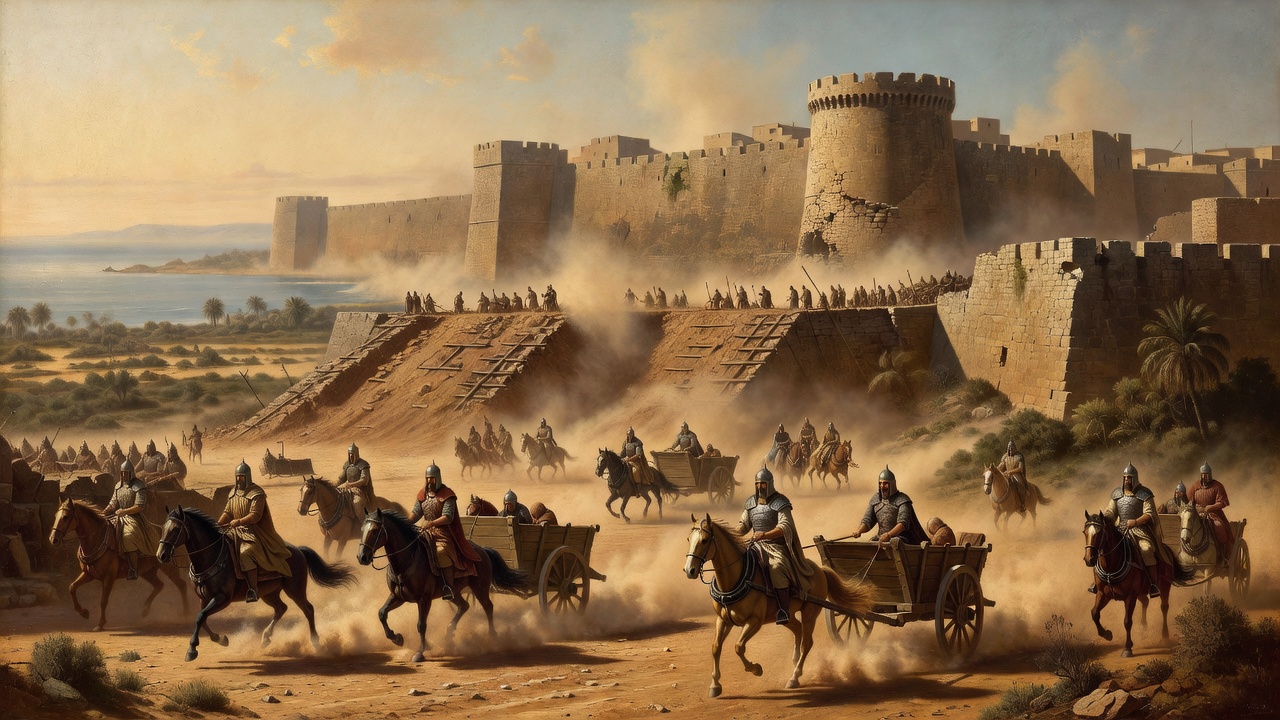
1And it came to pass in the eleventh year, on the first day of the month, that the word of the Lord came to me, saying, 2Son of man, because Sor has said against Jerusalem, Aha, she is crushed: the nations are destroyed: she is turned to me: she that was full is made desolate: 3therefore thus says the Lord; Behold, I am against you, O Sor, and I will bring up many nations against you, as the sea comes up with its waves. 4And they shall cast down the walls of Sor, and shall cast down your towers: and I will scrape her dust from off her, and make her a bare rock. 5She shall be in the midst of the sea a place for repairing nets: for I have spoken it, says the Lord: and it shall be a spoil for the nations. 6And her daughters which are in the field shall be slain with the sword, and they shall know that I am the Lord. 7For thus says the Lord; Behold, I will bring up against you, O Sor, Nabuchodonosor king of Babylon from the north: he is a king of kings, with horses, and chariots, and horsemen, and a concourse of very many nations. 8He shall kill your daughters that are in the field with the sword, and shall set a watch against you, and build forts around you, and carry a rampart round against you, and set up warlike works, and array his spears against you. 9He shall cast down with his swords your walls and your towers. 10By reason of your multitude of his horses their dust shall cover you, and by reason of the sound of his horsemen and the wheels of his chariots the walls shall be shaken, when he enters into your gates, as one entering into a city from the plain. 11With the hoofs of his horses they shall trample all your streets: he shall kill your people with the sword, and shall bring down to the ground the support of your strength. 12And he shall prey upon your power, and plunder your substance, and shall cast down your walls, and break down your pleasant houses: and he shall cast your stones and your timber and your dust into the midst of your sea. 13And he shall destroy the multitude of your musicians, and the sound of your lutes shall be heard no more. 14And I will make you a bare rock: you shall be a place to spread nets upon; you shall be built no more: for I the Lord have spoken it, says the Lord. 15For thus says the Lord God to Sor; Shall not the isles shake at the sound of your fall, while the wounded are groaning, while they have drawn a sword in the midst of you? 16And all the princes of the nations of the sea shall come down from their thrones, and shall take off their crowns from their heads, and shall take off their embroidered raiment: they shall be utterly amazed; they shall sit upon the ground, and fear their own destruction, and shall groan over you. 17And they shall take up a lamentation for you, and shall say to you, How are you destroyed from out of the sea, the renowned city, that brought her terror upon all her inhabitants. 18And the isles shall be alarmed at the day of your fall. 19For thus says the Lord God; When I shall make the city desolate, as the cities that shall not be inhabited, when I have brought the deep up upon you, 20and great waters shall cover you; and I shall bring you down to them that go down to the pit, to the people of old time, and shall cause you to dwell in the depths of the earth, as in everlasting desolation, with them that go down to the pit, that you may not be inhabited, nor stand upon the land of life; 21I will make you a destruction, and you shall be no more for ever, says the Lord God.
¿Sabías que…?
La profecía contra Tiro
- Tiro era una renombrada ciudad portuaria fenicia cuyos navegantes dominaban el comercio en el Mediterráneo. En este capítulo, Tiro celebra la caída de Jerusalén, confiando en que el colapso de la ciudad del interior redirigiría riquezas y rutas comerciales lucrativas hacia sus propios puertos.Fuentes: Tyre · el propio texto bíblico
- El nombre Tiro significa "una roca". Ezequiel destaca esta identidad al profetizar que la próspera ciudad marítima quedaría despojada de su suelo hasta ser una roca desnuda, reducida a un paraje desolado donde los pescadores extienden sus redes a secar.Fuentes: Tyre · el propio texto bíblico
- Nabucodonosor II, el poderoso rey de Babilonia, es señalado por su nombre como el ejecutor del juicio contra Tiro. Ezequiel describe el avance de sus tropas con caballería, carros de combate, rampas de asedio y arietes contra las fortificaciones y aldeas costeras.Fuentes: Nebuchadnezzar · el propio texto bíblico
Notas escritas con ayuda de IA a partir de fuentes abiertas (Theographic Bible Metadata, CC BY-SA 4.0; Easton’s Bible Dictionary, dominio público) y revisadas antes de publicarse.
Lugares de este capítulo
- Jerusalem · 31.777, 35.234 · versículo 2
- Tyre · 33.271, 35.196 · versículos 2, 3, 4, 5, 7, 15, 19
- Babylon · 32.543, 44.422 · versículo 7
Solo aparecen lugares identificados con alta confianza (90 % o más según las fuentes académicas reunidas por OpenBible). Mapa de la época: DARE (Digital Atlas of the Roman Empire), CC BY 4.0; mapa actual: © colaboradores de OpenStreetMap; lugares: OpenBible.info (CC BY 4.0).
Créditos y licencia de esta traducción
LXX2012: Septuagint in American English 2012
The Septuagint with Apocrypha, translated from Greek to English by Sir Lancelot C. L. Brenton and published in 1885, with some language updates (American English)
Public Domain
Language: English
Dialect (if applicable): American
Language in English: English
Translation by:
Sir Lancelot Charles Lee Brenton
Michael Paul Johnson
LXX2012: Septuagint in English 2012
This is a translation of the Old Testament and Apocrypha/Deuterocanon from Hebrew to Greek to 19th Century British English, with some updates of spelling and word usage to contemporary American English. The original English translation was done by Sir Lancelot Charles Lee Brenton and published by Samuel Bagster & Sons, Ltd., in London in 1851. It has entered the Public Domain due to the passage of sufficient time. In the process of scanning and typing the text, the original poetry and prose formatting, as well as peripheral material like introductions and notes, have been omitted.
This edition of the Septuagint has some language updates. Brenton's word order and punctuation has been mostly retained, meaning that quotation marks are not used, and sentences within quotes may not start with capital letters, as was standard usage in 1851. Names transliterated from Greek to those transliterated from Hebrew in the common English Bibles often differ. These language updates are dedicated to the Public Domain by the author of those edits, Michael Paul Johnson. Therefore this edition may be freely copied, published, etc.
Before considering making changes to the text of this work, I recommend that you consult with God, because this is really His Book.
If you find errors in the text, please report them so that we can correct them.
Donations to help with the expenses of operating this web site and thus help others have free access to the Word of God may be made to us, but are not required. Please see http://MLJohnson.org/partner/ for more about that.
Títulos de sección adaptados de la Berean Standard Bible (dominio público); no forman parte del texto bíblico de esta traducción.
Fuente: http://ebible.org/eng-lxx2012/ · eBible.org