Éxodo 32
LXX2012: Septuagint in American English 2012 · Toca un versículo para ver sus referencias cruzadas.
The Golden Calf
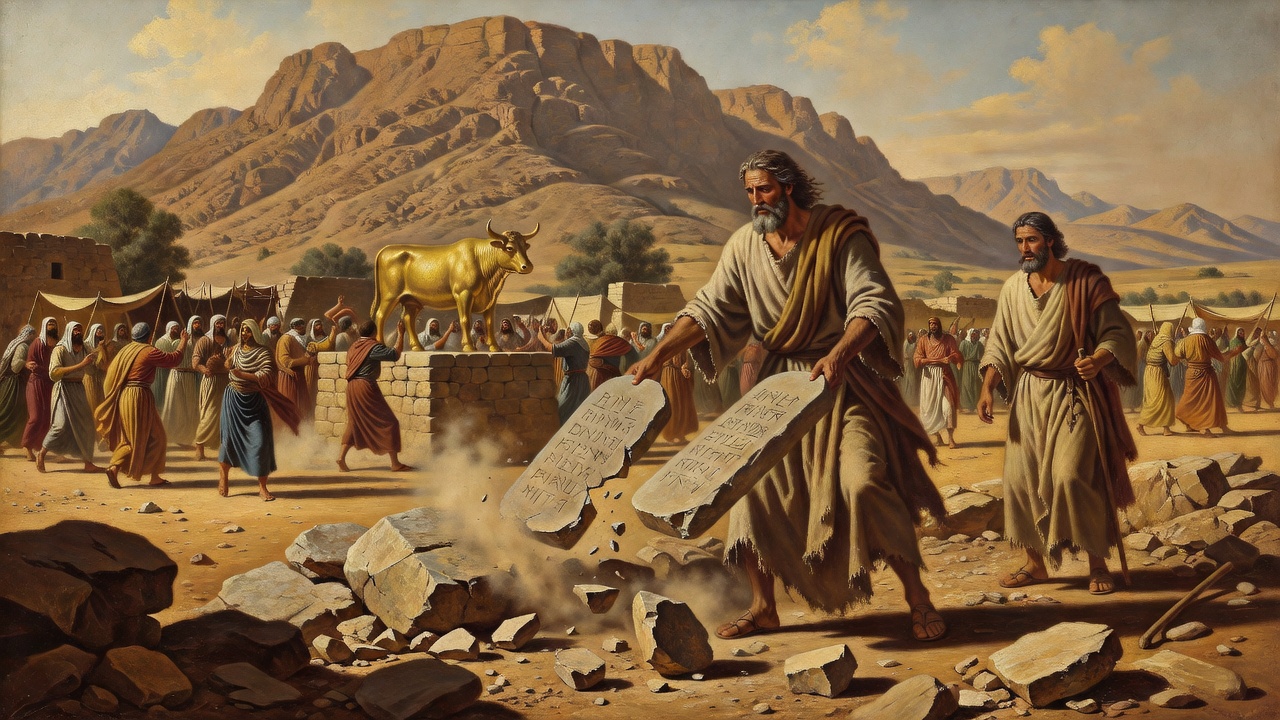
1And when the people saw that Moses delayed to come down from the mountain, the people combined against Aaron, and said to him, Arise and make us gods who shall go before us; for this Moses, the man who brought us forth out of the land of Egypt—we do not know what is become of him. 2And Aaron says to them, Take off the golden ear-rings which are in the ears of your wives and daughters, and bring them to me. 3And all the people took off the golden ear-rings that were in their ears, and brought them to Aaron. 4And he received them at their hands, and formed them with a graving tool; and he made them a molten calf, and said, These are your gods, O Israel, which have brought you up out of the land of Egypt. 5And Aaron having seen it built an altar before it, and Aaron made proclamation saying, To-morrow is a feast of the Lord. 6And having risen early on the morrow, he offered whole burnt offerings, and offered a peace-offering; and the people sat down to eat and drink, and rose up to play. 7And the Lord spoke to Moses, saying, Go quickly, descend hence, for your people whom you brought out of the land of Egypt have transgressed; 8they have quickly gone out of the way which you commanded; they have made for themselves a calf, and worshipped it, and sacrificed to it, and said, 9These are your gods, O Israel, who brought you up out of the land of Egypt. 10And now let me alone, and I will be very angry with them and consume them, and I will make you a great nation. 11And Moses prayed before the Lord God, and said, Therefore, O Lord, are you very angry with your people, whom you brought out of the land of Egypt with great strength, and with your high arm? 12Take heed lest at any time the Egyptians speak, saying, With evil intent he brought them out to kill them in the mountains, and to consume them from off the earth; cease from your wrathful anger, and be merciful to the sin of your people, 13remembering Abraam and Isaac and Jacob your servants, to whom you have sworn by yourself, and have spoken to them, saying, I will greatly multiply your seed as the stars of heaven for multitude, and all this land which you spoke of to give to them, so that they shall possess it for ever. 14And the Lord was prevailed upon to preserve his people. 15And Moses turned and went down from the mountain, and the two tables of testimony were in his hands, tables of stone written on both their sides: they were written within and without. 16And the tables were the work of God, and the writing the writing of God written on the tables. 17And Joshua having heard the voice of the people crying, says to Moses, There is a noise of war in the camp. 18And Moses says, It is not the voice of them that begin the battle, nor the voice of them that begin the cry of defeat, but the voice of them that begin the banquet of wine do I hear. 19And when he drew near to the camp, he sees the calf and the dances; and Moses being very angry cast the two tables out of his hands, and broke them to pieces under the mountain. 20And having taken the calf which they made, he consumed it with fire, and ground it very small, and scattered it on the water, and made the children of Israel to drink it. 21And Moses said to Aaron, What has this people done to you, that you have brought upon them a great sin? 22And Aaron said to Moses, Be not angry, my lord, for you know the impetuosity of this people. 23For they say to me, Make us gods, which shall go before us; for as for this man Moses, who brought us out of Egypt, we do not know what is become of him. 24And I said to them, If any one has golden ornaments, take them off; and they gave them me, and I cast them into the fire, and there came out this calf. 25And when Moses saw that the people was scattered, —for Aaron had scattered them so as to be a rejoicing to their enemies, — 26then stood Moses at the gate of the camp, and said, Who is on the Lord's side? let him come to me. Then all the sons of Levi came to him. 27And he says to them, Thus says the Lord God of Israel, Put every one his sword on his thigh, and go through and return from gate to gate through the camp, and kill every one his brother, and every one his neighbor, and every one him that is nearest to him. 28And the sons of Levi did as Moses spoke to them, and there fell of the people in that day to the number of three thousand men. 29And Moses said to them, You⌃ have filled your hands this day to the Lord each one on his son or on his brother, so that blessing should be given to you. 30And it came to pass after the morrow had begun, that Moses said to the people, You⌃ have sinned a great sin; and now I will go up to God, that I may make atonement for your sin. 31And Moses returned to the Lord and said, I pray, O Lord, this people has sinned a great sin, and they have made for themselves golden gods. 32And now if you will forgive their sin, forgive it; and if not, blot me out of your book, which you have written. 33And the Lord said to Moses, If any one has sinned against me, I will blot them out of my book. 34And now go, descend, and lead this people into the place of which I spoke to you: behold, my angel shall go before your face; and in the day when I shall visit I will bring upon them their sin. 35And the Lord struck the people for the making the calf, which Aaron made.
¿Sabías que…?
El becerro de oro y las tablas rotas
- Mientras Moisés tardaba en bajar del monte, los israelitas pidieron a Aarón que les hiciera dioses que los guiaran, pensando que Moisés se había perdido. Aarón recogió los aretes de oro del pueblo, moldeó un becerro con un cincel y edificó un altar delante de él, proclamando una fiesta.Fuentes: el propio texto bíblico · Aaron
- Al descender del monte Sinaí con dos tablas de piedra escritas por ambos lados por la misma escritura de Dios, su ayudante Josué confundió al principio el clamor festivo del campamento con el estruendo de una batalla. Al ver el becerro de oro y las danzas, Moisés arrojó y rompió las tablas al pie del monte.Fuentes: el propio texto bíblico · Joshua
- Cuando Moisés llamó a la entrada del campamento a quienes estuvieran de parte del Señor, toda la tribu de Leví se unió a él. Ellos ejecutaron el castigo a lo largo del campamento, muriendo cerca de tres mil hombres, tras lo cual Moisés declaró que habían sido consagrados al servicio del Señor.Fuentes: el propio texto bíblico · Levi (patriarch)
Notas escritas con ayuda de IA a partir de fuentes abiertas (Theographic Bible Metadata, CC BY-SA 4.0; Easton’s Bible Dictionary, dominio público) y revisadas antes de publicarse.
Lugares de este capítulo
Solo aparecen lugares identificados con alta confianza (90 % o más según las fuentes académicas reunidas por OpenBible). Mapa de la época: DARE (Digital Atlas of the Roman Empire), CC BY 4.0; mapa actual: © colaboradores de OpenStreetMap; lugares: OpenBible.info (CC BY 4.0).
Créditos y licencia de esta traducción
LXX2012: Septuagint in American English 2012
The Septuagint with Apocrypha, translated from Greek to English by Sir Lancelot C. L. Brenton and published in 1885, with some language updates (American English)
Public Domain
Language: English
Dialect (if applicable): American
Language in English: English
Translation by:
Sir Lancelot Charles Lee Brenton
Michael Paul Johnson
LXX2012: Septuagint in English 2012
This is a translation of the Old Testament and Apocrypha/Deuterocanon from Hebrew to Greek to 19th Century British English, with some updates of spelling and word usage to contemporary American English. The original English translation was done by Sir Lancelot Charles Lee Brenton and published by Samuel Bagster & Sons, Ltd., in London in 1851. It has entered the Public Domain due to the passage of sufficient time. In the process of scanning and typing the text, the original poetry and prose formatting, as well as peripheral material like introductions and notes, have been omitted.
This edition of the Septuagint has some language updates. Brenton's word order and punctuation has been mostly retained, meaning that quotation marks are not used, and sentences within quotes may not start with capital letters, as was standard usage in 1851. Names transliterated from Greek to those transliterated from Hebrew in the common English Bibles often differ. These language updates are dedicated to the Public Domain by the author of those edits, Michael Paul Johnson. Therefore this edition may be freely copied, published, etc.
Before considering making changes to the text of this work, I recommend that you consult with God, because this is really His Book.
If you find errors in the text, please report them so that we can correct them.
Donations to help with the expenses of operating this web site and thus help others have free access to the Word of God may be made to us, but are not required. Please see http://MLJohnson.org/partner/ for more about that.
Títulos de sección adaptados de la Berean Standard Bible (dominio público); no forman parte del texto bíblico de esta traducción.
Fuente: http://ebible.org/eng-lxx2012/ · eBible.org