1 Reyes 7
LXX2012: Septuagint in American English 2012 · Toca un versículo para ver sus referencias cruzadas.
Narración generada por IA · texto: LXX2012: Septuagint in American English 2012 (dominio público)
13And king Solomon sent, and took Chiram out of Tyre, 14the son of a widow woman; and he [was] of the tribe of Nephthalim, and his father [was] a Tyrian; a worker in brass, and accomplished in are and skill and knowledge to work every work in brass: and he was brought in to king Solomon, and he wrought all the works. 15And he cast the two pillars for the porch of the house: eighteen cubits [was] the height of [each] pillar, and a circumference of fourteen cubits encompassed it, even the thickness of the pillar: the flutings [were] four fingers [wide], and thus [was] the other pillar [formed]. 16And he made two molten capitals to put on the heads of the pillars: five cubits [was] the height of one chapiter, and five cubits [was] the height of the other chapiter. 17And he made two ornaments of network to cover the capitals of the pillars; even a net for one chapiter, and a net for the other chapiter. 18And hanging work, two rows of brazen pomegranates, formed with network, hanging work, row upon row: and thus he framed [the ornaments] for the second chapiter. And he set up the pillars of the porch of the temple: and he set up the one pillar, and called its name Jachum: and he set up the second pillar, and called its name Boloz. 19And on the heads of the pillars he made lily-work against the porch, of four cubits, 20and a chamber over both the pillars, and above the sides an addition [equal to] the chamber in width. 23And he made the sea, ten cubits from one rim to the other, the same was completely circular round about: its height [was] five cubits, and its circumference thirty-three cubits. 24And stays underneath its rim round about compassed it ten cubits round; 25And [there were] twelve oxen under the sea: three looking to the north, and three looking to the west, and three looking to the south, and three looking to the east: and all their hinder parts [were] inward, and the sea [was] above upon them. 26and its rim [was] as the work of the rim of a cup, a lily-flower, and the thickness of it [was] a span. 27And he made ten brazen bases: five cubits [was] the length of one base, and four cubits the breadth of it, and its height [was] six cubits. 28And this work of the bases [was] formed with a border the them, and [there was] a border between the ledges. 29And upon their borders between the projection [were] lions, and oxen, and cherubs: and on the projections, even so above, and also below [were] the places of lions and oxen, hanging work. 30And [there were] four brazen wheels to one base; and [there were] brazen bases, and their four sides [answering to them], side pieces under the bases. 31And [there were] axles in the wheels under the base. 32And the height of one wheel [was] a cubit and a half. 33And the work of the wheels [was] as the work of chariot wheels: their axles, and their felloes, and [the rest of] their work, [were] all molten. 34The four side pieces were at the four corners of each base; its shoulders [were formed] of the base. 35And on the top of the base half a cubit [was] the size of it, [there was] a circle on the top of the base, and [there was] the top of its spaces and its borders: and it was open at the top of its spaces. 36And its borders [were] cherubs, and lions, and palm-trees, upright, each [was] joined in front [and] within and round about. 37According to the same form he made all the ten bases, [even] one order and one measure to all. 38And he made ten brazen lavers, each laver containing forty baths, [and] measuring four cubits, each laver [placed] on a several base throughout the ten bases. 39And he put five bases on the right side of the house, and five on the left side of the house: and the sea was placed on the right side of the house eastward in the direction of the south. 40And Chiram made the caldrons, and the pans, and the bowls; and Chiram finished making all the works that he wrought for king Solomon in the house of the Lord: 41two pillars and the wreathen works of the pillars on the heads of the two pillars; and the two networks to cover both the wreathen works of the flutings that were upon the pillars. 42The four hundred pomegranates for both the networks, two rows of pomegranates for one network, to cover both the wreathen works of the bases belonging to both pillars. 43And the ten bases, and the ten lavers upon the bases. 44And one sea, and the twelve oxen under the sea. 45And the caldrons, and pans, and bowls, and all the furniture, which Chiram made for king Solomon for the house of the Lord: and [there were] eight and forty pillars of the house of the king and of the house of the Lord: all the works of the king which Chiram made were entirely of brass. 47There was no reckoning of the brass of which he made all these works, from the very great abundance, there was no end of the weight of the brass. In the country round about Jordan did he cast them, in the clay land between Socchoth and Sira. 48And king Solomon took the furniture which [Chiram] made for the house of the Lord, the golden altar, and the golden table of show bread. 49And [he put] the five candlesticks on the left, and five on the right in front of the oracle, [being] of pure gold, and the lamp-stands, and the lamps, and the snuffers of gold. 50And [there were made] the porches, and the nails, and the bowls, and the spoons, and the golden censers, of pure gold: and the panels of the doors of the innermost part of the house, [even] the holy of holies, and the golden doors of the temple. 51So the work of the house of the Lord which Solomon wrought was finished; and Solomon brought in the holy things of David his father, and all the holy things of Solomon; he put the silver, and the gold, and the furniture, into the treasures of the house of the Lord. And Solomon built a house for himself in thirteen years. And he built the house with the wood of Libanus; its length [was] one hundred cubits, and its breadth [was] fifty cubits, and its height [was] of thirty cubits, and [it was made] with three rows of cedar pillars, and the pillars had side-pieces of cedar. And he formed the house with chambers above on the sides of the pillars, and the number of the pillars [was each] row forty and five, and [there were] three chambers, and space against space in three rows. And all the doors and spaces formed like chambers [were] square, and from door to door [was a correspondence] in three rows. And [he made] the porch of the pillars, [they were] fifty [cubits] long and fifty broad, the porch joining them in front; and the [other] pillars and the thick beam [were] in front of the house by the porches. And [there was] the Porch of seats where he would judge, the porch of judgment. And their house where he would dwell, [had] one court communicating with these according to this work; and [he built] the house for the daughter of Pharao whom Solomon had taken, according to this porch. All these [were] of costly stones, sculptured at intervals within even from the foundation even to the top, and outward to the great court, founded with large costly stones, stones of ten cubits and eight cubits [long]. And above with costly stones, according to the measure of hewn stones, and with cedars. [There were] three rows of hewn [stones] round about the great hall, and a row of sculptured cedar: and Solomon finished all his house.
¿Sabías que…?
El palacio de Salomón y el mobiliario del templo
- Salomón tardó trece años en construir su complejo palaciego. Entre sus estructuras se encontraba la Casa del Bosque del Líbano, llamada así por sus numerosas columnas y vigas de cedro, junto con una sala para administrar justicia y una residencia para la hija del faraón.Fuentes: el propio texto bíblico · Daughter of Pharaoh · Lebanon
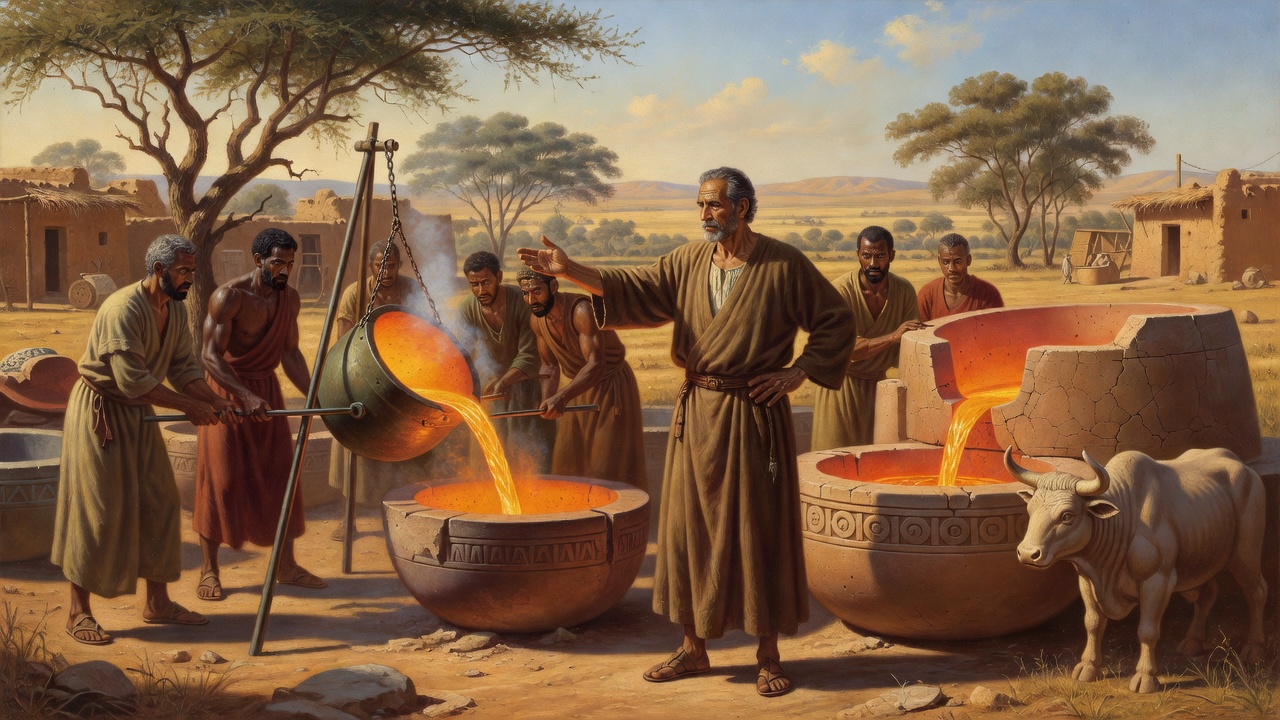
- Para supervisar las obras de bronce del templo, Salomón contrató a un maestro artesano llamado Huram, proveniente de Tiro. Era hijo de un artesano del bronce tirio y de una viuda israelita de la tribu de Neftalí, aportando gran destreza metalúrgica al proyecto.Fuentes: el propio texto bíblico · Hiram · Tyre · Naphtali
- Los enormes elementos de bronce, incluidas las dos columnas llamadas Jaquín y Boaz y la gran pila conocida como el Mar apoyada sobre doce bueyes, fueron fundidos en moldes de arcilla en la llanura del Jordán, entre Sucot y Saretán.Fuentes: el propio texto bíblico · Hiram · Jordan
Notas escritas con ayuda de IA a partir de fuentes abiertas (Theographic Bible Metadata, CC BY-SA 4.0; Easton’s Bible Dictionary, dominio público) y revisadas antes de publicarse.
Lugares de este capítulo
- House of the Forest of Lebanon · Hoy: in Jerusalem · 31.777, 35.234 · versículo 2
- Hall of Pillars · Hoy: in Jerusalem · 31.777, 35.234 · versículo 6
- Hall of Judgment · Hoy: in Jerusalem · 31.777, 35.234 · versículo 7
- Hall of the Throne · Hoy: in Jerusalem · 31.777, 35.234 · versículo 7
- Tyre · 33.271, 35.196 · versículos 13, 14
- Jordan · Hoy: Jordan River · 31.761, 35.558 · versículo 46
- Most Holy Place · Hoy: on Mount Moriah · 31.778, 35.236 · versículos 49, 50
Solo aparecen lugares identificados con alta confianza (90 % o más según las fuentes académicas reunidas por OpenBible). Mapa de la época: DARE (Digital Atlas of the Roman Empire), CC BY 4.0; mapa actual: © colaboradores de OpenStreetMap; lugares: OpenBible.info (CC BY 4.0).
Créditos y licencia de esta traducción
LXX2012: Septuagint in American English 2012
The Septuagint with Apocrypha, translated from Greek to English by Sir Lancelot C. L. Brenton and published in 1885, with some language updates (American English)
Public Domain
Language: English
Dialect (if applicable): American
Language in English: English
Translation by:
Sir Lancelot Charles Lee Brenton
Michael Paul Johnson
LXX2012: Septuagint in English 2012
This is a translation of the Old Testament and Apocrypha/Deuterocanon from Hebrew to Greek to 19th Century British English, with some updates of spelling and word usage to contemporary American English. The original English translation was done by Sir Lancelot Charles Lee Brenton and published by Samuel Bagster & Sons, Ltd., in London in 1851. It has entered the Public Domain due to the passage of sufficient time. In the process of scanning and typing the text, the original poetry and prose formatting, as well as peripheral material like introductions and notes, have been omitted.
This edition of the Septuagint has some language updates. Brenton's word order and punctuation has been mostly retained, meaning that quotation marks are not used, and sentences within quotes may not start with capital letters, as was standard usage in 1851. Names transliterated from Greek to those transliterated from Hebrew in the common English Bibles often differ. These language updates are dedicated to the Public Domain by the author of those edits, Michael Paul Johnson. Therefore this edition may be freely copied, published, etc.
Before considering making changes to the text of this work, I recommend that you consult with God, because this is really His Book.
If you find errors in the text, please report them so that we can correct them.
Donations to help with the expenses of operating this web site and thus help others have free access to the Word of God may be made to us, but are not required. Please see http://MLJohnson.org/partner/ for more about that.
Fuente: http://ebible.org/eng-lxx2012/ · eBible.org